
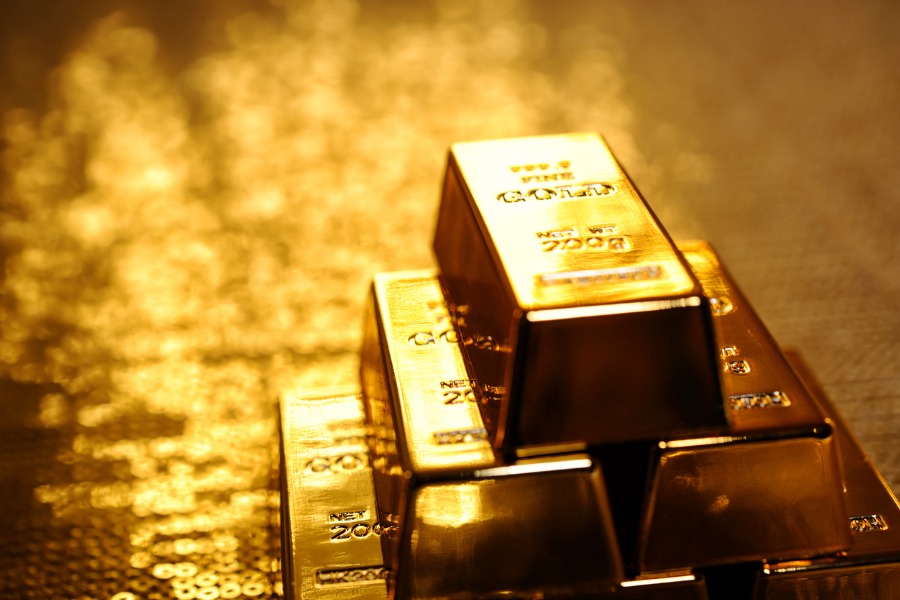
Gold logged its worst quarterly performance in 13 years in the three months through June, as a resurgent US dollar and mounting bets on a Federal Reserve interest-rate hike knocked the precious metal off its record highs.
The retreat is the sharpest for bullion since the second quarter of 2013, and it is forcing financial advisors to reassess how much of the yellow metal belongs in client portfolios heading into the second half of 2026.
Bullion fell below $4,000 an ounce in the final week of June for the first time since November – a level that put it more than 26% below its January record of $5,586.20, according to a recent note from UBS's chief investment office.
Spot gold was trading near $4,025 an ounce as the quarter closed, down more than 11% for June alone – bullion's steepest monthly drop since October 2008.
Traders' mood around the yellow metal shifted slightly positive on Wednesday following the release of new private payroll data from ADP. Private-sector hiring rose by just 98,000 jobs in June, short of the 110,000 economists had forecast and down from a downwardly revised 122,000 in May, according to the ADP National Employment Report released that morning.
"The pace of hiring is telling a story of both supply and demand," said Dr. Nela Richardson, ADP's chief economist, noting that labor supply constraints are showing up in the numbers even as overall hiring cools.
The softer-than-expected print landed hours after Federal Reserve Chair Kevin Warsh, speaking at the European Central Bank's forum in Sintra, Portugal, said inflation risks have come down in recent weeks, even as he declined to signal the central bank's next move on rates.
Warsh said "energy prices have come down quite substantially" since the US and Iran signed a memorandum of understanding to end their conflict last month, adding that they're "still a bit above where they were pre-conflict, but they've come down."
The combination sent spot gold up as much as 1.6% to $4,071.04 an ounce by early afternoon, reversing part of the prior session's slide to a fresh multi-month low.
Not every desk is capitulating on gold. UBS's chief investment office argues the quarter's pullback is an opportunity for underallocated investors, forecasting bullion will climb to roughly $5,200 an ounce over the next 12 months as dollar strength fades and the Fed holds rates rather than raising them further.
The bank points to steady central bank buying as a stabilizing force, citing preliminary May data showing Poland added 18 metric tons of gold to reserves and China added another 10 metric tons to its reserves.
"We believe the long-term investment case for gold remains positive, and we like the diversification benefits the yellow metal offers during periods of equity market stress, geopolitical uncertainty, inflation surprises, and episodes of declining confidence in fiat currencies," UBS analysts wrote.
Others are cautiously optimistic. In a note published Sunday, analysts from Goldman Sachs issued a 2026 price target of $4,900 an ounce, down from $5,400. In the near term, they pointed to what could be a more hawkish, inflation-focused Fed under Warsh, along with persistent inflation concerns.
"We expect these headwinds to at least partly reverse over time," wrote Goldman Sachs co-head of global commodities research Samantha Dart.
The Goldman researchers referenced a recent survey by the World Gold Council, which found a record 45% of 76 central banks polled between Februiary and May expecting to increase their own gold reserves over the next 12 months.
"Structurally, EM central bank diversification – following the 2022 freezing of Russia's reserves – remains the anchor of our $4,900/oz end 2026 forecast," Dart said, citing the 123% gain in gold since 2022. "Over the medium term, risks to our gold price forecast remain skewed to the upside on net."

A state-by-state analysis of retail investor behavior reveals AI-powered research tools are reshaping how clients approach investment decisions.

LPL picks up $1.1B from Wells Fargo's independent channel as the wirehouse gains a $410M family team from UBS.

Most Americans want to age at home but few have a financial plan to pay for it, according to new research.

Halbert Hargrove senior wealth advisor weighs in on the products' guaranteed income upside, the operational drag and his wish list for carriers.

With 8.6% of advisors set to switch firms in 2026, Cerulli says advisor recruitment hinges on technology, branding and HNW support.
Knighthead Life entered the market with a competitive MYGA. A strong launch earned advisor confidence and paved the way for FIAs.
As AI makes financial information more accessible than ever, Lana Hock explains why human judgment, trust, and empathy remain the qualities clients value most in a financial advisor

