
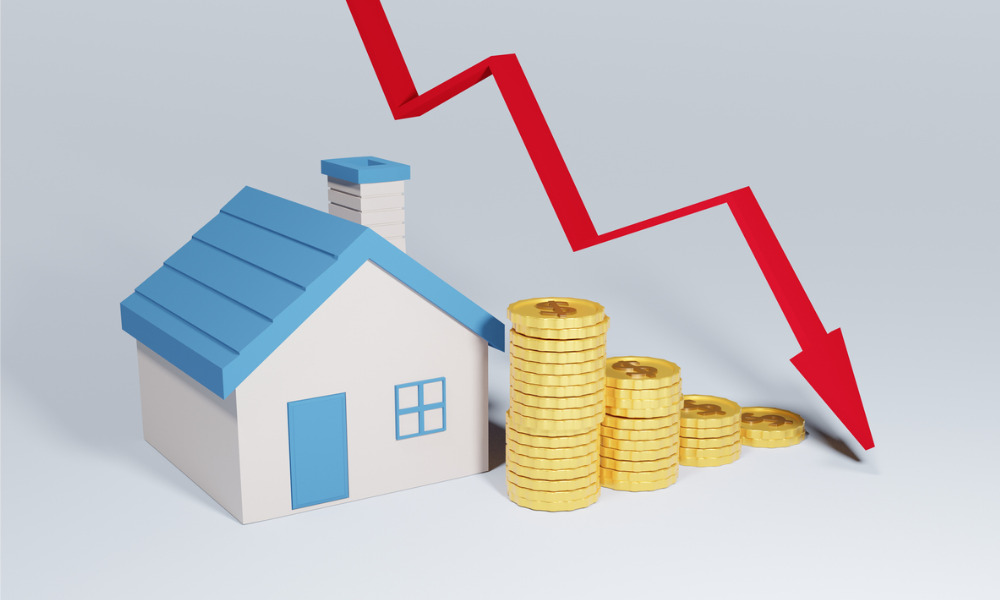
US home prices grew at a faster clip in April even as the broader market showed signs of shifting back in buyers' favor heading into summer, according to two new housing reports released this week.
This week’s release of the S&P Cotality Case-Shiller Home Price Index found that national annual home price growth accelerated to 0.84% in April, up from 0.73% in March, with major metro areas outpacing that figure.
The 10-City composite index rose 1.77% annually in April, and the 20-City index gained 1.14%, both comfortably ahead of the national figure.
Chicago led all metros with 6.52% annual growth, up from 6.12% the previous month, followed by New York at 3.82% and Cleveland at 3.18%. Los Angeles and San Francisco saw the sharpest acceleration in momentum, picking up 1.2 and 1.0 percentage points respectively. Seattle remained the weakest performer, down 2.26% annually, though that marked an improvement from March's 2.48% decline.
Despite the pickup, April's monthly price gains still lagged historical norms. National prices rose 0.8% month over month, below the 1.0% average recorded for April between 2015 and 2019.
High-end properties are doing most of the work. Monthly price changes averaged 0.74% for the low tier, 0.90% for the medium tier and 1.15% for the high tier across all markets tracked. Boston posted the broadest gains across every segment, up 2.37% in its low tier, 1.40% in the medium tier and 1.15% in the high tier, while Phoenix lagged badly with high-tier growth of just 0.02%.
"Home prices are shaking off a sluggish start, with a majority of cities shifting into a higher gear compared to last month," said Molly Boesel, principal economist at Cotality. "The most notable trend is the deep divide between tiers: premium properties are sprinting ahead and driving the bulk of the monthly momentum, while heavy affordability pressures keep entry-level buyers stuck in the starting blocks."
Chicago posted the strongest monthly growth among metros at 1.55%, ahead of its historical April average of 1.19%. San Francisco added 1.51% and Seattle 1.24%, though both still trailed their pre-pandemic norms of 1.55% and 2.14%. Phoenix broke from the seasonal pattern entirely, slipping 0.04% against a typical April gain of 0.80%.
While the Case-Shiller data reflects closed sales through April, Realtor.com's more current June figures point to a market where sellers are pricing more realistically and buyers are responding in kind.
The median national list price held at $430,000 in June, essentially unchanged from May but down 2.5% from a year earlier, a slightly sharper drop than May's 2.4% decline.
It marked the eighth straight month of annual price declines. Price per square foot, a measure that strips out shifts in home size, fell 2.1% year over year, and the share of listings with a price cut came in at 18.8%, down 1.9 percentage points annually.
At the same time, pending sales rose 3.7% year over year, extending a growth streak to seven months, the longest run since the stretch from December 2020 to June 2021. Contract cancellations for April and May sat at 6.9% of pending sales, modestly below the 7.3% rate from a year earlier.
"Eight straight months of falling prices and seven straight months of rising pending sales are not a contradiction. And they have to be considered together to get a full picture of what's happening in housing right now," said Danielle Hale, chief economist at Realtor.com. "Sellers are reading market conditions and are pricing accordingly from the start rather than listing high and cutting later, and buyers are taking note and making bids. This is a welcome sign that we are in a functioning market."
Homes also sold at a faster pace. The typical property spent 53 days on the market in June, identical to a year earlier, ending a 26-month run in which homes consistently took longer to sell than the prior year.
Realtor.com's report also points to a widening geographic split that has been building since prices peaked nationally at $449,000 in June 2022. Four years on, national list prices are down 4.2% from that high, but the regional experience varies sharply.
Prices have fallen 7.3% in the West and 3.5% in the South since that 2022 peak, while the Midwest is up 10% and the Northeast has climbed 12.6% over the same period. Among the top 50 metro areas, prices are now down in 28 markets and up in 22 since the 2022 high.
"The two Americas story in housing is now four years in the making," said Jake Krimmel, senior economist at Realtor.com. "In the West and South, prices gave ground back as affordability limits were tested. In the Midwest and Northeast, supply stayed tight enough and demand strong enough that prices kept climbing even through a historic rate shock. The national number hides two opposing trends under the surface."
Year over year, list prices fell 4.0% in the West and 2.5% in the South in June, while the Northeast slipped just 1.0% and the Midwest was flat. Per-square-foot prices told a similar story, rising in the Midwest and Northeast while continuing to decline in the South and West.
Austin, Texas posted the steepest per-square-foot decline among major metros at 8.2%, followed by Memphis at 6.0% and Buffalo at 5.2%. Providence, Indianapolis and New York saw the largest gains, up 8.7%, 4.9% and 3.4% respectively.
Active listings reached 1,102,615 in June, up 4.1% from May and 1.9% from a year earlier, though annual growth has decelerated from 2.2% the previous month. Supply remains 11.3% below typical 2017 to 2019 levels, a slightly wider shortfall than May's 10.4% gap.
New listings rose 2.4% annually to 463,480, driven largely by a 12.6% jump in the Northeast. Delistings, homes pulled from the market without selling, fell nearly 10% year over year and now account for roughly 5% of active inventory, near their lowest share since last year's surge began.
Looking toward July, Krimmel said early indicators suggest the market is unlikely to repeat last summer's stall.
"July is when the market traditionally takes its foot off the gas, spring listings age, buyer urgency fades, activity slows," Krimmel said. "June already shows the first signs of a slight seasonal slowdown: price cuts ticked up to 18.5% of current listings, and new listings were flat from last month even as they remained above last year. We'll be watching whether homes start sitting longer, whether price cuts accelerate beyond the usual summer ramp up, and whether new listings genuinely pull back or just flatten out. So far, the leading indicators are holding, so we do not expect the market to stall out like it did last summer."

Faulty Forms 1099 and account statements reportedly left some Vanguard brokerage customers overpaying or underpaying taxes for over a decade.

The democratization of ETFs cuts both ways

Independent broker-dealers snap up experienced advisors as competition for established practices intensifies.

Derek Flowers, a nearly 30-year veteran, is set to retire in mid-January, handing the reins to the executive who helped lead the bank's regulatory turnaround.

The campaign spans broadcast TV and streaming, as the brokerage faces slowing client net flows and an $8.1 billion advisor team that left to launch an RIA this month.
As AI makes financial information more accessible than ever, Lana Hock explains why human judgment, trust, and empathy remain the qualities clients value most in a financial advisor
Northern Trust’s Ken Lassner shows advisors how to convert volatility into after-tax portfolio gains

