
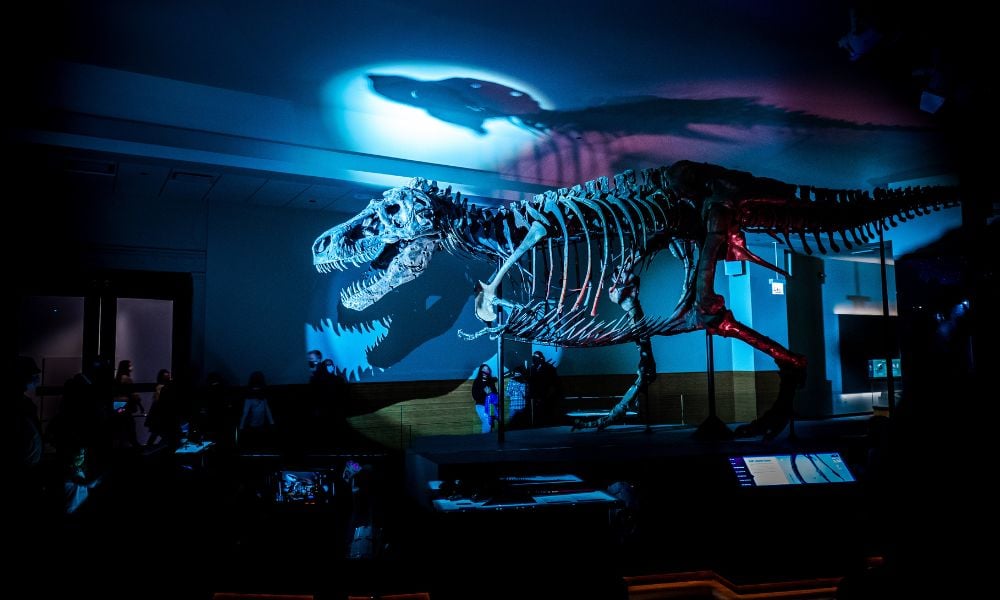
A near-complete Tyrannosaurus Rex skeleton named Gus which carried a pre-sale valuation of $30 million and a minimum opening bid of $19 million has sold for more than $50 million.
Gus headlined a natural history sale that has set a new record for a dinosaur sold at auction. The 38-foot long, 12.5 foot tall skeleton that dates back around 67 million years was sold for $50,130,000.
In the week that we mourn the loss of Jurassic Park actor Sam Neill, super-wealthy fans of the prehistoric had the opportunity today (July 14) to start the bidding on Gus and a bewildering array of other artefacts.
Sotheby's sale went live at 10am ET from its saleroom at 945 Madison Avenue in New York, with bidding open in person, by phone or online across 168 lots of fossils, minerals and natural history artwork.
The event traces back to 1997, when the house held its first natural history sale to feature a dinosaur, a T. Rex named Sue that sold for $8 million to Chicago's Field Museum in an auction then attended mostly by museum buyers rather than private collectors.
The market has moved a long way since. A T. Rex called Stan sold for $31.8 million in 2020, and the current auction record for any dinosaur belongs to a Stegosaurus named Apex, sold by Sotheby's in 2024 for $44.6 million to Kenneth Griffin, founder of hedge fund Citadel, who has since loaned the specimen to a museum.
Gus was recovered from Badlands terrain in South Dakota and named after the late Gary Licking, the cattle rancher on whose land it was found.
The excavation team spent three years extracting the fossil and another three documenting and reconstructing it. Cassandra Hatton, Sotheby's global head of natural history, said the specimen's scale and completeness set it apart.
"Gus is one of the largest and most complete T. rex ever found, 61% of the bones has been identified - in general you find half of the skeleton that's a major scientific find," Hatton told the BBC. "There's a huge bite mark on the top of the skull, which could have been sustained during a battle. You've got broken bones - some of the ribs, you see huge lumps where they broke and they healed.”
Gus was joined at auction by a separately sold leg, a partial jaw with four unusually dark teeth, an individual claw and multiple teeth, all pulled from Hell Creek Formation sites in Montana and South Dakota.
The wider catalogue spans a juvenile Gryposaurus skeleton, a pair of nestling hadrosaurs found with their eggshells, a Brachylophosaurus preserving skin impressions, an Allosaurus jaw preparation, a Stegosaurus dorsal plate, ammonites, ichthyosaurs, Eocene fish fossils and petrified wood, alongside natural history artwork.
For those weighing a bid, the fossil market's history is worth flagging.
According to CFA Institute research, a Triceratops skeleton failed to meet its reserve price at a 2008 sale held as the financial crisis took hold, a sign of how sensitive prices can be to broader market conditions, while Sue's 1997 result was driven in part by the cultural moment around the Jurassic Park films as much as by scarcity.
Specialists cited by CFA Institute point to preservation quality, accuracy of reconstruction, completeness, whether a mount comes from a single individual rather than several combined, and presentation as the main drivers of value, with carnivore specimens bearing prominent teeth and claws commanding the highest prices.
But Susannah Maidment, a dinosaur researcher at London's Natural History Museum, told the BBC that rising prices are shutting scientific institutions out of specimens they would otherwise study.
"We're already priced out of having access to many, many specimens," she said, adding that private ownership can cut a fossil off from the scientific record entirely if it later changes hands or is broken up.
** Article updated following closing of auction bids.

Meanwhile, DPL Financial Partners adds two annuity executives and Prime Capital Financial hires a Mid-Atlantic retirement plan consultant

Andrew Komarow pleaded guilty Thursday in federal court in Hartford to defrauding three financial services companies of close to $3.3 million.

Elsewhere, Cetera picks up a $210 million Connecticut team from MML, while Wells Fargo FiNet adds a San Diego family practice from LPL
Celebrity endorsements, $500M in claimed assets, and a state regulator stepping in.

“We needed to become a more agile and efficient organization,” said American Express CEO Stephen Squeri.
Knighthead Life entered the market with a competitive MYGA. A strong launch earned advisor confidence and paved the way for FIAs.
As AI makes financial information more accessible than ever, Lana Hock explains why human judgment, trust, and empathy remain the qualities clients value most in a financial advisor

