
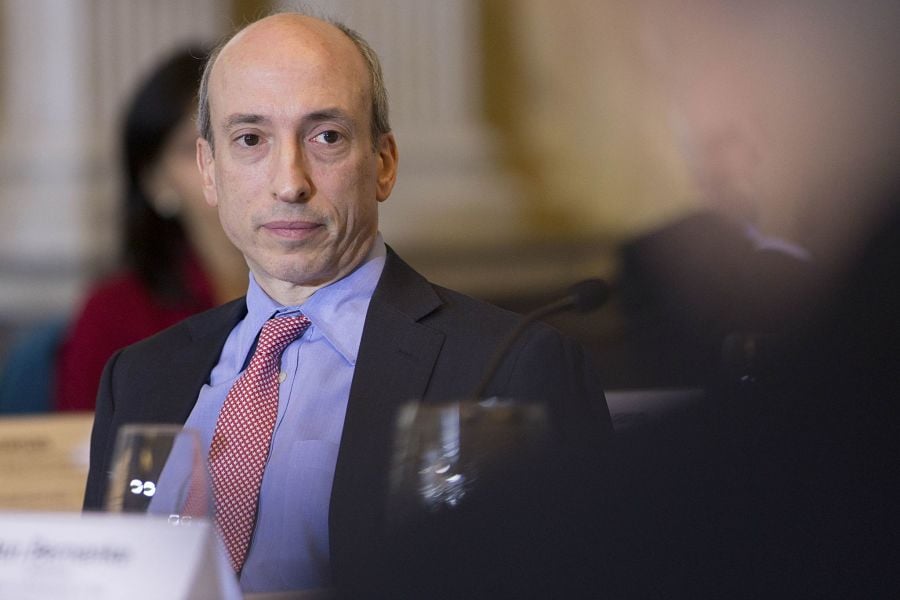
SEC Chair Gary Gensler was grilled today by the House Financial Services Committee for the first time in a year and a half, mostly over the pace of the agency’s rulemaking.
Republicans took the opportunity to chide Gensler about the nearly 50 rules the Securities and Exchange Commission has proposed since he began leading the agency two years ago. Much of their questioning and criticism focused on the SEC’s proposed climate disclosure rule for public companies, as well as its treatment of the regulation of digital assets.
But many of the agency’s proposals were scrutinized, with opponents of new regulations often pointing to an alleged lack of congressional approval for the SEC’s authority in pursuing some of them.
The treatment was effectively the fulfillment of a promise Republicans made after taking back control of the House last year.
However, it’s unlikely that anyone walked away from the hearing satisfied. Gensler refused to give yes or no answers to questions that were often loaded or posed for the purpose of grandstanding, visibly frustrating some of the committee members.
House Financial Services Committee Chair Patrick McHenry, R-N.C., pressed the SEC head to say whether the digital asset Ether is a security or a commodity, given that the agency has viewed bitcoin as a commodity.
“There is a lack of clarity here in the marketplace,” McHenry said, pointing to Wells notices being sent to exchanges, such as Coinbase, as a symptom of that problem. In March, Coinbase received a notice indicating that an enforcement action by the SEC is forthcoming.
In response, Gensler noted that the SEC applies its four-part test to determine whether something is considered a security, including whether it could be an investment contract in which the public would anticipate profit.
“We have the laws and the authority to oversee the crypto markets,” Gensler said in response to questions from ranking member Rep. Maxine Waters, D-Calif. “I’ve never seen a field that is so noncompliant with laws written by Congress.”
The greatest number of barbs Gensler received related to the SEC’s pace of rulemaking. Since he took the lead of the agency in 2021, there have been more than 50 rule proposals, including several that have been reintroduced during his tenure. That's roughly double the number that the prior two SEC chairs — Mary Jo White and Jay Clayton — made during their first two years on the job, committee members noted. They also took aim at the shorter comment periods for the current SEC’s proposals than those under previous leaders.
Gensler responded that the SEC’s comment periods average about 70 days and that the agency accepts written comments and takes meetings with stakeholders beyond comment deadlines. And it takes at least a year before rules typically go from their initial proposal stage to being published in final form, he said.
One problem with the number of rules is that the SEC is not considering the aggregate effect they could have on retail investors, said Rep. Ann Wagner, R-Mo.
“Your agenda is neither driven by congressional mandate … nor a widespread market failure like we saw in ’08,” Wagner said.
Waters noted that the comment periods have on average been twice the legally required time for proposals and said that the deluge of criticism of Gensler was merely a Republican effort to stymie regulation as the country faces bank failures and uncertainty around cryptocurrency.
“These reforms are not being rushed,” Waters said. “They are long overdue.”
Such reforms include a proposed rule last November around liquidity risk management for mutual funds and ETFs, as well as four proposals in December to overhaul equity markets regulation.
Despite the warm reception Gensler generally received from Democrats, several pressed him for actions they wanted the SEC to take.
Rep. Nydia Velazquez, D-N.Y., for example, wanted to know what the SEC was doing to address excessive executive compensation at public companies in the wake of Dodd-Frank.
Currently, the SEC requires executive compensation to be clawed back if the amount was based on inflated financial performance, and the agency last year adopted pay-versus-performance reporting disclosure, Gensler said.
Republicans also skewered the SEC leader over staff turnover at the agency, asking Gensler if the SEC had the resources to properly vet new rules and enforce the existing ones on its books.
The agency has an attrition rate between 6% and 7%, putting it on par with other government agencies, he said.
“In terms of [regulating] digital assets, we could certainly use more resources,” Gensler said. “There are more things to look at and investigate than we have staff to do.”
Aside from questions around cryptocurrencies, one of the top areas of inquiry was the SEC’s proposed climate disclosure rule. As proposed, it would cover greenhouse gas emissions for many large public companies, including wide-ranging Scope 3 emissions for some of the biggest entities, requiring them to report the carbon footprints in their supply chains and in the products they sell to consumers.
Many pressed Gensler to say whether the SEC has authority to act on climate issue regulation, but he noted that the agency is instead focused on disclosures that can help inform investors. Currently, most large public companies already provide some type of climate data disclosures, in part because they do business in Europe, which has more stringent requirements. And since investors are using that data to assess risk and opportunity, the SEC has a duty to help ensure that the disclosures are made in a standardized way, Gensler said.
Representatives from states with high stakes in oil or coal said that such a proposal could threaten jobs. Others noted that even though the proposal would only apply to public companies, private small businesses in the supply chains would be affected, as larger ones would ultimately request carbon data from them in order to report Scope 3 figures.
“Our authority is just about the public registrants,” Gensler said. “We are not a climate regulator, and we are neutral about that.”

What will financial advice look like 20 years from now? Evan Vladem explores how AI may transform wealth management while reinforcing the enduring value of human guidance, trust, and empathy.

The Boston deal is set to push the PE-backed consolidator past $187 billion amid a broad RIA M&A slowdown and a potential shift in its ownership.

Advisors with clients who own second homes in New York City face fresh uncertainty as the city seeks a stay and plans an appeal.

Meanwhile, a deal in the Midwest gives NorthRock Partners a new office in Wisconsin, while two teams join OnePoint BFG in Georgia and Atlanta.

These challenges are “changing the economics we see retirement savers face,” said Christopher Ceder of Goldman Sachs Asset Management
As AI makes financial information more accessible than ever, Lana Hock explains why human judgment, trust, and empathy remain the qualities clients value most in a financial advisor
Northern Trust’s Ken Lassner shows advisors how to convert volatility into after-tax portfolio gains

