
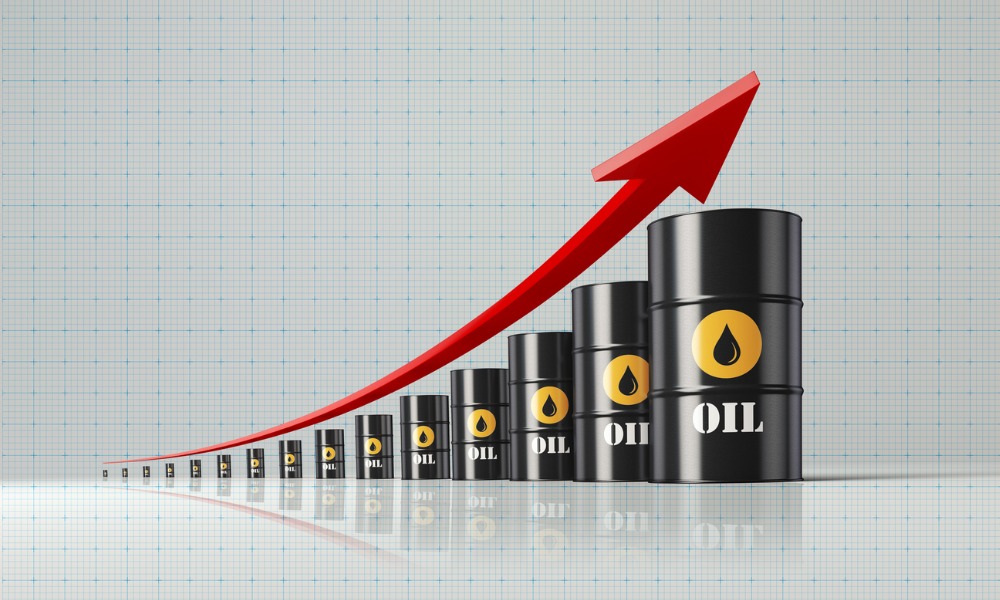
Oil prices climbed to their highest levels in years on Tuesday as Strait of Hormuz shipping risks kept Middle East supply anxiety front and center, with mounting tanker costs threatening to translate an energy crisis into a longer-lasting inflation problem for U.S. advisors and their clients.
Brent crude futures rose 1.7% to $102.07 a barrel in early European trading on September 22, 2026, while West Texas Intermediate gained 1.7% to $97.40 a barrel, according to the Wall Street Journal. The gains came even as U.S. Central Command reported that the volume of oil, natural gas and cargo passing through the strait over the past two weeks had reached its highest level in six months; a sign that markets are pricing in risk as much as actual supply loss.
One key question is what those elevated prices mean for the Federal Reserve's rate-cut calendar and for client portfolio positioning heading into 2027.
Chicago Federal Reserve President Austan Goolsbee said at the Semafor World Economy conference that interest-rate cuts could be pushed to 2027 if oil-driven inflation fails to subside. "The longer this goes, if inflation stays up, that pushes cuts out of 2026," Goolsbee said. Before the Middle East conflict escalated, he had anticipated multiple rate cuts this year.
The Fed held its benchmark rate steady at 3.50%–3.75% since December 2025 but raised its policy rate to a range of 3.75% to 4% at the latest meeting of the Federal Open Market Committee on September 16, 2026. The latest outlook from CME FedWatch shows a 53.1% probability of a 4.00%-4.25% range being announced at the October meeting.
The Fed's updated Summary of Economic Projections raised its median headline PCE inflation forecast to 2.7% for 2026, up from a prior estimate of 2.4%, with some analysts warning that continued energy pass-through could push PCE back toward 3.0%, according to CMC Markets.
Beyond crude prices, a less-discussed but increasingly important transmission channel is the cost of shipping oil; and it has surged.
The cost of shipping crude from Saudi Arabia's Ras Tanura terminal to Ningbo, China, has risen to nearly $63 million a voyage from around $4.5 million before the conflict, according to Michael Haigh, head of commodities research at Societe Generale. That is a cost increase that flows directly into the delivered price of oil and, ultimately, into consumer goods.
Supertanker rates on the Baltic Exchange's benchmark Middle East-to-China route have surged to approximately $800,000 a day, according to OilPrice.com. Kpler expects VLCC earnings to remain above $100,000 a day into early next year - more than double the historical norm of around $45,000.
Research published in March 2026 by Christina Anderl of the Bank of England and Alessandro Nava of the University of Padova found that inflation responses to oil shocks are more persistent when shipping conditions are under pressure, using evidence from 43 oil-importing and oil-exporting economies over 2000–2024. The researchers' conclusion is pointed for policymakers and advisors alike: oil-price monitoring alone is not enough - shipping conditions need to be part of the inflation surveillance picture.
The practical implications for wealth managers are substantial. Goldman Sachs' commodities desk has estimated that every $10 sustained increase in Brent crude adds roughly 35 basis points to U.S. headline CPI over six months, according to analysis reported by Hayes News Network - a figure that, if held at current price levels, would keep the Fed sidelined well into next year.
Understanding the pathways through which energy costs influence inflation, consumption, and corporate profitability is critical to positioning client portfolios appropriately in an environment where the conventional rate-cut thesis has stalled. Companies with strong balance sheets, consistent cash flows, and pricing power are generally better equipped to navigate inflationary environments, while sectors such as energy and materials may benefit directly from higher commodity prices - while consumer discretionary and transportation-linked holdings may face headwinds.
The diplomatic picture remains the swing factor. Lukman Otunuga, head of market research at FXTM, said oil markets are caught between Middle East supply risks and prospects for diplomacy, according to the Wall Street Journal.
Confirmation of direct U.S.-Iran talks at the United Nations General Assembly could weigh on prices by raising expectations for increased regional supply, while any renewed escalation could push crude materially higher. U.N. Secretary-General Antonio Guterres said over the weekend that dialogue between the U.S. and Iran was essential but would likely take place outside New York.

The RIA aggregator adds a New York and Los Angeles firm serving film and TV talent as it deepens its business management bench

Meanwhile, Janney picks up a $280 million Merrill Lynch veteran in Scranton as independent and hybrid platforms keep drawing teams

The breakaway-focused minority investor has staked 15 RIAs since 2024 as private sponsors increasingly trade stakes

Osaic subsidiary continues to forge new routes to US high-net-worth and ultra-high-net-worth people.

New data shows veterans report stronger financial security, legacy confidence and career earnings momentum than non-veterans.
Growing wealth, evolving priorities, and untapped opportunities are reshaping how women approach long-term investing.
Knighthead Life entered the market with a competitive MYGA. A strong launch earned advisor confidence and paved the way for FIAs.

