
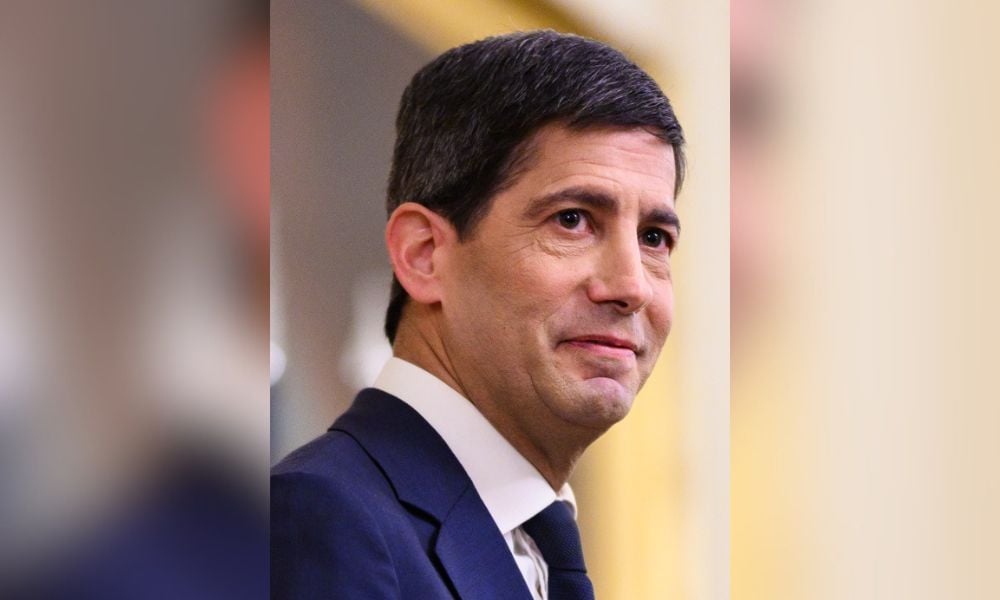
After weeks of speculation, the Federal Reserve finally delivered a rate hike Wednesday, raising its policy rate to a range of 3.75% to 4% at the latest meeting of the Federal Open Market Committee.
The decision, unanimously approved with a 12-0 vote, marks the first hike to come from the central bank since July 2023, which at the time reset the benchmark to its highest level in 22 years.
"Economic activity is expanding at a solid pace. While uncertainty remains elevated owing, in part, to geopolitical developments, domestic spending has been resilient," read the FOMC statement on Wednesday, tersely adding that "Inflation remains elevated."
The move was hardly out of the blue – core CPI, an important measure for inflation, came in hotter than expected amid rising energy prices last week, further fueling bets that a hike was imminent.
Prior to the Fed’s statement, on Wednesday morning, the CME’s FedWatch tool put the probability of a rate hike to between 3.75% and 4% at 92.9%. The tool, which updates in real time, put the likelihood of rates being unchanged at 7.1%.
There have also been more than enough hints from FOMC members that a rate hike was on the table. Last month Fed Chair Kevin Warsh told the Jackson Hole Economic Policy Symposium that elevated inflation could force the Fed's hand on further hikes.
Speaking at a recent Reuters event, Fed Governor Christopher Waller said that, if inflation didn’t cool, he would support a rate hike at this week’s FOMC meeting.
The decision to hike will undoubtedly provoke a reaction from President Donald Trump, who has repeatedly called for the Federal Reserve to cut rates. The central bank made its last cut in December 2025, and has subsequently kept its policy rate steady at 3.5% to 3.75%.
The decision also substantially answers any doubts around the central bank's credibility, said Janus Henderson's Daniel Siluk, who pointed to the "increasing pressure" Warsh had faced "to align policy action with increasingly hawkish rhetoric.
"Today's decision reduces the risk that investors question the Fed's inflation-fighting resolve," said Siluk, portfolio manager and head of Global Short Duration & Liquidity at Janus Henderson.
Now, attention is squarely focused on the market's reaction to the hike. In a note released earlier this week, Jeff Buchbinder, chief equity strategist, Jeffrey Roach, chief economist and Adam Turnquist, chief technical strategist at LPL Financial looked back at how the S&P 500 performed after initial Fed rate hikes over the last 30 years. "Stocks typically struggle for a few months before regaining their footing," they said.
"During the six tightening cycles since 1994, stocks generally struggled during the first several months following the initial rate increase," they added. "On average, returns were negative through the first four months before improving significantly by five to six months after the initial hike."
The S&P 500 ended Wednesday's session down 0.45%.
The looming rate hike had likewise been in the spotlight at the Future Proof festival in Huntington Beach, Calif. this week. On Monday Alex Morris, CEO of F/m Investments told InvestmentNews that more hikes could likely follow a rate increase.
"Only once in the modern rates era ... so post-late '80s, there's only been one time where there's been a single hike and no further," he said.
Also at Future Proof, Robert Minter, director of investment strategy at Aberdeen Investments, said Wednesday that the widely-expected rate hike changes none of the commodity story that markets are contending with. "It solves none of the supply tightness that is causing prices to rise, doesn’t solve a 47-year conflict between the US and Iran, a 4 year conflict between Ukraine and Russia, an all time severe El Niño that is disrupting agriculture production overseas, and it certainly doesn't erase the $5 trillion expansion of money supply that is supporting higher prices," he told InvestmentNews.
Whether the Fed's hawkish bias will be effective against the spectre of inflation is another open question, said Niladri ‘Neel’ Mukherjee, chief investment officer at TIAA Wealth Management. While that could help ease price pressures over time by slowing demand, he pointed to other headwinds that could challenge the central bank's objective of maintaining price stability and, on the fixed-income side, put pressure on bond yields.
"Several long-term structural forces like deficits and heavy government borrowing across developed markets, and AI-driven borrowing, should remain in place, keeping long-end yields elevated," Mukherjee said.

&Partners has also added a $357 million Texas family practice, while Janney recruits a $250 million Edward Jones advisor in Miami

Linda Patel will lead J.P. Morgan Advisors in Florida and Georgia as Bank of America adds nonprofit specialists in New York

Interval funds and other semi-liquid or illiquid products are typically two to three times more expensive than plain vanilla stock or bond mutual funds or exchange-traded funds.

The royalty statements looked normal - until someone checked the electronic files.

They allegedly fabricated SEC certificates to dupe investors.
Knighthead Life entered the market with a competitive MYGA. A strong launch earned advisor confidence and paved the way for FIAs.
As AI makes financial information more accessible than ever, Lana Hock explains why human judgment, trust, and empathy remain the qualities clients value most in a financial advisor

