
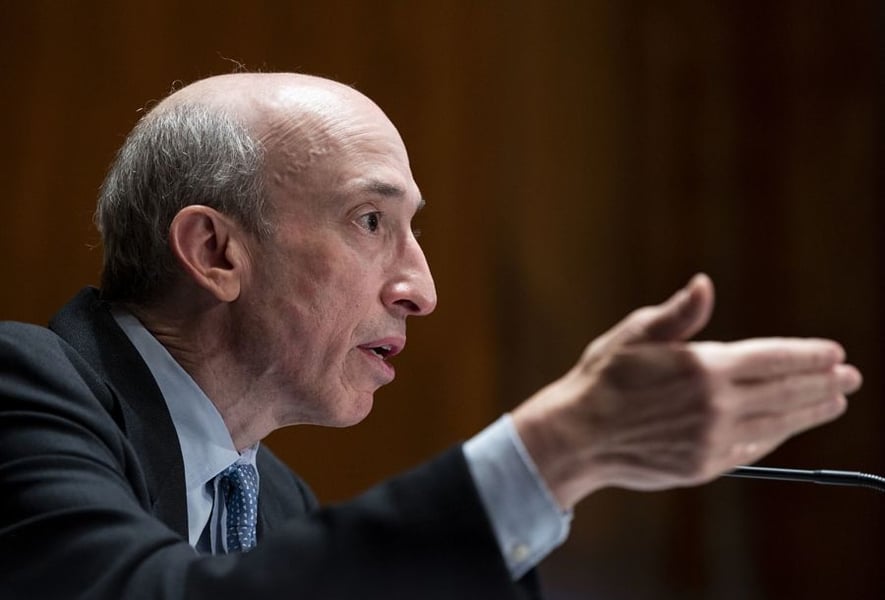
Tensions within the Securities and Exchange Commission over regulating cryptocurrencies emerged Thursday during a meeting of a panel that focuses on retail investor protection.
The fault lines weren't new but the differing opinions of SEC members were on display in the same forum — a virtual meeting of the SEC Investor Advisory Committee — instead of being conveyed by individual commissioners in disparate venues.
SEC Chairman Gary Gensler reiterated his concerns about the potential for investor harm in crypto markets.
“The American public is buying, selling and lending crypto on trading, lending and decentralized finance platforms, where there are significant gaps in investor protection,” Gensler told the committee. “This leaves markets open to manipulation. This leaves investors vulnerable. If we don’t address these issues, I worry a lot of people will be hurt.”
The SEC has the authority to regulate cryptocurrencies because they’re often part of an investment contract, which meets the definition of a security under current law, Gensler said. But they’re still evading the SEC.
“I believe we have a crypto market now where many tokens may be unregistered securities, without required disclosures or market oversight,” Gensler said. “Make no mistake: To the extent that there are securities on these trading platforms, under our laws they have to register with the Commission unless they meet an exemption. Make no mistake: If a lending platform is offering securities, it also falls into SEC jurisdiction.”
But SEC Commissioner Hester Peirce asserted that the SEC is resorting to enforcement first to the detriment of the crypto market.
“The SEC has not provided clarity in response to repeated questions on crypto from reputable players but has instead embraced an approach that has been described aptly to me as strategic ambiguity,” Peirce said in remarks to the IAC. “Such an approach facilitates enforcement actions but it is costly and treacherous for well-intentioned developers and their lawyers.”
Peirce took the agency to task for not approving a Bitcoin exchange-traded fund that holds the currency. The SEC has approved ETFs tied to Bitcoin futures contracts; the agency has said that the difference is that Bitcoin platforms are not regulated while futures contracts are regulated by the Commodity Futures Trading Commission.
Investors are seeking a spot Bitcoin ETF, Peirce said.
“Forcing investors who want exposure to crypto through traditional investment products into more expensive and less efficient wrappers is hardly the hallmark of an investor-protection-focused regulatory scheme,” she said.
Gensler and two other commissioners — Allison Herren Lee and Caroline Crenshaw — form the Democratic majority on the SEC. Peirce and Elad Roisman are the Republican members.
Like Gensler, Lee favors regulating crypto within existing securities laws.
‘We should continue to work together to bring these emerging assets and markets into compliance so that both markets and investors can benefit from the stability and certainty provided by our long-established framework,” Lee told the IAC.
The IAC, which was established to represent the retail investor’s point of view to the SEC, conducted a two-hour discussion on crypto regulation featuring eight witnesses. It was called the largest such panel that IAC has ever held.
“Digital assets do not fit neatly into our existing regulatory framework,” Timothy Massad, former CFTC chairman and a senior fellow at Harvard’s Kennedy School of Government, told the IAC. “[E]xisting rules were not written with crypto in mind, which means market participants often question how the rules should be applied.”
He suggested a way that the SEC could greenlight a Bitcoin ETF.
“The SEC could approve a Bitcoin ETF on the condition that the ETF price be based on an index of prices from exchanges meeting certain standards prescribed by the SEC,” Massad said. “These could include standards on reporting and disclosure, prevention of fraud and manipulation, governance, conflicts of interest, risk management and so forth.”
Investment advisers want the SEC to sort out crypto oversight, an executive of a platform that helps advisers navigate the crypto markets said.
“Man, oh man, would they like some clarity,” said Tyrone Ross, chief executive of Onramp Invest.
Ross touted the role crypto can play as a portal for new and diverse investors to enter the markets.
“Crypto is access, digital social justice, if you will,” he said. “Crypto networks represent equity.”
Another crypto backer warned the SEC not to go too far with regulation.
J.W. Verret, an associate professor of law at George Mason University and an IAC member, said many digital tokens don’t have the characteristics of a security. He asserted securities laws aren’t compatible with decentralized finance and urged the SEC to develop exemptions for crypto.
“Aggressive application of [current securities rules] could blow up in your face” and trigger legal action, Verret said.

CFP, CFA and CPA holders could gain accredited investor status as regulators weigh wider private market access for advisory clients

DeepVest, Vanilla and Libretto roll out tools to help financial advisors launch firms, close estate plans and sharpen planning skills

“People aren't effectively using their wealth in retirement,” said David Blanchett of Prudential.

Second-generation NFL ref Shawn Hochuli co-founded IWM Partners in Irvine, California, a wealth management practice with more than $500M in client assets

U.S. seniors lose $28.3 billion annually as a result of financial exploitation, according to a 2023 AARP study.
As AI makes financial information more accessible than ever, Lana Hock explains why human judgment, trust, and empathy remain the qualities clients value most in a financial advisor
Northern Trust’s Ken Lassner shows advisors how to convert volatility into after-tax portfolio gains

