Financial Planning & Goals-Based Software

Planning is becoming an engine
Financial planning software is shifting from static modeling tools into AI-enabled workflow engines that increasingly automate how advisors gather client data, construct plans, and translate recommendations into action across the broader wealth management stack.
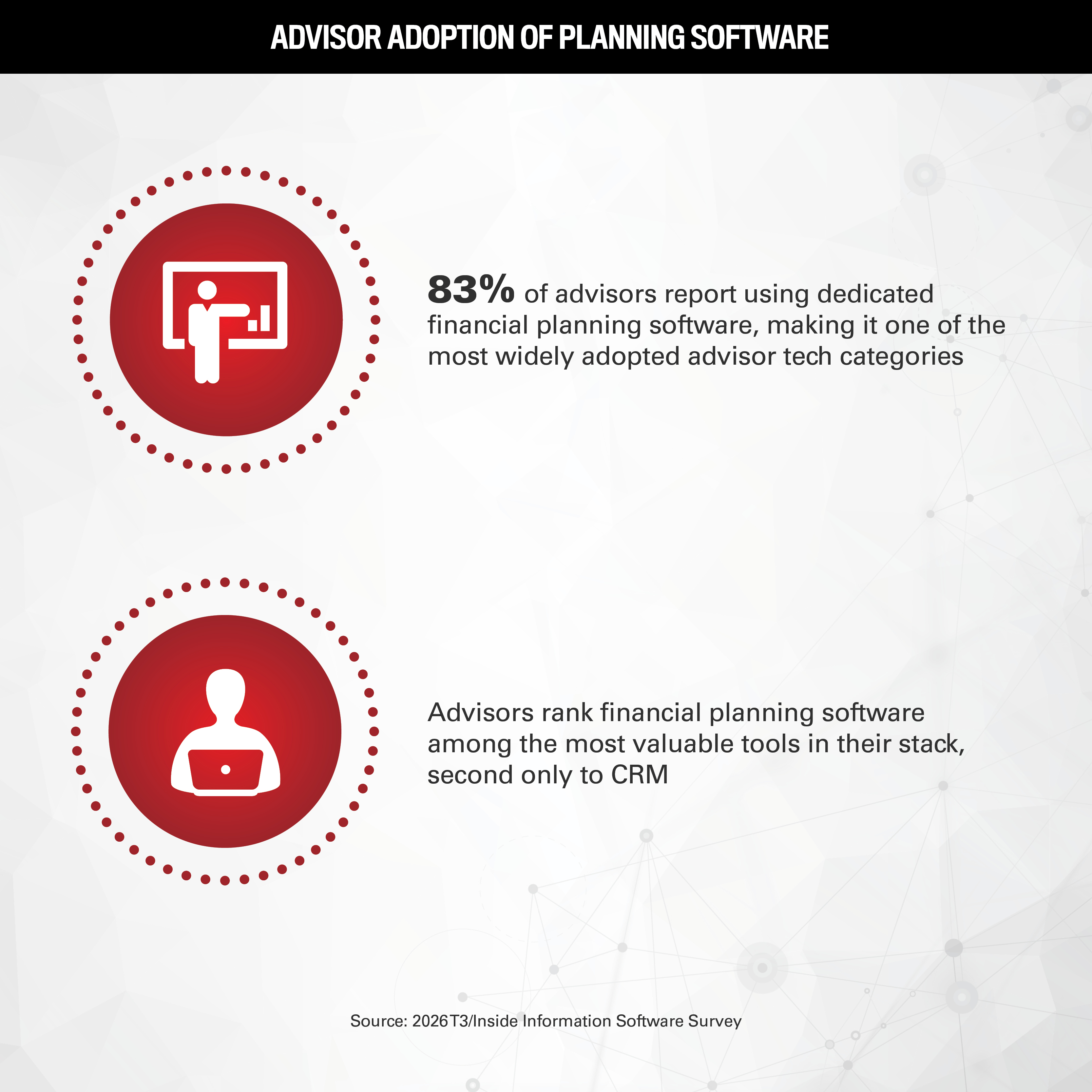
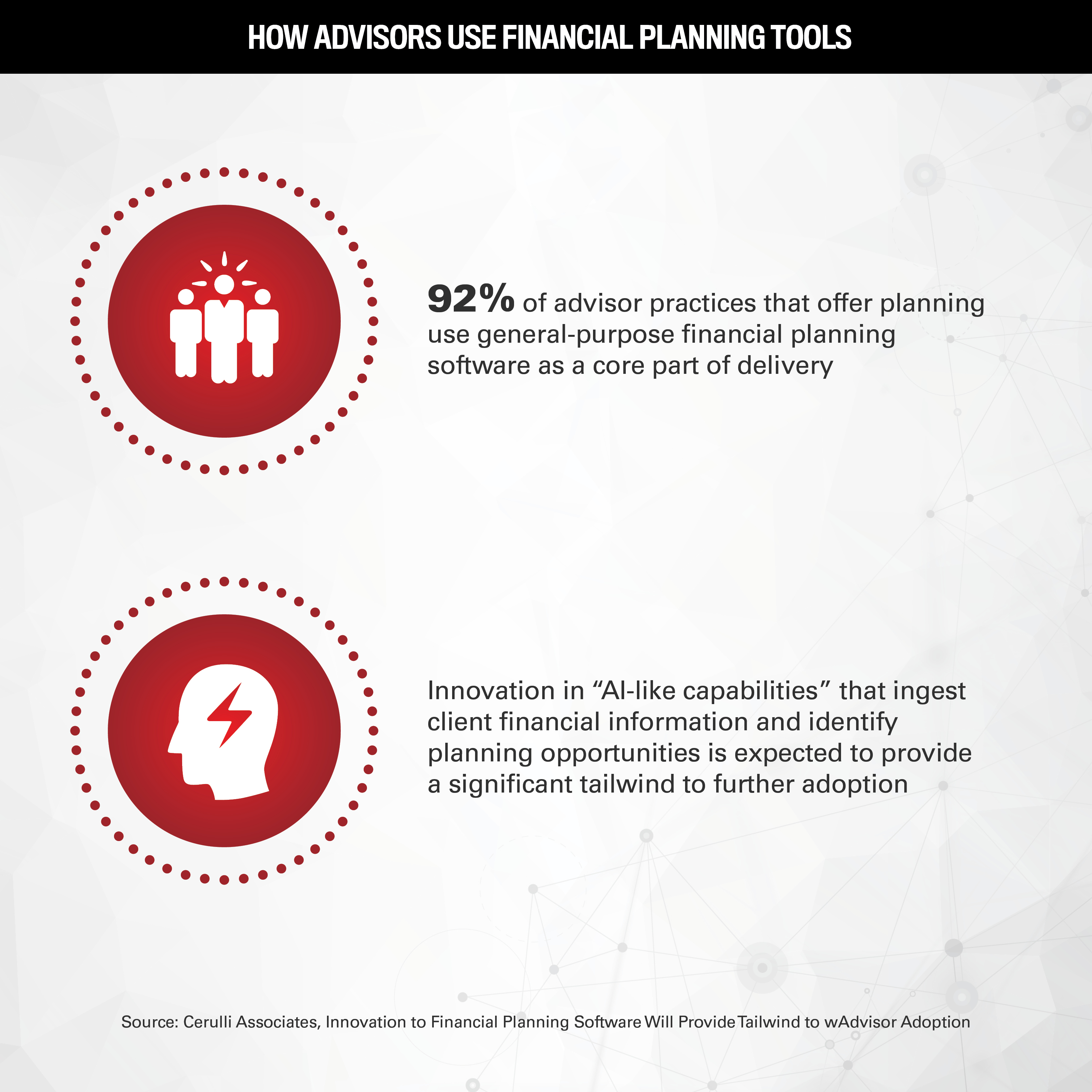
Industry data underscores how central this category has become. The 2026 T3/Inside Information Software Survey reports that 83 percent of advisors now use dedicated financial planning software, and they rank it among the most valuable components of their tech stack, just behind CRM. Cerulli Associates finds that 92 percent of advisor practices offering planning rely on general-purpose planning tools, and it expects “AI-like capabilities” that ingest client financial information to provide a meaningful tailwind to further adoption.
Fidelity’s eMoney Advisor has enhanced its foundational planning and needs analysis tools to streamline data gathering and support more focused, goal-based client conversations. Envestnet’s MoneyGuide has introduced its Dash experience to simplify planning workflows and reduce the steps required to move from discovery to recommendations. RightCapital is leveraging AI-driven integrations such as Smart Import and partner tools to automate data capture and reduce manual inputs in plan construction.
Rusty Sommer, head of partnerships and marketing at portfolio management software Flyer Financial Technologies, says changes in client investment preferences have been a driving force behind the evolution of software infrastructure.“Alternatives have moved from a niche 5% allocation to over 15–20% depending on the firm and client,” he says. “The back-office manual labor required to handle trading, portfolio management, capital calls, and K-1s for these assets has exploded, making old infrastructure an impediment to growth.”


Against that backdrop, this Annual Guide explores how new products, features, and AI integrations across leading platforms – including eMoney Advisor, MoneyGuide, RightCapital, NaviPlan, Moneytree, Orion, and Advyzon – are reshaping the role of financial planning and goals-based software in advisory firms.
Financial planning software adoption is high, expectations are rising
The traditional role of financial planning software was relatively narrow: input client data, run projections, and produce a plan document. Today, that model is being replaced by a continuous planning framework, where software is expected to update in real time, integrate across custodians and portfolios, and support ongoing client conversations.
In Kitces’ AdvisorTech research, Moneytree ranks first in overall satisfaction, underscoring how factors such as ease of use, support, and practical feature design can outweigh pure market share for many RIAs. For technology leaders, the battle for advisor mindshare continues to be fought on usability, integration, and innovation.
Lighter, modular planning to meet advisors where they are
One of the most visible product trends is the move toward lighter, modular planning workflows that complement – rather than fully replace – comprehensive planning. Many firms want to initiate planning conversations quickly, particularly with mass affluent or emerging wealth clients, and then deepen engagement over time.
“Five years ago, ‘T+1’ (waiting until the next day for data) was acceptable. Today, the rise of volatile markets, alts, and fractional shares has made operations a strategic priority,” says Sommer. “Firms now realize that if they aren’t using an intraday book of record like the one in Co-Pilot, they are effectively trading on yesterday’s news. Infrastructure has become a race for real-time data accuracy to prevent trade errors and cash drag.”
eMoney’s enhancements to its Needs Analysis capability are a response to this demand. The updated tools support allows advisors to quickly analyze specific client needs, such as retirement readiness or education funding, with streamlined data entry and real-time outputs that can be adjusted during the conversation. eMoney’s foundational planning initiatives and CoPlanner experience are designed to give advisors a way to engage clients in collaborative, scenario-based discussions without necessarily building a full, traditional plan every time.
Envestnet has taken a similar approach with MoneyGuide Dash. Dash is positioned to help advisors move from data gathering to goal-based recommendations more quickly, with fewer clicks and a more conversational flow. The emphasis is on compressing the time between the first meeting and an actionable plan while leaving the underlying engine’s more advanced capabilities intact for complex cases.
These developments reflect a broader industry recognition: many clients are willing to engage in planning, but neither they nor their advisors always have the appetite for a multi-hour, data-heavy process at the outset. Modular tools that support specific goals and can be built upon over time help firms make planning more accessible without diluting rigor.
AI and intelligent automation: from data gathering to time-to-advice
Looking ahead, Cerulli expects “AI-like capabilities” in planning software to be a material tailwind for adoption, particularly where they reduce manual data entry and highlight planning opportunities advisors might otherwise miss. RightCapital offers a concrete example of how this is playing out in practice.
The firm’s integration with Zocks, an AI-powered assistant, is designed to “accelerate time to advice” by capturing granular details from client meetings, emails, and documents and synchronizing them into more than 200 fields inside RightCapital. A separate partnership with Jump aims to take meeting notes and call transcripts into structured planning tasks and follow-ups, enabling advisors to spend more time on interpretation and less on transcription.
Other vendors are embedding AI capabilities into broader advisor platforms. Orion’s Denali AI initiative is positioned as an enterprise-level productivity layer that can assist with content creation, analysis, and workflow across the Orion stack – with financial planning as one of the key beneficiaries. Enterprise AI leader Anthropic has partnered with Orion to integrate Claude plug-ins designed for wealth management into Orion advisor workflows.
RIAs need to define clear guardrails around where AI can be used for data collection, scenario generation, and pattern recognition while following compliance expectations regarding human oversight and protecting client data from third-party systems.
“Data is becoming a growing concern due to increasing integration demands and the risk of systems operating from different sources of truth. These risks include inaccurate reporting, failure to meet client goals, missed opportunities to manage portfolios in line with client expectations, and trading errors,” says Sommer.
Planning embedded in all-in-one platforms
Another defining trend is the integration of planning into end-to-end advisor platforms, reducing the need for firms to stitch together multiple point solutions.
Orion exemplifies this evolution. Its planning tools are tightly linked with portfolio management and trading, and recent product updates have deepened connections with external data sources. An expanded integration with Pontera, for instance, now pulls held-away retirement accounts directly into Orion’s Eclipse trading workflows, giving advisors a more complete picture of client assets inside the same system used for portfolio implementation. In practice, this means that planning assumptions about 401(k)s and other workplace plans can be more easily translated into concrete allocation and rebalancing decisions.
Advyzon, long known for its all-in-one approach to performance reporting, CRM, and client portals, has continued to expand its planning capabilities as part of its integrated platform. Its selection by Citi as a core technology partner for a global UMA program highlights confidence in its ability to serve as infrastructure that links planning insights to product implementation at scale. For independent advisors, the advantage of such platforms is a more seamless experience: fewer data handoffs, consistent interfaces, and a clearer bridge between goal-based advice and actual portfolios.
“What’s interesting is that the shift to modular ecosystems – which is genuinely the right direction for the industry – can actually accelerate this problem if firms aren’t intentional about the data layer connecting those modules. The seams between layers are where the manual tax accumulates. Modularity without orchestration simply creates a new version of the same old problem,” says Sommer.
MoneyGuide, as part of Envestnet’s broader ecosystem, sits at the intersection of standalone planning and enterprise infrastructure. Its partnerships and integrations – including work with WealthStream to facilitate more fluid planning conversations – showcase a strategy of embedding planning into the daily workflows of advisors who are already relying on Envestnet for investment management and proposal generation.
Differentiation among core planning engines
Within the core planning category, providers continue to differentiate along several key axes:
-
Analytical depth vs. simplicity. Tools like NaviPlan and Moneytree have historically emphasized detailed cash flow modeling and robust scenario analysis, appealing to planners serving high-net-worth households and complex cases. Recent developments around AI-powered advice architectures, backed by institutional investors, suggest that NaviPlan’s legacy of depth is being reimagined for a more automated, insight-driven future.
-
User experience and advisor satisfaction. Moneytree’s top ranking in the 2025 Kitces AdvisorTech Study underscores how strongly ease of use, training, and responsive feature development influence advisor sentiment, particularly among independent RIAs who may not have large internal tech teams.
-
Client-facing collaboration. Platforms such as eMoney, RightCapital, and Orion are investing heavily in client portals, co-planning tools, and visualizations that make complex trade-offs – such as sequence-of-returns risk, tax impacts, and multi-goal prioritization – more tangible for households.
For firms evaluating these options, the key is alignment with their advice model. A planning-first RIA with a focus on detailed cash flow and tax strategies may prioritize different capabilities than a fast-growing practice that needs highly scalable, template-driven, goal-centric plans.
Operational realities: turning innovation into everyday behavior
Even as vendors innovate, advisory firms face familiar operational questions.
Adoption is one. Survey results routinely show a gap between firm-wide license counts and consistent, deep usage across advisors. Bridging that gap requires more than product training; it demands process design. Leading firms are standardizing a small set of planning pathways (e.g., retirement-first, multi-goal, and business owner) and embedding them into CRM tasks, service calendars, and compensation models, so that using the planning software is the easiest way to do the work, not an optional extra.
Data quality is another issue. Integrations like Orion–Pontera and AI-driven connectors such as Zocks–RightCapital reduce manual entry, but they also raise the bar for data governance. Firms need clear policies around which systems are authoritative for key fields, how frequently data are refreshed, and how plan assumptions are reviewed and updated.
Finally, governance around AI and advanced analytics is becoming a board-level topic. As planning tools begin to suggest next-best actions or flag risks and opportunities, firms must ensure that advisors understand how those suggestions are generated, where their own judgment should override or adapt them, and how to explain the underlying logic to clients.
Strategic implications for advisors and firm leaders
For RIAs, hybrids, and broker-dealer platforms, financial planning and goals-based software now sits at the crossroads of client experience, regulatory expectations, and growth strategy. The latest wave of product development – from focused planning modules and AI integrations to platform-embedded engines – is giving firms more ways to deliver planning efficiently and at scale.
“The conversation has shifted to headless infrastructure. Firms no longer want to be locked into a single vendor’s mediocre UI,” says Sommer. “They want Flyer’s APIs to handle the heavy lifting – trading and rebalancing – while they build or choose their own advisor desktop experience. It’s no longer about a single platform, but a connected ecosystem in which Flyer serves as the trading brain.”
But the technology choices that matter most will be those that align with a firm’s specific client base and vision for advice. That includes selecting tools that support the desired depth of analysis, the right level of client collaboration, and a practical path from plan to implementation. Just as importantly, it involves investing in adoption, data quality, and governance so that innovation in the software actually shows up in day-to-day client conversations.
The next phase of competition will likely center on depth of integration, AI-driven automation, and the ability to turn planning insights into actionable investment and client engagement workflows. Firms that succeed in embedding planning into the daily rhythm of advisor-client interaction will be best positioned to scale personalized advice efficiently.

Related Stories:
When Growth Outruns the System
