Workflow Automation & Operations Technology 2026
The operational shift reshaping financial advisory firms
Advisory firms have always understood that operations consume time. What has shifted is the calculus around what that time costs.
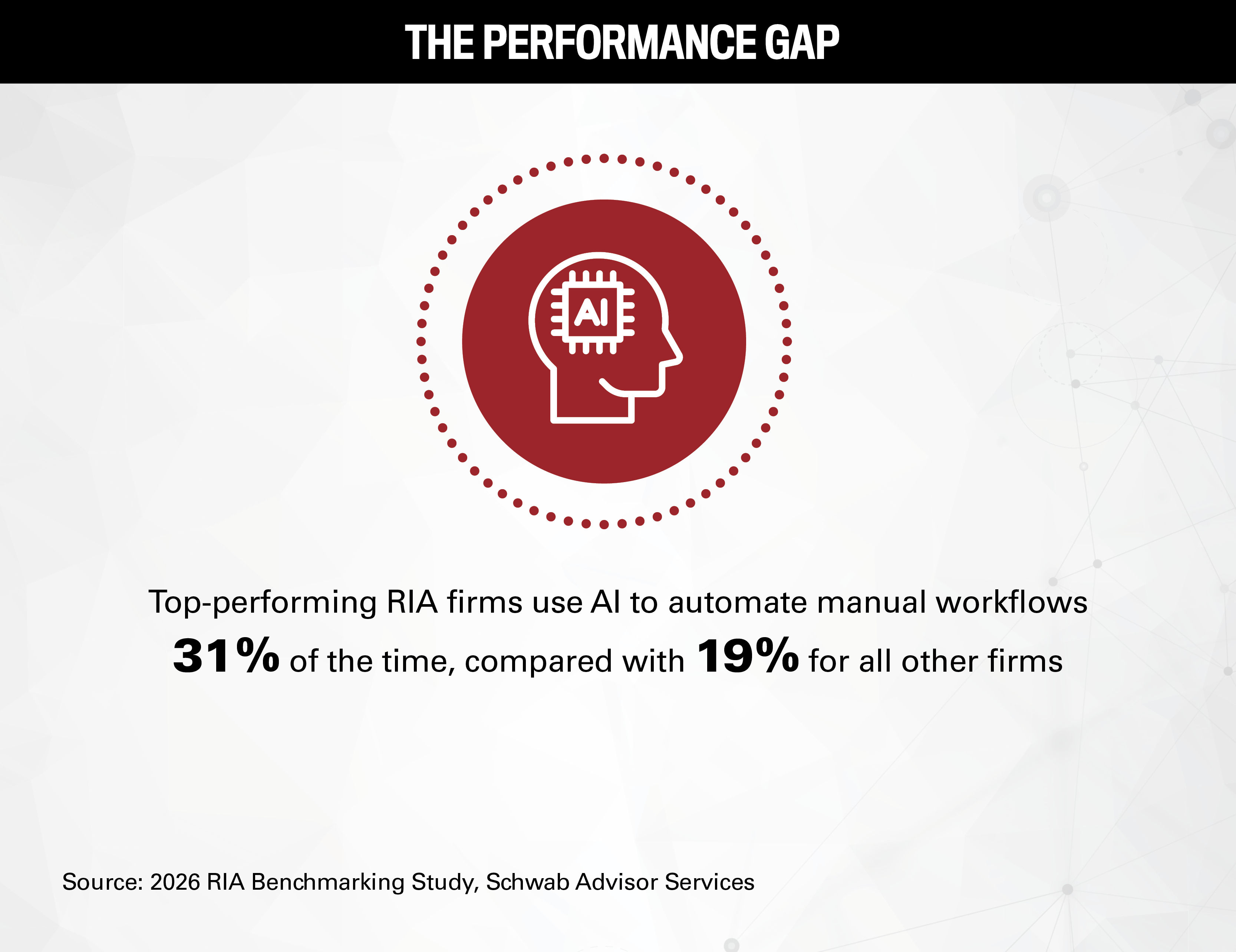
The 2026 RIA Benchmarking Study from Schwab, based on self-reported data from 1,236 firms representing more than $2.5 trillion in assets under management, found that top-performing firms spend 25 percent less time on operations than their peers and are more likely to use digital processes for client workflows. According to Schwab’s findings, those same firms use AI to automate time-consuming and manual workflows 31 percent of the time, compared with 19 percent for all other firms. Schwab includes standardized workflows as one of 15 explicit metrics in its Firm Performance Index, treating operational discipline as a direct measure of firm health alongside client growth, revenue, and operating margin.
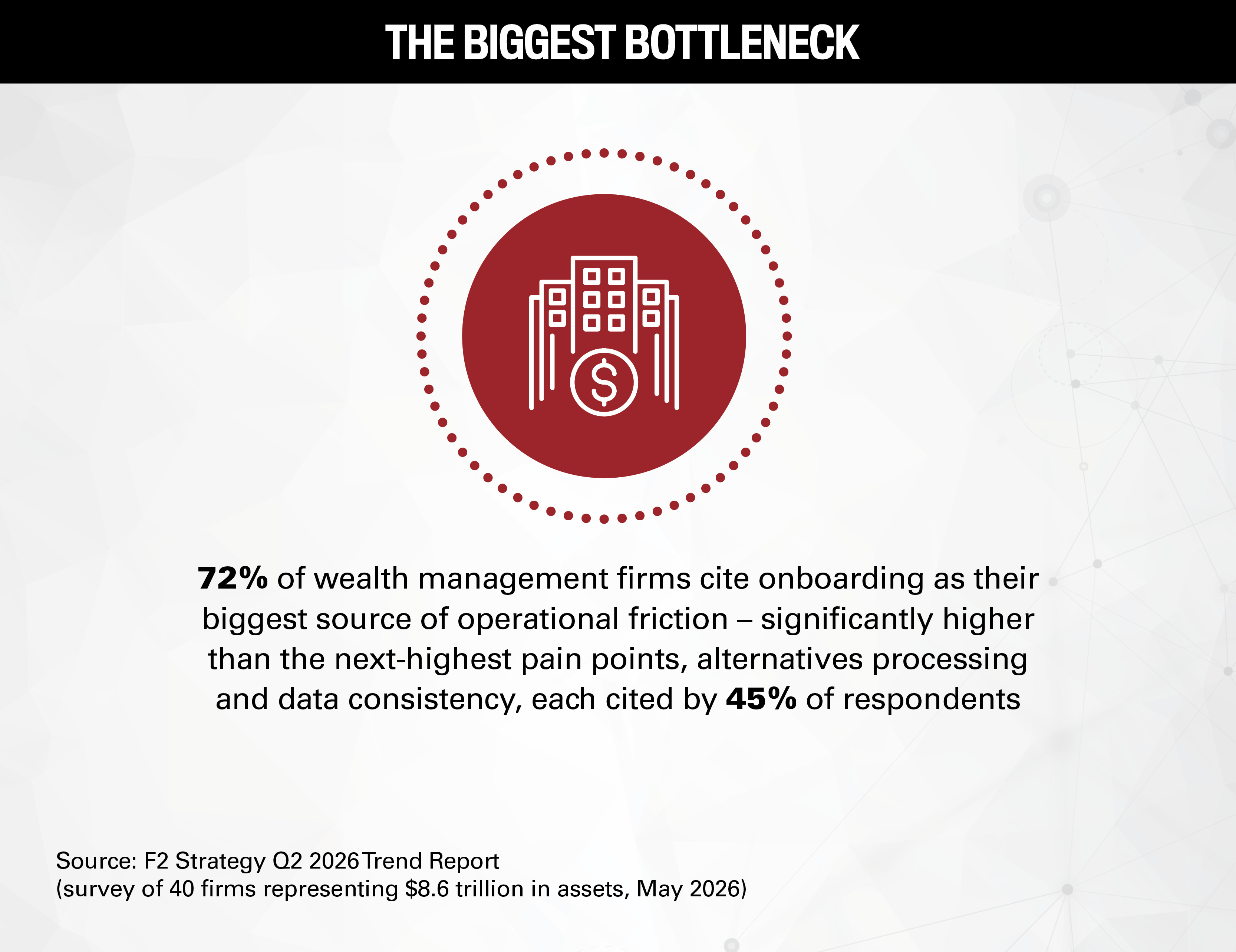
The F2 Strategy Q2 2026 Trend Report, drawn from a May 2026 survey of 40 RIAs, wealth management firms, and broker-dealers representing $8.6 trillion in assets, found that 79 percent of firms plan changes to their operating model in the next 12-24 months. The single biggest driver was onboarding, cited by 72 percent of respondents as a key source of friction. This was significantly higher than the next-highest friction points, alternatives processing and data consistency and reporting, each cited by 45 percent of participants.
Workflow automation and operations technology are no longer just back-office conversations. They are growth conversations, tied directly to advisor productivity, client experience, acquisition capacity, and enterprise value. What follows is a vendor-by-category overview of the platforms and product developments that define the space for financial advisors in 2026.
The data layer underneath everything
Before workflow automation can deliver on its promise, most firms must first solve an upstream constraint: data. According to the F2 Strategy Q2 2026 Trend Report, 64 percent of wealth management firms and 83 percent of bank trust companies report that they do not have a unified data layer to make their AI projects work, effectively limiting those firms to generic use cases. F2 concludes that personalized analytics and workflow automation require the data layer first. Among firms that do measure their AI implementations, more than two-thirds report gaining 25 percent more efficiency in targeted workflows, according to F2 – but they remain a small minority.
This data fragmentation problem has generated its own vendor market. Dispatch, a data orchestration platform, maps the data fields each custodian requires, pulls information already stored across an advisor’s CRM and planning tools, and generates a single consolidated client request. Dispatch’s customer base grew fivefold in the past year, with assets on its platform rising from roughly $900 billion to more than $9 trillion. In June 2026, Dispatch launched Advisor Transitions, a software product to manage the movement of advisors and client assets between firms, with the company citing a case study in which complex household onboarding was compressed from hours to roughly 30 minutes for Sanctuary Wealth. Skience and Marstone are established digital onboarding and data infrastructure platforms, alongside Docupace as active digital onboarding tools for advisory firms.
Onboarding: where investment is concentrating
Client onboarding is the operational workflow attracting the most fintech capital and development activity. The 2026 T3/Inside Information Advisor Software Survey, which drew 2,906 responses covering more than 800 programs across 70 categories, found that proposal generation and client onboarding tools jumped from 15.84 percent market penetration in 2025 to 21.45 percent in 2026, among the sharpest single-year adoption gains across all measured categories.
Docupace is an established enterprise platform in the segment, offering a productivity suite that integrates CRM, workflow automation, custodial forms, data validation, and document management. Its subsidiaries, PreciseFP and Hubly, carry most of the performance data. PreciseFP handled nearly 400,000 automated data transfers between integrated applications in 2025, a 28 percent year-over-year increase. Hubly, the workflow engine within the Docupace ecosystem, saw users complete 719,559 workflows and 3.9 million individual tasks in 2025 – year-over-year increases of 57 percent and 69 percent, respectively.
Together, according to InvestmentNews coverage of Docupace’s annual reporting, PreciseFP and Hubly helped eliminate more than 200,000 hours of manual work for advisors in 2025, translating to an estimated $29.7 million in productivity gains across more than 400,000 accounts.
Feathery raised $30 million in July 2026 for its AI workflow automation and account-opening tools. Sequoia Financial, a national RIA overseeing roughly $32 billion in assets, cut custodial account-opening times by 45 percent after deploying Feathery’s onboarding platform.
Amplify, which supports more than 655 advisors and $24.5 billion in assets on its platform, launched a Custody Command Layer in partnership with Goldman Sachs Custody Solutions, giving RIAs a way to open, fund, and manage custodial accounts within a single operating environment. Amplify said it earned the highest TAMP rating in the 2026 T3/Inside Information Software Survey, with an 8.67 average user score.
Workflow orchestration and document management
Workflow tools occupy the operational layer directly above the CRM, handling task management, sequential process automation, and cross-system coordination. The 2026 T3/Inside Information Software Survey includes a dedicated Workflow Tools category, reflecting established demand for purpose-built solutions at this layer of the advisory stack.
Workflow management platform Hubly built integrations with AI notetaker Jump, meeting management tool GReminders, and client engagement tool Pulse360, enabling workflows to be triggered directly from AI tools as well as from CRMs. If workflow tools can outperform CRMs on process management, and AI notetakers increasingly serve as the central client data hub, the traditional CRM’s role faces competitive pressure from two directions simultaneously. For forms-based document workflow, iPipeline’s Laser App and Quik are among the vendors in the advisor industry for processing documents.
AI meeting tools: one year, 42 percent market share
No category has moved more rapidly into the RIA operations stack. According to the 2026 T3/Inside Information Software Survey, AI notetaking solutions, a category the survey added for the first time, reached 42.86 percent aggregate market share in a single year, with 14 identified platforms. Survey co-author Bob Veres described the adoption trajectory as “rocket-like.”
AI notetaker Jump reaches more than 25,000 advisors within two years of its January 2024 launch. In January 2026, Focus Financial Partners, with affiliated firms collectively managing more than $500 billion in assets, was rolling out Jump to 800 advisors after a pilot in which advisors reduced task time by 70 percent. Jump has since closed an $80 million Series B and launched AI Associate, an agentic capability that allows advisors to query their technology stack, update records across connected systems, and draft communications within a single interface – with human approval required before any action executes. In June 2026, Jump expanded further into account opening and onboarding workflows, extending its platform from the meeting room into the full client lifecycle.
CRM: the workflow foundation
The CRM remains the system where most advisory workflows begin. According to the 2025 T3/Inside Information Software Survey, Advyzon earned the highest client satisfaction rating in the CRM Programs category at 8.49 for firms with more than 3 percent market share, with the survey report specifically noting that the platform “made a significant investment in its CRM capabilities, particularly in workflow automation.” Advyzon also earned the highest all-in-one software rating at 8.88 for the eighth consecutive year.
Wealthbox, the second-most-used RIA CRM by market share per the T3 survey, introduced an AI-powered meeting notes assistant in 2025. Redtail, the market-share leader in the CRM category and now owned by Orion, offers workflow templates for onboarding and annual review processes. Salesforce Financial Services Cloud remains dominant in the enterprise segment. Practifi, a Salesforce-based CRM purpose-built for advisors, and AdvisorEngine round out the field of advisor-specific CRM providers with native workflow capabilities.
What the data argues for
The F2 Strategy Q2 2026 Trend Report is direct about where the industry advantage lies: firms that build measurement frameworks for their AI implementations and construct the data layer that fuels those tools will lead the industry over the next 24 months. F2 also cautioned that AI goals are outpacing change management support and that spending on AI has increased exponentially over three years without consistent clarity on cost or return.
The Schwab 2026 benchmarking data makes the operational case that top-performing firms standardize their workflows and invest in digital client processes. The gap between firms that have built that discipline and those that have not is already measurable in their AUM growth rates, time spent on operations, and advisor capacity.