

What’s safer than short-duration bonds? Even shorter duration debt. As investors brace for an increasingly aggressive Federal Reserve, money is flooding into cash-like ETFs, which are seen as relatively less vulnerable to interest-rate risk. Traders have been piling into exchange-traded funds mostly focused on ultra-short instruments like Treasury bills, while offloading ETFs tracking longer-dated debt — even those that are considered short-term bonds maturing in five years or less.
The $14 billion Pimco Enhanced Short Maturity Active ETF (MINT) lured inflows of nearly $900 million in the best week since it started trading in 2009, according to data compiled by Bloomberg. Meantime, roughly $1.6 billion was pulled from the $39 billion Vanguard Short-Term Bond ETF (BSV) — the biggest withdrawal in three years.
Bond yields have surged as markets project a 40% chance the Fed will kick off rate hikes with the sharpest increase in two decades in March, with an unexpectedly strong jobs report Friday reinforcing speculation the economy is at risk of overheating. That’s making traders flock to ultra-short duration funds, which have emerged as a haven of sorts as volatility ripples across asset classes.
“The hunt is on for anything that resembles a store of capital,” said Peter Chatwell, head of multi-asset strategy at Mizuho International. “What this flow shows is how the chain reaction of Fed hikes and quantitative easing will take liquidity out of ‘duration’ risk assets, into the short-duration products.”
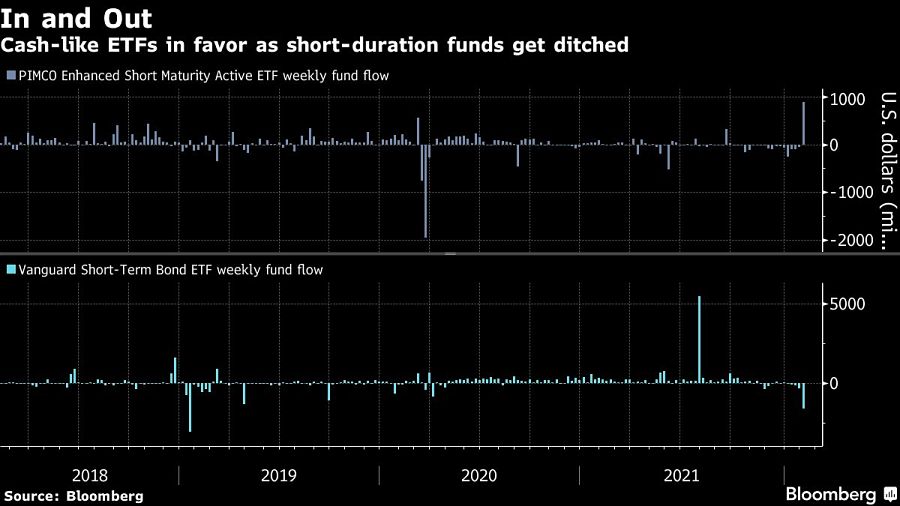
MINT has fallen less than 0.5% so far this year, while BSV has dropped 1.5%.
In addition to MINT’s influx, the $16 billion SPDR Bloomberg 1-3 Month T-Bill ETF (BIL) and the $14 billion iShares Short Treasury Bond ETF (SHV) both posted their biggest weekly inflows since 2020, according to data compiled by Bloomberg. Meantime, the $13 billion Vanguard Short-Term Treasury ETF (VGSH) and the $8 billion Schwab Short-Term U.S. Treasury ETF (SCHO) — which track Treasuries maturing in three years or less -- both bled the most cash since 2019.
However, while billions are being sent to ultra-short bond funds at the moment, the rotation might not last beyond the Fed’s March meeting, Chatwell said.
“Until there are higher policy rates and higher term premia in U.S. T-bills, commercial paper and other short-term credit products are likely to do well from these flows,” he said. “We expect this flow to become much more risk-averse after the March 16 Fed as by then, we should have higher and steeper T-bill curves.”

Shorter waits for failed SIE and Series 7 candidates take effect Jan. 19, speeding the path to registration

Raymond James and Cetera also welcomed advisors from UBS and LPL as competition for experienced teams stays fierce

Jim Walesa worked in the securities industry for 39 years before leaving in 2021.

As the market turned from pricing in cuts to betting on hikes this year, the developing reality of a K-shaped economy has had real implications for households and investors alike.

Alleged cash payments, stolen client data, and a court that jumped the gun
Knighthead Life entered the market with a competitive MYGA. A strong launch earned advisor confidence and paved the way for FIAs.
As AI makes financial information more accessible than ever, Lana Hock explains why human judgment, trust, and empathy remain the qualities clients value most in a financial advisor

