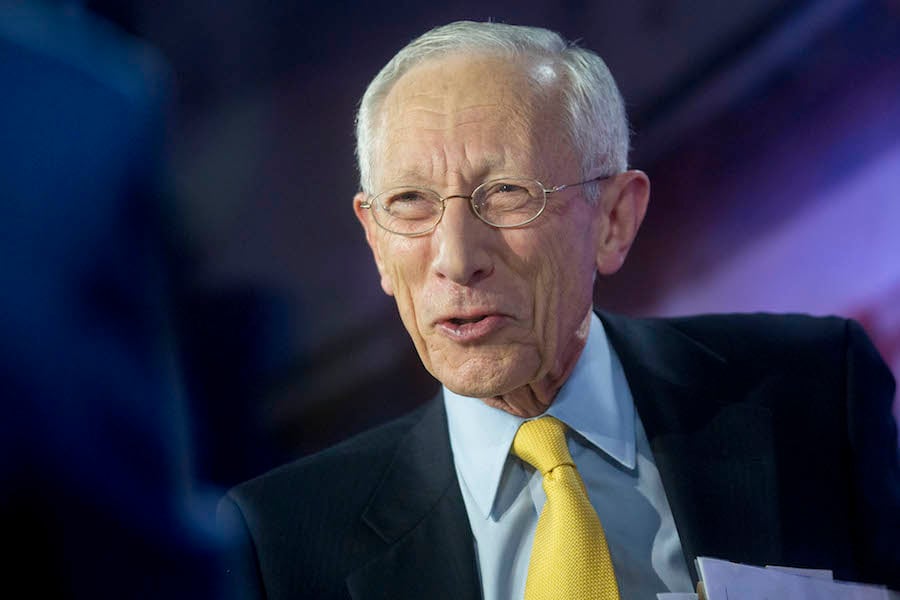
Federal Reserve Vice Chairman Stanley Fischer said he doesn't see immediate risks of financial bubbles in the U.S., while raising concerns that the central bank's policy tool kit to deal with such occurrences is limited and untested.
“Banks are well capitalized and have sizable liquidity buffers, the housing market is not overheated and borrowing by households and businesses has only begun to pick up after years of decline or very slow growth,” the Fed's No. 2 policy maker said in a
speech Friday in Boston. Still, he warned that “potential shifts of activity away from more regulated to less regulated institutions could lead to new risks.”
Mr. Fischer, 71, who leads a committee at the U.S. central bank charged with identifying asset-price bubbles and other risks to financial stability, also said he sees some scope for using interest-rate policy to combat potential threats, but doing so could come with “significant costs.”
Mr. Fisher did not address the economic or interest rate outlook in his remarks to a two-day Federal Reserve Bank of Boston conference on “macroprudential monetary policy.” Markets are keen for guidance on when the central bank might make its first rate increase in almost a decade.
“The limited macroprudential toolkit in the United States leads me to conclude that there may be times when adjustments in monetary policy should be discussed as a means to curb risks to financial stability,” Mr. Fischer said. “A more restrictive monetary policy would, all else being equal, lead to deviations from price stability and full employment.”
FINDING THREATS
Created a century ago in response to recurring banking crises, the Fed has taken a renewed interest in identifying potential systemic financial threats since the global meltdown of 2008-09 pushed the U.S. into its worst
recession since the Great Depression.
Economists continue to debate whether central banks should respond to financial stability threats exclusively through regulatory and supervisory tools, known as macroprudential policy, or also by using interest rates. The Federal Reserve conducts stress tests of the largest banks every year, and has boosted capital and liquidity requirements to reduce the risk of bank failures.
Mr. Fischer said U.S. policy makers should consider the trade-offs between using monetary policy to pop asset bubbles and the costs to its mandate to keep inflation stable and employment high.
FRUITFUL INVESTIGATION
“It may also be fruitful for researchers to continue investigating the deployment of new or little-used monetary policy tools,” he said. “For example, it is arguable that reserve requirements — a traditional monetary policy instrument — can be viewed as a macroprudential tool.”
Responding to an audience question from Mervyn King, former governor of the Bank of England, about identifying risks to financial stability, Mr. Fischer said policy makers need to reach outside their usual sources of information.
“The overwhelming thing I have seen is the necessity for central banks to discuss issues outside the institution with experts who come from elsewhere, and to not dismiss things that are not consistent with your framework just because they sound bizarre to you,” said Mr. Fischer, who is also a former governor of Israel's central bank.
Boston Fed President Eric Rosengren, the conference host, said in a
paper delivered Friday that the Fed's rate-setting panel, the Federal Open Market Committee, already takes financial stability into account when setting interest rates.
Mr. Rosengren and co-authors Joe Peek and Geoffrey Tootell, also from the Boston Fed, said their analysis of FOMC minutes “are strongly suggestive that the FOMC often behaves as if monetary policy has a third mandate” — namely, to respond to financial instability.