
Office address: 550 17th Street, NW, Washington, DC 20429
Website: fdic.gov
Year established: 1933
Company type: government agency
Employees: 5,600+ (full-time employees in 2025)
Expertise: deposit insurance, bank examination and supervision, financial institution regulation, failed bank resolution, consumer protection and compliance, community reinvestment oversight, receivership management
Parent company: US Government
Key people: Travis Hill (acting chair); Jonathan Gould and Russell Vought (directors); Matthew Reed (general counsel); Dana Wade, Alex LePore, and Leonard Chanin (deputies to the chair)
Financing status: N/A
Based in Washington, the Federal Deposit Insurance Corporation maintains stability in America's financial system. The FDIC insures deposits up to $250,000 per account and supervises nearly 3,000 banks. Since 1934, no depositor has lost insured funds, and the agency is funded entirely through premiums from member banks.
Through the Banking Act of 1933, lawmakers created the Federal Deposit Insurance Corporation to help Americans trust their banks again. Nearly 9,000 banks had collapsed between 1930 and 1933 due to panic withdrawals and unsound lending.
The FDIC began protecting deposits in 1934, initially covering up to $2,500 per account. By 1950, insured deposits had grown to $91 billion with coverage expanded to $10,000 per account.
Inflation and rising interest rates throughout the 1960s and 1970s forced major changes in coverage limits. Coverage jumped to $20,000 per account in 1969 and doubled to $40,000 by 1974 due to economic strain.
The collapse of Franklin National Bank in 1974 also marked a turning point for the agency. With $3.6 billion in assets, Franklin's failure represented the largest single institution collapse in FDIC history to date.
The 1980s brought widespread failure as nearly 1,300 savings and loans and over 1,600 banks collapsed nationwide. In 1984, Continental Illinois National Bank required a $1 billion FDIC bailout to prevent systemic collapse.
The FDIC's insurance fund fell below zero in 1991 due to significant losses. The agency then raised bank premiums sharply to rebuild reserves. Congress responded with reforms to strengthen oversight, and by 2004 the banking system had stabilized considerably.
The agency became the receiver after Silicon Valley Bank collapsed with a $42 billion deposit run in March 2023. It swiftly established Silicon Valley Bridge Bank to assume $119 billion in deposits and protect all depositors. The FDIC then extended the bidding process to maximize value before selecting First Citizens Bank.
The resolution protected all account holders, yet disputes arose over $1.9 billion in cash the Federal Deposit Insurance Corporation withheld. SVB Financial sued the agency in July 2023 as it claimed that the withholding violated bankruptcy law and hindered reorganization. Such disputes demonstrate the FDIC's responsibility to balance depositor protection with asset recovery amid complex legal entanglements.
The FDIC provides deposit protection, bank supervision, and resolution services designed to strengthen financial system stability:
The FDIC also administers training programs and international seminars for banking professionals. Its commitment to transparency and research helps Americans maintain confidence in deposit-insured financial institutions.
The FDIC states that guiding principles shape decisions and build public trust through ethical standards. The agency identifies six core values that guide organizational behavior:
The Federal Deposit Insurance Corporation also provides workplace benefits for its staff, such as:
The FDIC's Office of Minority and Women Inclusion also manages diversity and equal employment opportunity programs. Applicants with disabilities can request accommodations from the FDIC's Disability Program Manager.
Travis Hill became acting chair of the FDIC Board in January 2025 after serving as vice chair. Hill worked in the organization from 2018–22 and previously served as counsel for the US Senate. Hill earned a BS in economics and political science from Duke University and a JD from Georgetown.
The FDIC Board of Directors and senior executives guide the agency's operations and strategy:
This leadership team works to maintain financial stability and protect depositors through coordinated policy development.
The agency publishes quarterly banking profiles to reveal financial system health to the public. Its Q3 2025 report showed net income growth of 13.5 percent and deposit insurance reserves at $150 billion. This reporting demonstrates the FDIC's supervisory role in maintaining depositor confidence despite emerging risks in commercial real estate.
For those protecting their savings, the FDIC offers important safeguards. The organization protects deposits in savings accounts and certificates of deposit up to $250,000 which make them safer choices for conservative investors.
This federal insurance removes the risk of losing principal and allows people to preserve capital during economic uncertainty. To explore more low-risk investment options suited to today's volatile markets, check out this comprehensive investment guide.
Based on evidence that has always and only been observed during or immediately prior to U.S. recessions, the U.S. economy appears headed into a second leg of an unusually challenging downturn.
With added charges, shrinking interest, putting mony in the bank can be a losing proposition; mattress starting to look good

'We gave the SEC the power to do it', the Congressman said just moments before the House passed the financial-reform bill. 'And they're going to do it.'

Investors seeking the safety of government-insured certificates of deposit and a chance to profit from market rallies may end up earning nothing and owing taxes for their efforts.

The Wall Street giant wants a $1.4B tax refund from the bank it rescued. The regulator says TARP recipients aren't entitled to such refunds

Congress and the SEC could require ABS packagers to hold some asset-backed securities on their books. Wall Street is not thrilled by this idea.

The amount of toxic debt held by banks may be declining. But as the closure of four banks over the weekend showed, bad loans are still rippling through the financial system.
The FDIC seized another pair of community banks over the weekend, making it 22 for the year. With 700 banks now on the agency's 'problem' list, last year's tally of 25 bank failures is sure to be surpassed.
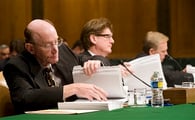
According to a new report, Washington Mutual provided the largest chunk of funding for the federal agency that oversaw the thrift. Yesterday, a Senate panel said that arrangement was less than ideal.

The FDIC labels more than 700 U.S. banks as 'problems'. Nearly 10% could fail. Meanwhile, one analysts claims regulators are hoping the economic turnaround will bail out the bad banks. It better.

Regulators shut four banks from California to Florida on Friday, boosting to 20 the number of U.S. bank failures this year following the 140 closures last year in the worst financial climate in decades.

Despite double-digit unemployment, big deficits and a raft of other looming concerns, the economy isn't bad enough to justify the more than $9 trillion sitting on the sidelines in various low-yielding bank instruments.
The recent pattern of money flows into bank deposits suggests growing investor concerns that an inflationary period is looming, according to Dan Geller, executive vice president at researcher Market Rates Insight.
Hours before passing the most significant financial-reform package in nearly 80 years, the House Friday killed an amendment that would have given the Financial Industry Regulatory Authority Inc. the authority to regulate investment advisers at broker-dealers.
Real estate money managers are joining private-equity firms in the line to buy failed banks.
