
Office address: 420 Montgomery Street, San Francisco, CA 94104
Website: wellsfargo.com
Year established: 1852
Company type: banking
Employees: 217,000 (2024)
Expertise: retail banking, commercial banking, investment banking, wealth management, asset management, mortgage lending, treasury management, capital markets, insurance, global payments
Parent company: Wells Fargo & Company
Key people: Charles Scharf (CEO); Barry Sommers, Fernando Rivas, Michael Santomassimo, Derek Flowers, Scott Powell, and Kyle Hranicky (senior EVPs)
Financing status: corporation
Wells Fargo is a leading US bank headquartered in California, serving millions of clients nationwide. It delivers diverse financial and investment options, covering wealth management, asset management, and investment banking services. Managing over $2 trillion in assets, the company operates one of the largest investment advisory networks and is recognized as a Big Four US bank.
Wells Fargo began its story in 1852, when Henry Wells and William Fargo saw a need for reliable banking and express services during the California Gold Rush. Their company quickly became known for moving gold, mail, and freight across the growing American West. The famous Wells Fargo stagecoach soon became a symbol of trust and connection for people seeking opportunity.
The company played a key role in linking distant towns and cities, helping communities grow and thrive. By the late 1800s, Wells Fargo was handling express deliveries, banking, and even managing the western portion of the Pony Express. Its reach stretched from California to the Midwest, making it a household name for pioneers and businesses.
Wells Fargo faced many changes over the years, including government takeovers and new banking laws. In 1905, the express and banking businesses split, and the bank merged with Nevada National Bank. Through world wars, economic downturns, and the rise of new technologies, it adapted to meet the needs of each era.
A major milestone came in 1998, when Wells Fargo merged with Norwest Corporation, creating a coast-to-coast banking powerhouse. The company expanded further by acquiring Wachovia in 2008, which made it one of the largest banks in the US. Today, it stands as a leader in American banking, known for its resilience and commitment to serving millions of customers nationwide.
Wells Fargo’s offerings are structured to provide a range of options for independent advisors, individuals, and businesses. The company combines technology, national reach, and advisor support to deliver financial and investment solutions:
Wells Fargo also provides digital tools and platform enhancements to help advisors and clients manage their finances efficiently. The company’s national reach and experienced teams offer support and resources for a wide range of financial needs.
Wells Fargo states that its culture focuses on inclusion, support, and engagement for all employees. The work environment is described as one where people are encouraged to speak up and feel valued, with teamwork and respect emphasized.
Eligible employees at Wells Fargo receive a variety of benefits that support their health, finances, and work-life balance, including:
According to Wells Fargo, it supports social, economic, and environmental sustainability through business practices and community efforts. The company reports $178 billion deployed in sustainable finance over three years, including $16 billion for renewable energy. It also notes $55 billion in commitments to oil, gas, utilities, and over $15 billion for clean transportation.
Charles W. Scharf is CEO and President of Wells Fargo, leading the company’s strategy and operations since 2019. Scharf previously served as CEO of Bank of New York Mellon and Visa, and held executive roles at JPMorgan Chase. He brings over 30 years of experience in banking and payments, including leadership in both public and private companies.
Here are the key people overseeing Wells Fargo’s investment, banking, and financial management divisions:
The board and management state that they are committed to sound and effective corporate governance. Leadership aims to ensure strong oversight and clear accountability throughout the company.
Wells Fargo Investment Institute’s chief investment officer shared four signals that could support a longer bull market for clients. The firm highlights trends like AI growth, fiscal clarity, and broadening market strength as reasons for optimism through 2026. This analysis helps the company guide investors with strategies that match changing market conditions and future opportunities.
Wells Fargo Advisors also brought in four experienced professionals in 2025, adding nearly $1 billion in assets under management. The company’s new hires from UBS and JPMorgan show its focus on attracting advisors with strong client relationships and established books of business. This move expands Wells Fargo’s wealth management division and increases the firm’s total client AUM.

Fines, levied in July and August, top $500,000; Voya Financial takes biggest hit

Banks are watching wealthy clients flirt with robo-advisers, and that's one reason the lenders are racing to release their own versions of the automated investing technology.
Organizations that dominate lobbying expenditures also donate the most to political campaigns. Leading the charge are NAIFA and the ICI, while TD Ameritrade contributed just $9,000.
Tracking the more than $26 billion in AUM that changed firms late in 2015.
Over the past five years, big advisers moves picked up steam toward the end of 2015.
The $5.4 billion deal could have RBC's regional wealth management business looking more like a wirehouse or private bank than a regional firm.
As the prime rate set by banks goes up, companies may raise fees or restrict offers.
<i>Breakfast with Benjamin</i> It took the bank just 12 minutes after the Fed's rate hike announcement to bump its prime rate to 3.5% from 3.25%.

Better client understanding of the investing process should be a boon to the client-adviser relationship.

Massachusetts regulator looking at whether financial institutions violated any laws.

Although delaying retirement helps financial readiness, it can't be a safety net for everyone.
Merrill Lynch has dozens of employees working on a robo-adviser prototype for Merrill Edge that's set to be unveiled next year.
Federal Reserve officials have signaled that an interest-rate increase is in play for their December meeting.
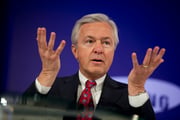
Wells Fargo's wealth- and investment-management business has the potential to earn multiples of what it brings in now, making it the firm's largest growth opportunity, chief executive John Stumpf said.

Wells executive says 'feeding frenzy' taking place over some high-end producers.
