
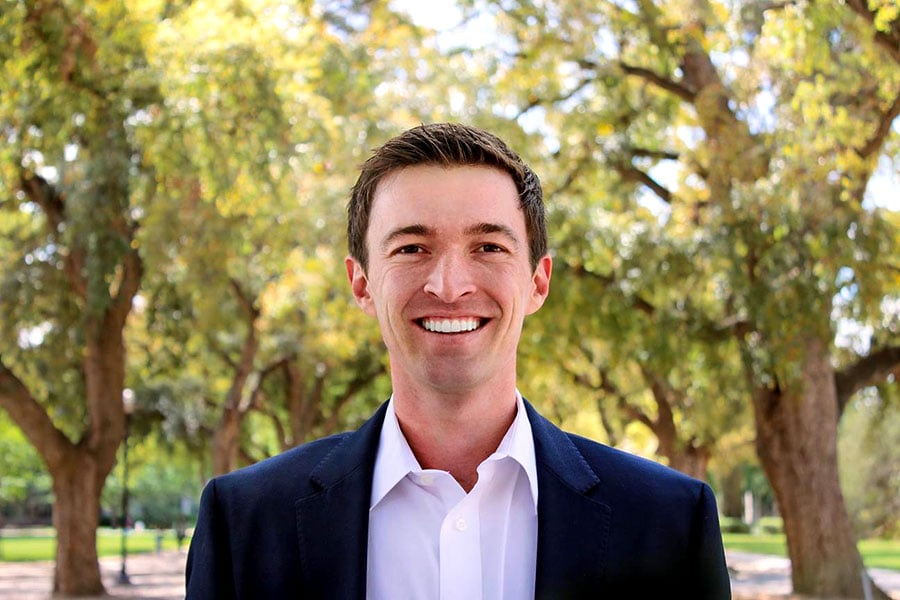
When L.J. Jones was developing a niche for his Pacifica, California-based advisory practice, he focused on where the money is headed, as opposed to where it is.
“It wasn’t really an ah-ha moment, but I knew I wanted to work with young people,” he said. “I want to build a business where I can help people get to the point of being financially independent.”

With that in mind, and with some influence from his wife Jillian’s professional experience, Jones zeroed in on young professionals in general, and more specifically young lawyers.
Jones, 29, has been working in financial services for about six years, most recently at Merrill Lynch, where, he said, “the model wasn’t set up to help young people.”
The challenge is true across most of wealth management, where the popular asset-based pricing formula typically dictates that clients have lots of assets.
At Developing Financial, the San Francisco Bay-area firm Jones launched a year ago, the income-based fee model is a key element of making his niche work.
“Figuring out how to charge was probably harder than finding my niche,” he said. “I knew asset-based fees wouldn’t work, and I knew fees based on net worth wouldn’t work because most lawyers graduate with more debt than assets.”
Thus, considering cash flow management to be among the biggest challenges facing young lawyers, Jones decided to charge a fee equal to 2% of household income, which is capped at $4,000 for households earning more than $200,000.
He said the focus on young lawyers was hatched after watching his wife, a recent law school graduate, and some of her classmates face some financial obstacles unique to the career. Top of the list is an average of $150,000 worth of student loan debt just from law school.
But Jones said there are other issues and circumstances that a lot of lawyers deal with early in their careers.
Going from school or a lower-paying job into the legal profession can mean a significant income boost, which Jones said can be both a blessing and a curse if the cash flow isn’t managed and monitored properly.
“There is a natural tendency to have a lifestyle creep, where they start spending more in accordance with the increased income, and expenses can jump drastically,” he said. “They worked hard to get there, and they should allow the expenses to go up, but it can go up without saving for retirement or building a safety net. Sometimes people are so focused on spending to enjoy today that they’re not focused on saving for the future.”
Jones said he helps clients stay grounded through conversations about career planning and lifestyle balance.
“We’ll talk about whether the goal is to make partner or if they have other goals that might include starting a family,” he said. “What does an ideal career look like and how do we plan for that?”
Another reason Jones stresses the importance of budgeting and financial safety nets is because in the legal profession, “burnout is a big thing.”
“There can be a lot of financial insecurity when leaving a big firm and a big income,” he said. “It’s important to set up a financial safety net so they know if they do get burned out, they can take time to find another job.”

Salespeople at the firm often went beyond the matching algorithm to recommend network advisors on its Zoe Wealth platform, according to the regulator.

The Protect College Sports Act would cap school payments and codify NIL rights, with implications for advisors guiding young athletes.

"I know the number that I want to be able to retire on, and now I just want out," says Wilmington Trust's Marguerite Weese, describing a common refrain among business-owner clients.

Bessemer and Brown Brothers Harriman veteran Robert Ludricks III and private markets specialist Olof Akesson join the ultra-high-net-worth push on the East Coast.

765 investors were promised 260% annual returns on truck leases
As AI makes financial information more accessible than ever, Lana Hock explains why human judgment, trust, and empathy remain the qualities clients value most in a financial advisor
Northern Trust’s Ken Lassner shows advisors how to convert volatility into after-tax portfolio gains

