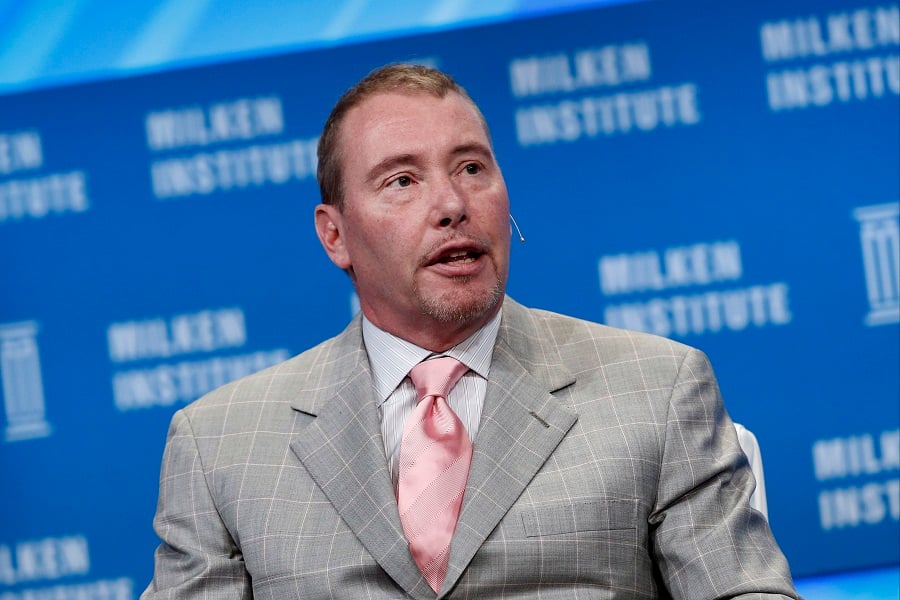
Jeffrey Gundlach is the bond king, for now.
Over the past month, a stretch that saw the upheaval of financial markets around the world, Mr. Gundlach has beaten rivals including Tad Rivelle, Bill Gross, Dan Fuss and the Pimco Total Return Fund team by a wide margin. Mr. Gundlach's $48.2 billion DoubleLine Total Return Bond Fund returned 0.7% in the period; all of these peers except Mr. Rivelle showed losses.
Mr. Gundlach has prospered during the turmoil, as he has for much of the year, by betting that interest rates would stay low and by avoiding minefields such as emerging market currencies and energy bonds. The co-founder of DoubleLine Capital has repeatedly cast doubt on expectations that the
Federal Reserve would raise interest rates this year because of weakness he sees in the U.S. economy.
“A lot of people that were expecting the economy to pick up steam and the Fed to hike rates have had too much risk in their portfolios,” Mr. Gundlach said in an Aug. 24 interview. “We've avoided things that have proved problematic.”
Mr. Rivelle's $68 billion MetWest Total Return Fund gained 0.1% in the past month, according to data compiled by Bloomberg. The $101 billion Pimco Total Return Fund lost 0.5%, putting it in the 11th percentile against peers. Mr. Gross's $1.47 billion Janus Global Unconstrained Bond fund was down 3.2%, and Mr. Fuss's $20.5 billion Loomis Sayles Bond Fund dropped 2%.
PIMCO'S DOLLAR BET
Pimco Total Return has been betting on the U.S. dollar versus the euro, Japanese yen and other currencies. The Bloomberg Dollar Spot Index, which tracks the greenback versus 10 of its most-traded peers, surged 18% in the 12 months through March before losing steam. In the past month, it's declined 0.6%.
The fund has also wagered on longer-duration U.S. government debt, with more than 8% of the fund in Treasuries maturing in 2044 and 2045 as of March 31, according to the firm's website. Yields on the 30-year note have jumped 20 basis points in the past three days, to 2.9%.
Total Return's investment themes take between three months and three years to work out, a view that helps insulate the fund from being “whipsawed by some of the volatility,” Scott Mather, who manages the fund with Mark Kiesel and Mihir Worah, said in an interview. “But some people who focus on very short-term horizon really have a difficult time in periods like this.”
The fund's dedication to Treasury inflation-protected securities, known as TIPS, has hurt its performance in recent months, as “people are super beared up on inflation and basically have deflation priced into markets,” Mr. Mather said. But the managers still believe that inflation is coming and are “more than happy to keep that position and wait,” he said.
“We have a number of contrarian positions that maybe haven't worked over the past week or two, but they've worked well year to date, so we always examine the fundamentals and if the fundamentals have changed then maybe we'll change,” Mr. Mather said.
MR. GROSS'S PUTS
Mr. Gross's strategy of selling volatility, or underwriting the risk of wide price swings, may have hurt his fund's performance. The manager and a Janus spokeswoman didn't immediately respond to requests for an interview.
Mr. Gross has sold put options on U.S. Treasury yields, on the Markit CDX North American Investment Grade Index, on the Standard & Poor's 500 Index, and on Mexican and Brazilian sovereign debt using credit-default swaps. As of June 30, one put option on U.S. Treasuries accounted for almost 7% of the fund.
Each of these positions probably cost him as markets blew through his targets.
Beginning in February, Mr. Gross has used an options strategy known as a strangle, betting on a largely range-bound market in U.S. government bonds, usually wagering at most three months out. He's adjusted the bet's upper and lower bounds as the market has moved, and as of July 8 has targeted within 2.1% and 2.5% for the benchmark 10-year note.
The trade was “basically a form of selling insurance” against volatility, Mr. Gross said in an April 9 interview. “And like any insurance company, you just have to sell it at the right price. If you sell at the wrong price and you have an earthquake or a flood, then you lose money.”
MR. FUSS'S CURRENCY WAGERS
Mr. Fuss has a strong long-term record as a bond manager, helped, in part, by his willingness to own bonds priced in currencies other than the U.S. dollar. This year that strategy has backfired as the Canadian dollar and the New Zealand dollar have lost ground to the U.S. dollar.
Loomis Sayles Bond, which beat 94% of peers over five years, trails 98% this year, according to Bloomberg data.
Mr. Fuss in an e-mail reaffirmed that he is sticking with his currency bets on the assumption that the U.S. dollar will at some point peak and decline.
“When something goes up and up, unless there is a completely new paradigm eventually it stops,” he said in an interview earlier this month.
METWEST'S ALLOCATIONS
MetWest Total Return, which beat 94% of peers over the past five years, had 33% of its assets in mortgage-backed securities as of June 30 and another 26% in U.S. government bonds, according to the TCW Group website.
Mr. Rivelle, in an Aug. 24 interview with Bloomberg Radio, said years of aggressive monetary policy on the part of the Fed had not achieved the desired result.
“We have eased and eased yet growth has disappointed,” he said.
A message to TCW was not immediately returned.
MR. GUNDLACH'S MORTGAGES
Mr. Gundlach, whose firm managed $76 billion as of June 30, said in January he did not expect the yield on the 10-year Treasury bond to top 2.6%. The yield reached its peak for the year June 10 when it hit 2.48%.
The manager extended the duration of DoubleLine Total Return between January and June, according to a firm presentation, which allowed him to benefit from the unexpected decline in rates over the past month. Duration is a measure of a bond's sensitivity to changes in rates.
The fund had more than half of its assets in mortgage securities backed by the U.S. government as of July 31. Those bonds behave much like Treasuries in periods of falling rates and have one advantage, said Mr. Gundlach.
“They're immunized from commodity prices,” he said.
Falling oil prices are a plus for homeowners, he said, because they make it easier for borrowers to pay back their loans.
AVOIDING COMMODITY BONDS
Mr. Gundlach said he has held relatively few commodity and energy bonds. He has avoided emerging market currencies since 2011 on the belief that the U.S. dollar was likely to strengthen.
For Mr. Gundlach, all but one of his firm's eight bond mutual funds are in the top 10% of their categories for the year, a period in which rates have both climbed and dropped.
“We've had an embarrassment of riches,” he said. “That doesn't always happen.”