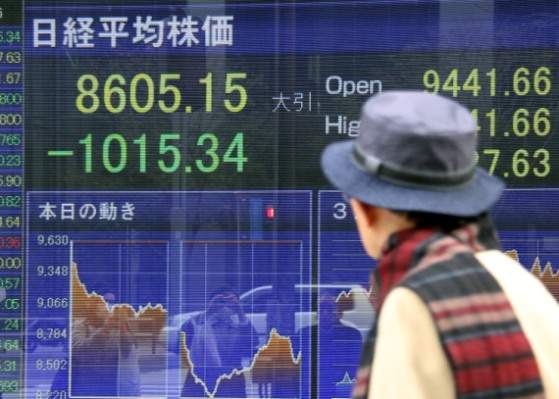
Money managers are divided on whether the tragedy in Japan marks the end of the global bull run — or the start of a new buying opportunity
The tragic, unpredictable events playing out in Japan are leaving money managers and market watchers at odds over whether the financial markets are becoming more attractive or more risky.
“We think after a disaster like this, it's typical for investors to sell first and ask questions later, but we think it's better to sit back and wait, because oftentimes, these pullbacks will present opportunities to buy,” said Qi Lu, senior portfolio manager at Altfest Personal Wealth Management, which has $700 million under advisement.
Mr. Lu added that the Japanese stock market, at about book value, was cheap before the earthquake last week. It has since declined by about 20%, although on Wednesday, the Nikkei 250 rebounded, ending the day up close to 6%.
The S&P 500, by comparison, is trading at two and a half times book value and has declined by 2.2% since the earthquake struck Japan on Friday.
“Compared to the rest of the world, the U.S. market seems to be holding up rather well,” Mr. Lu said. “Right now, there seems to be a rotation into the U.S., but if the sell-off continues, it could present an entry point.”
It's unclear when — or if — investors will boost Japanese stocks back to pre-earthquake levels. Renewed worries Wednesday about radiation leakage at the Fukushima nuclear facility could trigger another sell-off this week. "There is still a very high risk of further radioactive material coming out," Prime Minister Naoto Kan said Tuesday.
Such a scenario very well could have a knock on effect on markets in Asia and elsewhere.
Regardless of where the market impact is most extreme, it still adds up to another flight from risk assets, according to Mohamed El-Erian, chief executive and co-chief investment officer at Pacific Investment Management Co. LLC.
“The across-the-board fall in risk assets is a reflection of both fundamental and technical issues,” he said. “Regarding fundamentals, the markets are pricing in a more subdued outlook for the global growth and supply chains on account of both the tragedies in Japan as well as developments in the Middle East.”
The technical part of the market's reaction, he explained, boils down to the way natural disasters tend to catch investors by surprise.
“The initial market moves have caught some investors with excessive risk on, leading to indiscriminate sales and increasing correlations across both asset classes and geographies,” he said. “Such top-down-driven sell-offs tend to overwhelm long-term fundamentals, and as such, value is created in selected places.”
From an investment perspective, the latest flight from risk, on the heels of the market turmoil that started building with the recent political unrest in Africa and the Middle East, could be just the kind of pullback the stock market has been waiting for.
“For anyone who has been on the fence about staying in or getting out of the market, this is now their excuse to sell,” said Keith Springer, president of Capital Advisory Financial Services, which has $100 million under advisement.
The S&P 500, which has fallen 4.5% from its recent Feb. 18 high, still has some room to decline in the course of a normal and healthy correction, Mr. Springer said.
“I wouldn't want it to fall by 10%, but 5% to 7% wrings the excess out of the market,” he said. “I'm looking at this as probably near the bottom right now, and if I had new cash, I would be putting it to work.”
The immediate impact, particularly in Japan, represents an economic “screeching halt,” said Barry Glassman, president of Glassman Wealth Services LLC, a $450 million advisory firm.
“This is Japan's 9/11,” he said. “Outside of the alternative-energy space, the whole world's markets are down, which means there could be buying opportunities anywhere.”
However, Mr. Glassman added, the initial reaction from the global markets have been counterintuitive.
“Gold has plummeted and the yen has strengthened,” he said. “It's difficult to predict how this kind of natural disaster unfolds, and we're not sure of the ultimate impact on a global scale.”
Like Mr. Lu, Mr. Glassman sees the global markets showing favor to the United States, especially when compared with Japan.
“Even before the earthquake, Japan's economy was a bug looking for a windshield,” Mr. Glassman said. “Their debt-to-GDP ratio and economic-growth prospects were very concerning, and now the debt can only go higher.”
He contrasts that with healthy and cash-rich U.S. corporations that have been participating in an economic recovery.
“It will be interesting to see what the U.S. government does now to try and ease investors' worries,” Mr. Glassman said. “There is slightly less chance now of Congress getting in the way, and if there was any chance of the Fed reducing [the second round of quantitative easing] early, the Japanese disaster certainly lessons those chances.”