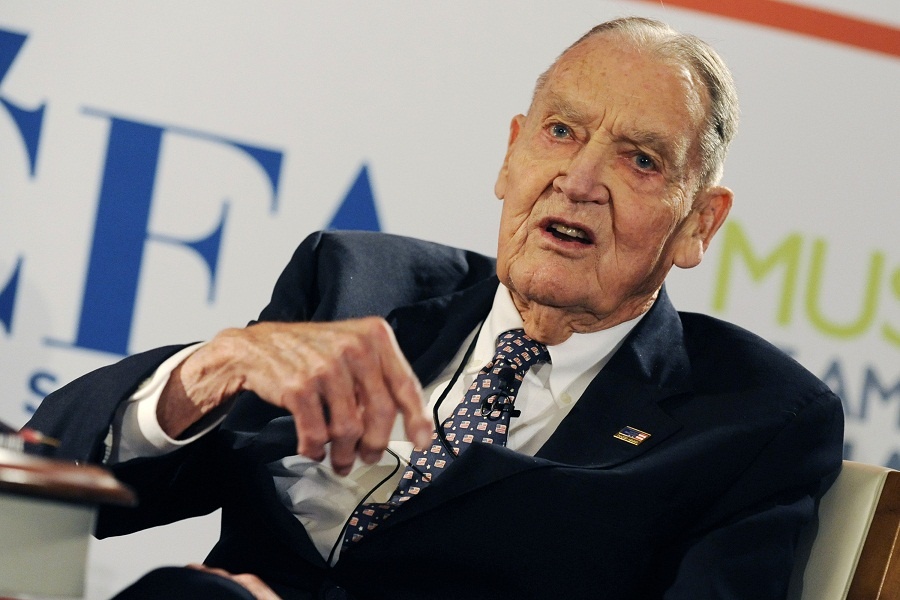
Freezing rain is falling on the sidewalks at Vanguard Group's sprawling suburban campus outside Philadelphia, but it doesn't slow down company founder John C. “Jack” Bogle as he hustles from his office to the cafeteria for lunch.
“This is a walking stick, not a cane,” he jokes, and he waves it in the air for a moment. “Anyone who calls it a cane will get three good whacks.”
They're not the only ones likely to get a good thrashing from Mr. Bogle. Even with the ailments that come from being 85 years old and having had a heart transplant 19 years ago, Mr. Bogle arrives at work every day itching for a fight with anyone who questions the wisdom of the low-cost index funds he has advocated for four decades. His message — he will repeat it as often as necessary — is that trying to beat the market is a fool's game and that fees collected by fund managers who say they know how are a waste of money.
He compares himself to the mythical “man in the arena” evoked by former President Theodore Roosevelt in a famous speech in 1910: the doer of deeds who exhausts himself in a worthy cause and “whose face is marred by dust and sweat and blood.” Which raises a question. Is there no one to enter the arena and take Bogle's place?
A slew of money managers and academics — Robert Arnott of Research Affiliates, for example, and Andrew Lo at AlphaSimplexGroup — say they're building on what Mr. Bogle created. As they offer new categories of passive investment products, Mr. Bogle mostly grumbles. Likewise, as established money management giants such as
BlackRock cut fees on some funds and expand their index offerings, he remains skeptical that they embrace his world view.
On this icy January day, holding court in a cluttered office more reminiscent of a state university than a Wall Street firm, Mr. Bogle says he's still a one-man crusade.
“I don't want to sound too egotistical, but I think it's crystal clear that nobody, nobody, plunges into this battle to build a better industry with any more enthusiasm than I do,” he says. “Certainly nobody within the industry. Everybody thinks: 'Kind of, fat, dumb, and happy. Let's enjoy what we've got.' Because they're making a lot of money.”
Making money for themselves, he means, not for the investing public. Performance by active managers is dismal, especially of late, and investors are fleeing to passively managed index funds, so Mr. Bogle is enjoying something of a told-you-so decade. Only 25% of actively managed equity mutual funds beat their benchmarks last year, the lowest rate since 1995, according to data from Morningstar. For U.S. stock funds, the beat rate was only 21%, the worst on record.
Investors have pulled money from actively managed U.S. equity funds for nine straight years. They withdrew $98 billion last year while putting $167 billion into passively managed U.S. stock mutual funds and ETFs. The trend toward passive management is unlikely to reverse, Mr. Bogle argues. Investment firms that make their money off actively managed funds will milk the cash cow, but their business will wither, he says. Their thinking might go something like this: “'We'll shrink, but we'll take a lot of money out of it on the way down, year after year.' That's what a cash cow is,” Mr. Bogle says. “In 25 or 30 years, they'll be gone. That seems like an extreme statement, but I think it's not without possibility.”
As much as that idea pleases him, other recent trends don't. The proliferation of ETFs — there were 6,618 worldwide as of mid-February, up from several hundred a decade earlier — alarms Mr. Bogle. With so many options, choosing the right ETF becomes almost as prone to error as picking individual stocks, he says. Mr. Bogle rejected the first ETF when it was just an idea being shopped around in the early 1990s by Nathan Most of the American Stock Exchange. Vanguard started offering ETFs only in 2001, after Mr. Bogle had given up the CEO and chairman posts. Mr. Bogle will concede that ETFs haven't ruined the place. But simplicity is his watchword, so he'll never make his peace with an industry that offers investors an ever-expanding collection of ETFs linked to solar power companies or Brazilian stocks or gold or some kind of algorithm. “We've had too much innovation in this business, far too much,” Bogle says. “How many innovations have helped investors?”
CONTRARIAN, STUBBORN
As the conversation turns to ETFs, Mr. Bogle gets up from the couch and starts searching for something, checking the stacks of books and papers piled on his desk, shelves, and floor. “Sorry, but this office always looks like this.” After a minute, he gives up the search, sits back down, and explains that he was looking for an old Wall Street Journal page with listings for hundreds of ETFs. He delivers his punchline without the prop: “Just throw a dart.”
When something displeases Jack Bogle, he'll say so in the most forceful way. He describes himself as an independent thinker, very contrarian, very stubborn, who is looking out for the little guy. (He still answers every Vanguard fund investor who writes to him; handwritten notes get handwritten replies.) The investment management industry needs “more management and less marketing,” he says. It needs “more stewardship and less salesmanship.”
Such complaints would be easier to dismiss if Mr. Bogle were an outsider, but he's not. He started Vanguard four decades ago, and today it oversees more than $3 trillion in 280 funds and is the second-largest money manager in the world, after BlackRock.
“I don't think we'll see his like again,” says Cliff Asness, co-founder of AQR Capital Management. Mr. Asness tries to follow in Mr. Bogle's footsteps by daring to champion contrarian views, even when they might offend some of his financial industry peers.
The rare combination of outsider critic and insider business legend is what makes Mr. Bogle such a tough act to follow. Many people in the investment industry call Mr. Bogle their friend — justifiably, as Mr. Bogle mostly directs his criticisms at ideas and has kind words for individuals. And many want to extend what he's done, but they're unlikely to get his endorsement for their innovations.