

President Donald Trump may consider him a “numbskull,” but Federal Reserve chair Jerome Powell will be taking center stage next week.
And wealth managers will be watching.
The next Federal Reserve meeting kicks off next Tuesday June 17th, and their decision on interest rates will be released the following day at 2pm EST. The federal funds rate target range currently stands at 4.25% to 4.5%.
The Fed has been holding rates steady since December 2024 when it cut rates by 25 basis points - much to the president’s chagrin. Speaking to reporters on Thursday, President Trump used unusually personal language to denounce Mr. Powell’s leadership of the central bank, calling him a “numbskull” for failing to lower borrowing costs.
“We are spending $600 billion a year because of one man who doesn’t see the need to cut rates,” President Trump said, adding that he may have to “force something” without clarifying what he meant by "force." Mr. Powell’s term as chair extends until May 2026.
As to Chairman Powell’s next move, Stash Graham, managing director and chief investment officer at Graham Capital Wealth Management, believes his hands are currently tied. His expectation for next week is for a continued “wait-and-see approach” consistent with recent comments from Fed leadership.
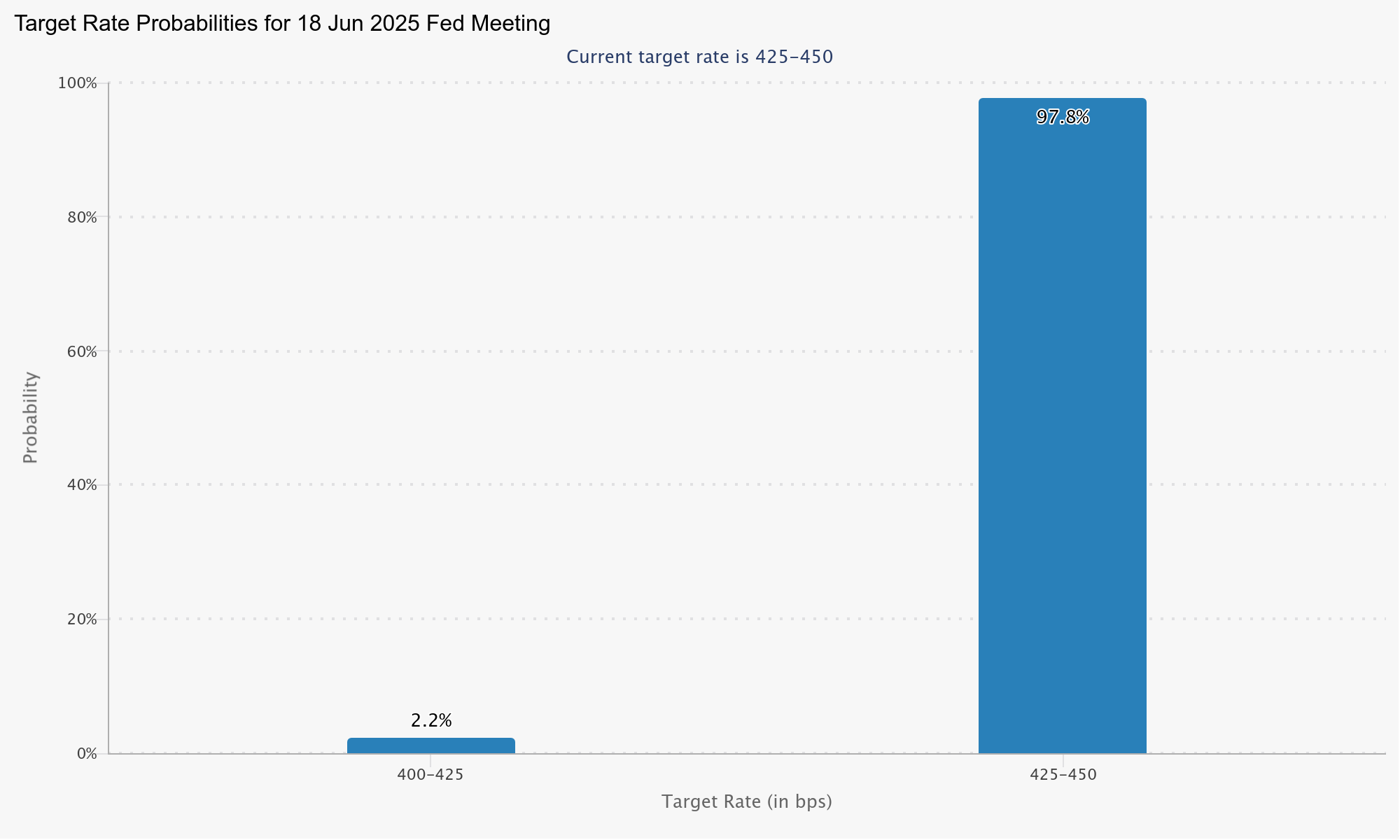
CME FedWatch prediction for June 18th announcement
Based on this outlook, Graham is maintaining a strong preference for short-duration exposure on the fixed income portion of his portfolio.
“Certainly, the development of tariffs has not helped the business community, large or small. Several of our portfolio banks, which have exposure to SBA lending, have informed us that the recent increase in non-accruals is unlikely to subside and will likely continue through the summer months. As a result, credit quality is crucial, as economic uncertainty is expected to persist for the foreseeable future,” Graham said.
Elsewhere, Jim Thorne, chief market strategist at Wellington-Altus Private Wealth, expects the Fed to pause in June, but set up rate cuts for later this summer. In his view, the economy is slowing, but inflation does not pose a threat so he’s telling clients to put cash to work.
“Since Wall Street missed the bottom in April, or are under-invested, I would expect a catchup trade in the back half of the year. Interest rate sensitive names and consumer names should be considered, housing stocks, as a tactical trade into year end,” Thorne said, adding his S&P 500 target for 2025 is 7000, up around 16% from its current level.
In the wake of recent tame CPI and PPI data, as well as marginally weaker jobs numbers, Todd Walsh, CEO of Alpha Cubed Investments also believes the Fed is getting into a position to lower rates. According to Walsh, they will likely wait until the July meeting to ensure any tariff related inflation data “does not well up in the interim.”
As it relates to client portfolios, Walsh is looking for a “murky and more volatile summer” to evolve into a more optimistic autumn.
“The path of least resistance is back to the all-time high for the S&P 500, but then the markets may need to digest the risks above over the summer before moving higher,” Walsh said.
Along similar lines, Chad Rushing, managing director at Steward Partners, believes the Fed will see inflation “staying steady to declining a bit,” and will in turn keep rates unchanged with a bias to cutting a quarter of a point.
“They have been notoriously late to cutting or raising rates and personally believe a cut would be warranted,” Rushing said.
Rushing said he expects some choppy trading this summer, and has positioning clients to buy on the dips on the belief that the Fed will start to cut rates later in the year.
“We also believe the Government will continue to work out some tariff deals that give the market more certainty going forward. The thought is that cash on the sidelines will start moving into the market pushing it higher by year end,” Rushing said.

These challenges are “changing the economics we see retirement savers face,” said Christopher Ceder of Goldman Sachs Asset Management

Richardson firm joins as Kestra builds out its platform with new leadership, technology, and expanded planning tools.

Retiring RIA seller David Laidlaw alleges the Carnegie valued his stake on $11.7 million EBITA while pitching potential buyers on $21.3 million.

New tool gives RIAs and family offices AI help vetting private market deals, with some users reportedly halving review time.

Investors got projected returns dressed up as real ones, SEC says
As AI makes financial information more accessible than ever, Lana Hock explains why human judgment, trust, and empathy remain the qualities clients value most in a financial advisor
Northern Trust’s Ken Lassner shows advisors how to convert volatility into after-tax portfolio gains

