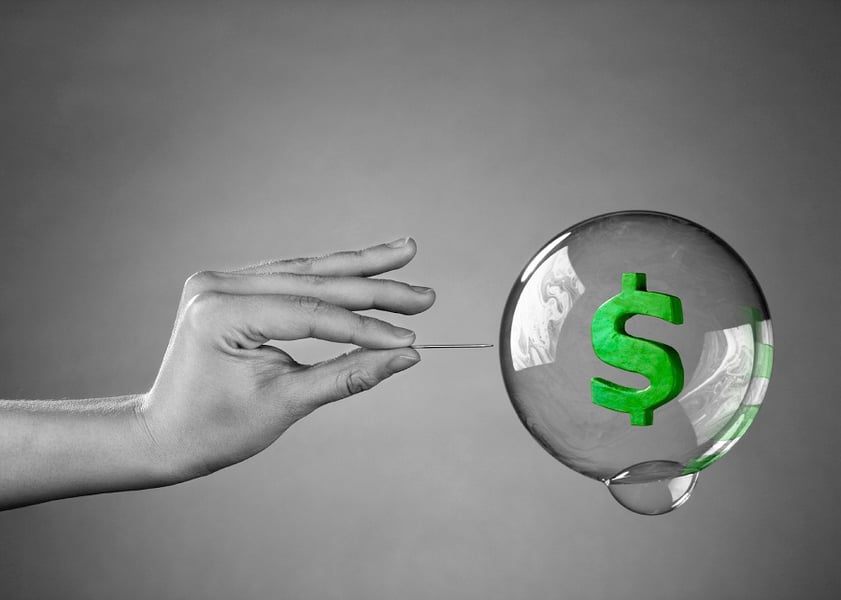
Financial markets suffer from irrationality. In the last 15 years, policy makers such as Alan Greenspan and Nobel Prize winners such as Robert Shiller and Paul Samuelson have noted “irrational exuberance” and “macro inefficiencies” as drivers of booms and busts. One need look no further than the recent Chinese equity market bubble for a reminder.
All this stems from the simple fact that financial markets are the creation of – and subject to the behavior of – human beings. They reflect the full range of our dreams, aspirations, greed, biases and fears, many of which drive us as a whole to irrational behavior.
This is not to say rational factors have no place. I am a senior investment professional at a quantitatively oriented investment shop, and I cannot imagine a world in which we cannot try to take advantage of market inefficiencies and also address their risks. History shows that irrational behavior in markets has existed for centuries. To deliver for investors, I believe it is as necessary to study the impact of human behavior as it is to dive deep into the numbers to find value.
An example of market inefficiency is the herding of investors that causes the formation of bubbles. We like to say that history does not repeat itself in financial markets – but it does rhyme. Bubbles are easier seen in hindsight, but all are characterized by excessive differences between price and value; resistance to corrections; mania and herding behavior; and painful crashes.
(Related insight: What the ETF industry is doing to prevent wild trading swings)
Evidence suggests bubbles have become more common. Several main factors contribute:
More money: Ever larger pools of money are looking for returns – sovereign wealth funds, high-net-worth individuals, insurance companies, pension plans and others. These huge pools of capital are easy to move. When they move together, they can have outsized impacts. This can cause some parts of the market to become overvalued and overlooked parts to become undervalued as everyone chases the next new winner.
More information: Huge amounts of data are available on a fingertip basis, in real time, concerning virtually every market on the planet. More investors can learn about the next hot idea or theme (while not without risk), and chase it.
More hype: The media loves to see fortunes rise and fall, and the more extreme the better. Describing steady climbs gets no one on TV; screaming to pour gasoline on the fire of the latest fad does. News organizations' fierce competition to be first, across traditional and new media, has led to a steady flow of breaking news and updates – often without critical analysis to understand the full scope of what might happen, and why.
Investors who catch the bubble, ride the wave and jump off before the inevitable crash can do quite well. It is my experience that almost no one acts dispassionately enough to do this.
When investors see markets heading down, they often hold on too long, believing they are right. Next they become overly pessimistic, resulting in a habit of panicking and selling at the worst times.
This all too human behavior can make fortunes for market professionals who have the wherewithal to act rationally, truly diversifying and adapting to changing market conditions. Their more systematic approaches have the potential to help weather the storms that sink others.
Another inefficiency that has been gaining notice is the outperformance over time of lower-volatility stocks. According to market theory, risk is tied to reward. However, both practitioners and academics have noted that lower-volatility stocks often have defied theory by achieving higher returns with less risk. Once again, human behavior illuminates this effect.
Many investors love winners and growth, becoming overly optimistic about volatile growth stocks, but gambling on growth historically has not paid off. To build wealth, it is important not to lose money. Investors should pursue cumulative returns: incremental gains, even small ones, can produce significant growth. Losses are just as possible as gains, but managing risk is the key.
(Related ETF read: Want high-yield exposure? Forget ETFs)
The tortoise beats the hare: Slow and steady frequently wins the race over time.
So how can advisers help investors capture these opportunities while addressing their risks? ETFs can help, specifically those not tied to market-cap indexes.
ETFs that focus on specific sectors, industries or countries can help mitigate the impact of bubbles when they burst, largely by avoiding market concentration risk (their exposure to which many holders of market-cap-weighted ETFs are only now fully realizing).
Low-volatility and high-
dividend-seeking ETFs also follow strategies intended to better manage risk and take advantage of human behavior, which can cause investors to overlook these types of stocks.
Many investors think of ETFs only as indexed vehicles, but there are many defensive and diversification options that limit specific risks and address behavioral inefficiencies. They may not capture a bubble's full growth, but when the bubble bursts, they can help mitigate the full pain of the inevitable crash.
We believe advisers can serve their clients by emphasizing defense and true diversification in their ETF choices.
James Norman is president of QS Investors, a Legg Mason affiliate.