
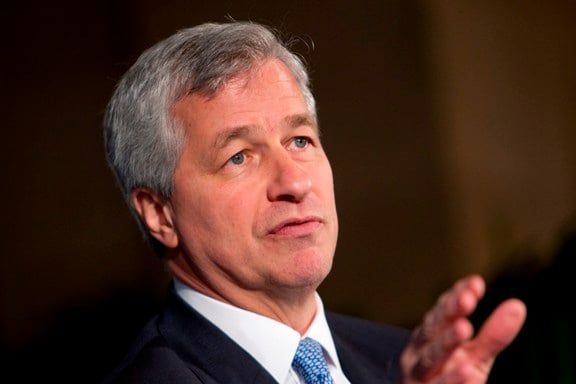
JPMorgan Chase CEO Jamie Dimon used his annual shareholder letter Monday to single out three compounding risks – private credit deterioration, war-driven inflation, and the uncharted disruption of artificial intelligence – that he argues markets are underestimating heading into the second half of 2026.
The sprawling, 48-page letter arrives as the S&P 500 closes its worst quarter since 2022, when the sharp inflation spike from the Russia-Ukraine conflict led to losses in both equity and bond markets.
Despite the unsettling landscape so far this year, the US economy continues to be resilient, with consumers still earning and spending and businesses still healthy. Still, Dimon was blunt about the forces that could unwind that picture quickly.
Because of the war in Iran, the US faces the potential for significant ongoing oil and commodity price shocks, along with the reshaping of global supply chains, which may lead to stickier inflation and ultimately higher interest rates than markets currently expect.
Dimon invoked the recessions of 1974 and 1982 as historical precedents, both driven in part by surging oil prices and runaway inflation. He called gradually rising inflation and interest rates "the skunk at the party" that could cause stocks to fall this year.
Trade battles are "clearly not over," he wrote, and "it is hard to figure out what the long-term effects will be."
Some of Dimon's most pointed warnings were reserved for leveraged lending. As he sees it, losses in private credit and other forms of leveraged lending will be higher than expected due to weakening credit standards, with actual losses already "a little higher than they should be, relative to the environment."
The structural problem runs deeper than credit quality alone. Private credit "does not tend to have great transparency or rigorous valuation 'marks' of their loans – this increases the chance that people will sell if they think the environment will get worse – even if actual realized losses barely change."
"Not everyone providing credit is necessarily good at it," Dimon wrote, noting further that "we have not had a credit recession in a long time, and it seems that some people assume it will never happen."
The stress is already visible. A growing string of private fund giants including Apollo, BlackRock, and Morgan Stanley have recently imposed redemption limits on certain funds as investors rush to exit, while Blue Owl Capital reported a record number of redemptions in two of its funds. Investors have become increasingly anxious about what rapid advancements in artificial intelligence might do to these companies' significant loan portfolios to software providers.
On the regulatory front, Dimon warned that "at some point insurance regulators will insist on more rigorous ratings or markdowns, which will likely lead to demands for more capital."
Insurance watchdogs may already be facing pressure to look harder at private credit, as a recent report by Reuters suggests the US Treasury Department under Secretary Scott Bessent will be meeting with domestic and international regulators about the rising use of fundlevel leverage, the consistency of private credit ratings, and liquidity of investments in the asset class, among other concerns.
On AI, Dimon wrote that "investment in AI is not a speculative bubble; rather, it will deliver significant benefits." JPMorgan is among those on the front lines of the AI opportunity, having placed early bets on the technology as far back as 2024.
But he was equally clear that certainty ends there, conceding that "we cannot predict the ultimate winners and losers in AI-related industries." He acknowledged that AI will bring unpredictable "second and third-order effects" – the way agriculture enabled cities, cars brought about suburbs, and the internet ushered in social media.
On labor, AI "will definitely eliminate some jobs, while it enhances others," with the risk that adoption moves faster than the workforce can absorb.
Taken in aggregate, Dimon's letter serves as another call for cautious diversification, encouraging clients holding private credit to revisit liquidity assumptions and understand how valuations are marked. On the macro side, advisors would also do well to stress-test fixed-income and equity allocations against a scenario in which inflation re-accelerates and rate cuts are pushed further out than the market currently prices.
While Dimon is not calling a recession, he warned "sentiment and confidence can change rapidly and drive the markets," and that bearish expectations can create a self-fulfilling prophecy of gloom.
"[F]alling asset prices at one point can change sentiment rapidly and cause a flight to cash," he said.

Salespeople at the firm often went beyond the matching algorithm to recommend network advisors on its Zoe Wealth platform, according to the regulator.

The Protect College Sports Act would cap school payments and codify NIL rights, with implications for advisors guiding young athletes.

"I know the number that I want to be able to retire on, and now I just want out," says Wilmington Trust's Marguerite Weese, describing a common refrain among business-owner clients.

Bessemer and Brown Brothers Harriman veteran Robert Ludricks III and private markets specialist Olof Akesson join the ultra-high-net-worth push on the East Coast.

765 investors were promised 260% annual returns on truck leases
As AI makes financial information more accessible than ever, Lana Hock explains why human judgment, trust, and empathy remain the qualities clients value most in a financial advisor
Northern Trust’s Ken Lassner shows advisors how to convert volatility into after-tax portfolio gains

