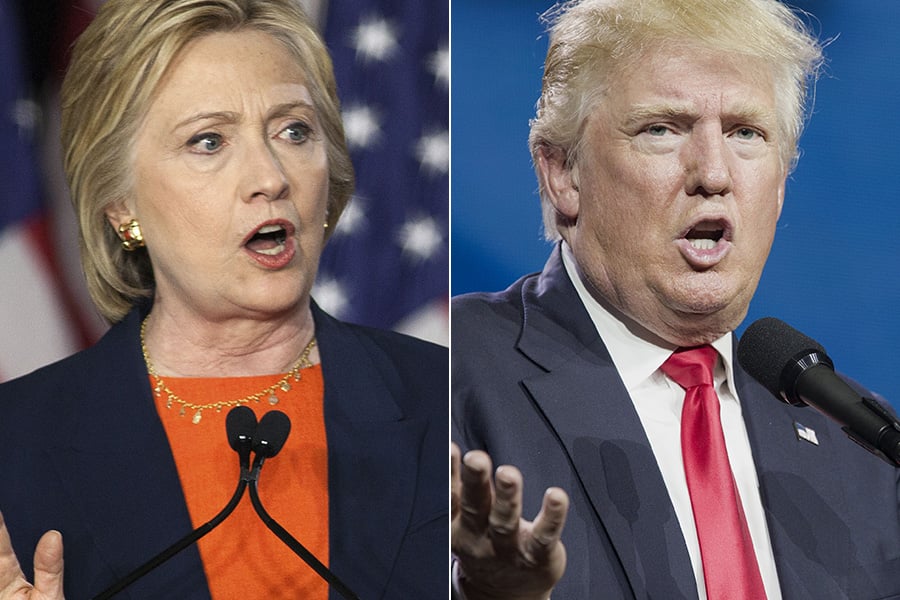
The 2016 presidential campaign is anything but ordinary, which is a big part of the reason financial advisers should not be banking on ordinary election-year stock market results.
“I don't think the market is moving with any precision towards any direction in the election,” said Liz Ann Sonders, chief investment strategist at Charles Schwab & Co.
“But I do think the election will be a volatility factor,” she added, noting that the stock market often performs better leading into elections where the margin of victory is higher.
Historically, according to Stock Trader's Almanac, the equity markets often rally during the second half of a presidential-election year.
Of the 16 presidential elections since 1950, the S&P 500 Index produced gains over the final seven months of the election year on 14 occasions.
The exceptions included the contested 2000 election, which didn't produce a winner for 36 days after the vote, and 2008 during a major financial crisis.
The S&P is up more than 8% so far this year, but It's too early to say whether the market has a late rally in it, and any such forecast would also be hampered by another historic pattern of the annual
September-October market lull.
But this year, with
two controversial candidates in Democrat Hillary Clinton and Republican Donald Trump, the caution running through the financial markets is heavily influenced by the unknown.
“I'm a little surprised the stock market hasn't pulled back some with the recent polls showing the candidates are getting close to even,” said Crit Thomas, global market strategist at Touchstone Investments.
Until recently, many of the polls showed Mr. Trump lagging behind Ms. Clinton. But as
new controversies surround Mrs. Clinton, the gap has been narrowing.
The idea of a celebrity and political novice like Mr. Trump potentially overtaking a seasoned politician like Ms. Clinton has the financial markets on edge.
“My inclination is that as it becomes more clear that Trump will win, the markets should pull back because he represents uncertainty,” Mr. Thomas said. “We might have to wait for the first debate for the market to start paying attention, but if Trump starts to move ahead in the polls we could get a correction.”
According to Stock Trader's Almanac, election-year corrections of 10% or more are rare. With the exception of the 33.8% drop by the Dow Jones Industrial Average during the financial crisis of 2008, the index last corrected during an election year in 1940 when it lost 12.7%. The Dow also had full-year declines of 6.2% in 2000, and 9.3% in 1960.
“The polls are getting more even, but it's still more likely that Ms. Clinton will win, and that's better for the markets because it's all about the devil you know versus the devil you don't know,” said Jeffrey Hirsh, the Almanac's editor.
“People are already positioned for continuation of Obama, and it's pretty clear Clinton is going to be a continuation of Obama,” Mr. Hirsch added.
Kashif Ahmed, president of American Private Wealth, believes the markets, including individual investors and corporations that could be putting capital to work, are waiting to see what happens with the election.
“Everything is different this year, and the candidates from both major parties have unenviable disapproval ratings,” he said. “The electorate is dismayed because they have to choose between two people they don't really like.”
Rose Swanger, principal at Advise Financial, has a similar perspective.
“Wherever you go, the general feedback is, 'Is this the best we've got for this election?'” she said. “From my perspective, a lot of people seem undecided, and the lack of love for either candidate has many voters not hedging in either direction of buying or selling in their portfolios.”
In there was such a hedge to be made, it might make more sense after the election, according to Stock Trader's Almanac.
Since 1901, the party in power has retained the White House 17 times, which led to a five-month average rally by the Dow of 1.5%. That compares to an average five-month decline of 4.6% following those 11 times that the sitting party did not retain the White House.
Regardless of how many ways the data is sliced, it still boils down to an unprecedented presidential election, and the financial markets are not ready to risk being caught off guard.
“Investors are terrified of Trump, because nobody knows what to make of the guy,” said Bob Rice, chief investment strategist at Tangent Capital.
“He is so unpredictable, and the markets do not like uncertainty,” Mr. Rice added. “I know plenty of individuals who work on Wall Street and support Trump, but it's still not in the institution's best interests. We've seen the Clinton movie before and at least we know what to expect from her.”