
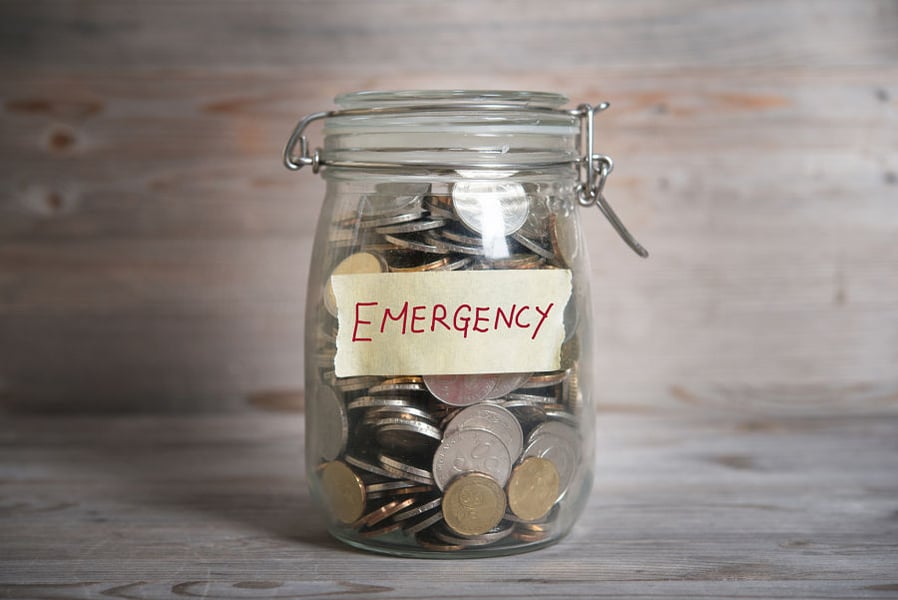
Even with yields unable to keep pace with inflation, most financial advisers are holding firm in support of liquid, emergency cash allocations.
“The most important characteristic of holding cash is not return but safety and stability,” said Christopher Lyman, financial planner at Allied Financial Advisors.
“Cash is for if things go sideways and you need to pay for something without putting it on the credit card or selling assets that have currently taken a loss, or as a means of taking advantage of buying at a deep discount when a market correction or crash occurs and everyone else is scared,” he added. “With that being said, stability and liquidity are more important for your cash reserves than return, so I still recommend a money market mutual fund.”
According to Bankrate.com, the highest-yielding money market funds and bank savings accounts are barely paying 50 basis points and you must go out at least five years to get more than 1% return from a certificate of deposit.
Compared to an inflation rate cresting at 2% and climbing, it is simple math that idle cash is quickly losing value.
But when it comes to prudent financial planning, advisers are generally siding with the comfort of at least six-months’ worth of liquid emergency cash over the kind of returns found elsewhere.
“We absolutely recommend a cash reserve, even though current rates are paltry and in no way will keep up with inflation,” said Dennis Nolte, vice president at Seacoast Investment Services. “It’s an emergency fund, not an equity portfolio geared to beat inflation and taxes. We recommend it is housed in a bank or credit Union.”
Kristin Sullivan, owner of Sullivan Financial Planning, also embraces the cautious approach saying, “if you truly need the stability of cash as an emergency fund or for expenses coming up in the next 12 to 18 months, you need to let go of beating inflation as a goal.”
“Instead, calculate the smallest amount that needs to be in that cash fund and just resign yourself to no returns,” she added. “It's the price you pay for safety.”
Emergency cash is not a new idea in financial planning, but it became a fresh priority in 2020 with the growing uncertainty surrounding the global pandemic. But as Federal Reserve policy keeps interest rates lower longer and as the federal government continues stimulating the financial markets and asset prices, the gap between returns on cash and the rate of inflation will continue to expand.
Shane Morrow, managing partner at IronBridge Wealth Counsel, says his firm is holding cash in a blend of money market funds and target maturity ETFs that have specific liability dates.
“Inflation is a challenge and short-term reserves may lose some of their purchasing power, however, we need to balance that with the psychological and liquidity needs,” he said.
Glenn Downing, principal and investment adviser representative at CameronDowning, keeps client cash reserves in bank savings accounts because he ranks liquidity as a top priority.
“When the emergency does come around, the client can do a simple electronic transfer of funds to the checking account,” he said. “Emergency funds are about mitigating risk. Investing those funds into market securities adds an additional element of risk to the equation, defeating the purpose.”
Jon Ulin, managing principal of Ulin & Co., is advising clients to keep at least 4- to 12-months’ worth of cash reserves in liquid, low-risk accounts.
“We are recommending for clients holding larger sums of secondary cash reserves over $100,000 to employ a conservative 20%/80%, liquid, low-cost managed portfolio weighted in short term, floating and TIPS weighted municipal and some taxable bond ETFs and fund positions for total return,” he said. “These portfolios can potentially return near 4% a year and help to at least keep up with inflation and minimize taxes.”
But inflation is not yet a concern for Tara Unverzagt, founder of South Bay Financial Partners.
“I'm willing to pay the cost of inflation in order to have liquid access to a known amount of money,” she said. “If you invest it even in a short-term bond fund, the price can go down by more than the interest you earn in a given year. If inflation gets up above 5%, I might see it differently but then the world will also be different if or when that happens. I can only address what I know today.”

Salespeople at the firm often went beyond the matching algorithm to recommend network advisors on its Zoe Wealth platform, according to the regulator.

The Protect College Sports Act would cap school payments and codify NIL rights, with implications for advisors guiding young athletes.

"I know the number that I want to be able to retire on, and now I just want out," says Wilmington Trust's Marguerite Weese, describing a common refrain among business-owner clients.

Bessemer and Brown Brothers Harriman veteran Robert Ludricks III and private markets specialist Olof Akesson join the ultra-high-net-worth push on the East Coast.

765 investors were promised 260% annual returns on truck leases
As AI makes financial information more accessible than ever, Lana Hock explains why human judgment, trust, and empathy remain the qualities clients value most in a financial advisor
Northern Trust’s Ken Lassner shows advisors how to convert volatility into after-tax portfolio gains

