
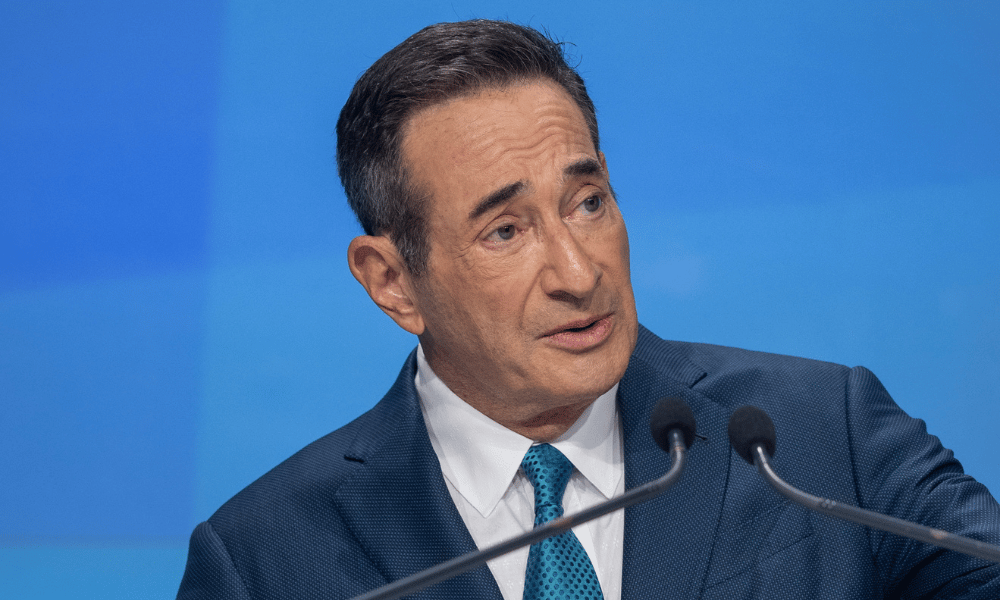
The CEO and chief investment officer of ERShares, is not running a typical playbook ahead of the SpaceX IPO on June 12.
While competitors scramble to capture flows from investors eager to gain exposure to the most anticipated public offering in years, Joel Shulman says it's doing something almost unheard of in the exchange-traded fund industry: turning money away.
This week, ERShares halted new creation unit issuance for its Private-Public Crossover ETF (Nasdaq: XOVR) and imposed a redemption fee of up to 2% beginning on the day of the IPO.
The firm has already rejected hundreds of millions of dollars in the leadup to the offering, according to Shulman, and could have raised considerably more.
"We've already turned down $400 million just in the last day or so alone," Shulman said in an interview with InvestmentNews. "We could have easily another billion or two if we wanted before Friday if we were really trying to promote our 13% [position in SpaceX]."
Shulman believes his firm may be among the first ETF managers to systematically reject inflows, a decision rooted in fiduciary duty rather than contrarianism.
XOVR holds more than $300 million in SpaceX exposure – its largest private holding – accumulated over time via a special purpose vehicle. That position has already appreciated by approximately $50 million in unrealized gains ahead of the IPO
Shulman's concern is that as new money floods into XOVR immediately before the offering, it dilutes the percentage exposure existing shareholders have built up, reducing the benefit they were intended to receive from the firm's long-term conviction play.
"Then they don't get the return that they were hoping to get. So they're disappointed. And we're disappointed for them," he said.
The 2% redemption fee is designed to discourage investors who might enter the fund to capture gains on IPO day and take profits right away. Shulman pointed to other cases of fund managers absorbing massive amounts of such "hot money" around high-profile IPOs – in some cases billions of dollars overnight – only for that capital to disappear just as quickly.
In January, when the fund's SpaceX position was much smaller, Shulman said the firm faced a similar situation as $1.4 billion arrived from five to ten large block trades over five days. The fund turned it away, effectively giving up roughly $1 million per month in management fees.
ERShares' approach to SpaceX reflects a broader investment framework the firm has applied for more than two decades. The firm's Entrepreneur 30 Total Return Index, which underpins XOVR, uses what Shulman describes as a "VC lens" – 18 attributes developed partly during his time doing research at Harvard – to identify founder-led public companies with the characteristics venture capitalists look for before a company gets mainstream recognition.
The firm purchased Nvidia in 2005 at approximately $5 per share and has held it for 21 years. It also picked up Alphabet, nee Google; Tesla; and Meta, formerly Facebook, at or near their respective IPOs.
SpaceX, Shulman argues, fits that same mold – and then some.
"It's not just one growth engine, it's a three-engine empire. You've got space, you have telecom with Starlink, which is a cash cow, and then you have the optionality of putting data centers in space."
Holding up the firm's thesis is its assessment of Elon Musk as a founder-CEO. Shulman noted that Musk's net worth already exceeds the combined net worth of Sergey Brin of Google, Jeff Bezos of Amazon, Mark Zuckerberg of Meta, and Jensen Huang of Nvidia – even before the SpaceX offering.
"When an entrepreneur – forget arguably the greatest in the history of the planet – goes up against a bureaucrat like the telecoms, which are arguably the most bureaucratic companies on the planet, it's game over," Shulman said. "We want Elon Musk to be working hard on our behalf against these telecom companies. He's leapfrogged them."
Among the terms of SpaceX's historic IPO filing is an offering that would create a two-class share structure placing Musk lightyears above all other shareholders. Class A shares, which will be sold to the public, carry one vote each. Class B shares carry ten votes apiece. Musk, who serves simultaneously as founder, chief executive, chief technology officer and chairman, would retain the ability to control the outcome of essentially all matters requiring shareholder approval.
That structure prompted a reaction from Democratic Senator Elizabeth Warren, who has called on the SEC to put the brakes on the debut given the "uniquely unchecked" power Musk would end up enjoying in the company.
Shulman is certainly bullish for SpaceX's IPO. He sees the firm potentially opening 10% to 20% above its $135 IPO price and ending its first trading day up more than 25%, reaching $165 to $170. Within the first week, he would not be shocked to see the stock approach $200, implying a market capitalization above $2 trillion.
While Shulman doesn't have insider knowledge, one anonymous source told Reuters the SpaceX IPO has already drawn more than $250 billion of investor demand, eclipsing the $75 billion raise the company is hoping for.
There's also the index buying pressure set to come immediately following the debut listing. The Nasdaq 100 and the Russell 1000 are both expected to add SpaceX as a constituent within two weeks of the listing. The Nasdaq 100 alone has between $500 billion and $1 trillion tracking it, and SpaceX is expected to carry a roughly 6% weight based on its market capitalization relative to Tesla's current 5% weight. That translates to an estimated $25 billion to $35 billion in forced buying pressure against a float of approximately $75 billion to $78 billion.
Read more: SpaceX's index fund debut will look nothing like what most investors expect, says Jacob Friedman
And while the S&P 500 formally rejected SpaceX's bid for early inclusion, Shulman does not expect S&P-benchmarked managers to ignore the stock entirely. With approximately half of the $15 trillion to $20 trillion tracking the S&P sitting in active or semi-active strategies, he believes some managers will find ways to add exposure regardless.
"The indices provide a floor," Shulman said. "Some people take their quick profits, but then the steady money, the long-term money from the indices comes pouring in. That will keep it going for a while."

The proposed changes around retail communications and certain representations of projected performance or targeted returns have tangible implications for B-D firms' compliance policies and procedures.

The independent wealth firm's latest move in Massachusetts a dedicated non-advisory platform for ultra-wealthy families as RIA family office spinoffs keep multiplying.

Savant Wealth Management's tax subsidiary is taking a new name and two new partners as the RIA continues layering accounting services onto its wealth platform.

“Investment from Envestnet will accelerate roadmaps at Vestmark,” said Freedom Dumlao of Vestmark.

Broker-dealers and RIAs can now offer clients crypto and tokenized securities through a single integrated platform.
Northern Trust’s Ken Lassner shows advisors how to convert volatility into after-tax portfolio gains
Dan Biagini of American Equity says the steady decline of pensions, longer lifespans and a reset in interest rates are rewriting how advisors build retirement income

