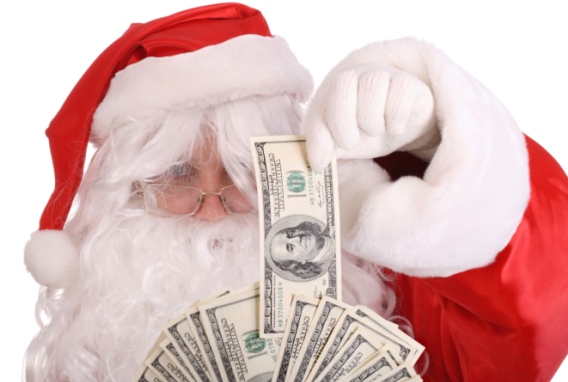
History is on the side of a Santa Claus rally by the stock market at the end of the year, but the bigger issue is what it means for stocks next year if that year-end rally doesn't pan out.
Over the past 41 years, a measurement of the last five trading days of December, combined with the first two trading days of January, has produced an average return of 1.6%, with just 10 of those concentrated periods in the red.
The most recent period through the first few days of January, for example, the “Santa rally” produced a 1.1% gain, which is not great but apparently enough to keep the bears in hibernation, as it does appear that the S&P 500 will eke out a positive gain for 2011.
Contrast that with the most recent negative Santa run — a 2.5% decline to kick off 2008 — and you have 2008 finishing the year with a 38.5% decline for the worst one-year decline ever by the S&P 500.
Ditto for the last few days of 1999 and first few days of 2000, during which the S&P 500 fell by 4% for the biggest Santa Claus pullback in the more than 40 years that the Stock Trader's Almanac has been tracking the data.
What followed was the implosion of the tech bubble and a 10% decline by the S&P 500 for 2000, which was extended to become a 13% drop in 2001, exacerbated by the Sept. 11 terrorist attacks.
On the flip side, there is the 7.4% Santa rally that rolled into 2009, a year in which the index gained 26.5%.
Another example of the momentum at work was 1998, which started out with a 4% Santa rally after which the S&P 500 finished the year up 26%.
The reason the rally usually appears can be attributed to a number of factors, according to Jeffrey Hirsch, editor-in-chief of the almanac.
“It's a time of year when tax loss selling abates and a lot of individual investors are out of the game because they're busy doing other things related to the holiday season,” he said. “So you're left with the professionals in the market, and if they're not feeling positive, it's reflected in the markets.”
Mr. Hirsch admits that a 1.6% rally is not overly impressive, particularly at a time when markets are so volatile.
“But when that rally does not appear, there is a potential for a
bear market,” he said. “It means the overarching forces are so negative that nobody is buying at a time that is usually bullish for equities.”