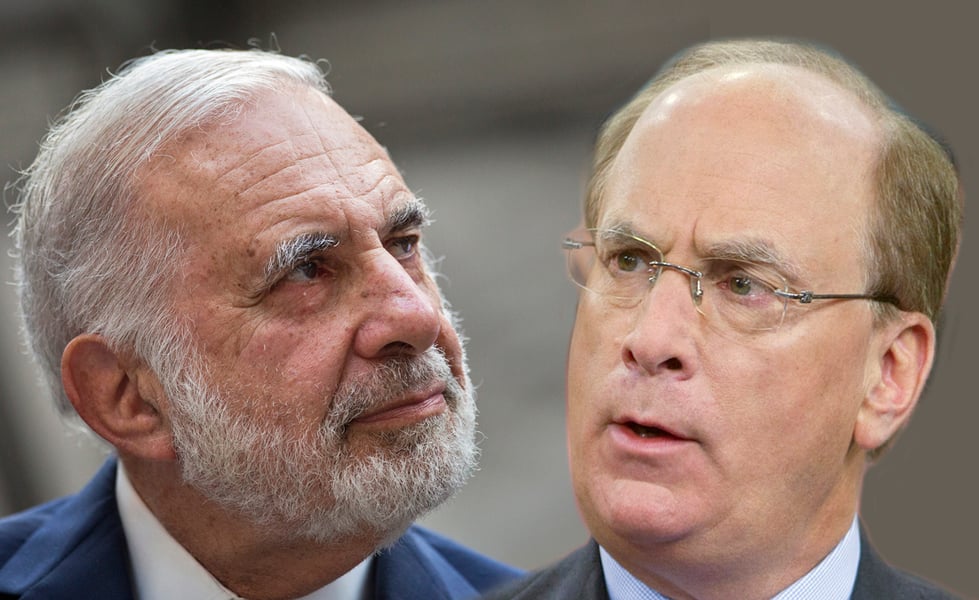
Activist investor Carl Icahn's public rant against high-yield bond ETFs at an investment conference Wednesday has drawn a lot of attention, but mostly for its shock value, according to analysts and market watchers.
On Mr. Icahn's charge that exchange-traded funds are bad for the bond market, Todd Rosenbluth, director of mutual fund and ETF research at S&P Capital IQ, said the opposite is probably more accurate.
“ETFs add liquidity to the marketplace, they don't take it away, especially bond ETFs because they take securities that don't trade as often and add liquidity to them,” he said. “At the same time, bond ETFs make up less than 1% of the global bond market, so I just don't agree with the idea that bond ETFs are going to cause havoc in the bond market.”
A large part of what made
Mr. Icahn's comments so sensational is that he was sharing the stage with
BlackRock Inc. chief executive Laurence Fink.
(More: Sage or simpleton? 8 pears of investment advice from Carl Icahn)
As part of his general criticism of bond ETFs, Mr. Icahn chided Mr. Fink by declaring that, “I think BlackRock is a very dangerous company.”
Mr. Icahn's core premise was the bond ETF space is a ticking time bomb that could go off when rates start to rise and investors start selling to avoid the pain of falling bond prices.
Christian Magoon, chief executive of YieldShares, has a different take on liquidity in the bond market.
“The ETFs are more actively traded than the underlying, and they give the underlying market liquidity,” he said.
While Mr. Icahn worries about the liquidity in the bond market as bond ETF and mutual fund investors potentially rush to the exits, Mr. Magoon believes the market will work itself out, and he cites the recent example of the Greek stock market.
“The Greek stock market was closed due to the crisis there, but the Greek ETF (FTSE Greece 20) kept trading here in the U.S. and you could see that the price was actually more accurate than what the market was worth on the last Greek market trade before it closed,” he said. “More trading and activity is a better indication of what the pricing is for those underlying bonds in the bond ETFs.”
Mr. Icahn's longtime reputation as a vocal activist investor has some interpreting his comments as fuel to generate news on which he can invest.
“Carl Icahn can say anything he wants and he will get the news he wants,” said Gershon Distenfeld, direct of high-yield debt at
AllianceBernstein.
“His agenda is that he needs high-yield bonds to go down, so he's looking for a story about that,” Mr. Distenfeld added. “I actually think ETFs have been good for the marketplace; I just think
they're a terrible deal for investors because they have to trade a lot and that bleeds the value of them.”
Mr. Distenfeld also disputes the notion that ETFs have hurt or are hurting liquidity in the underlying bond market.
But the liquidity debate remains open, mostly because it has
never been tested in such an unprecedented interest rate environment on a market the size of the current ETF and mutual space.
“I agree with Icahn, fundamentally, and so does, [
Federal Reserve Chairwoman] Janet Yellen and so does the Treasury,” said Bob Rice, chief investment strategist at Tangent Capital.
“Right now, the liquidity in the bond market is disguised by all the money that has been coming in, but the vast majority of the underlying bonds don't even trade daily,” he added. “Let's assume the Fed raises rates, and investors see some losses and want to redeem their ETF shares, you've got a real chance for real volatility in the bond market.”