
As money has poured out of actively managed mutual funds industrywide for most of the past decade, investors have gravitated to another category that until recently was on the fringes: active ETFs.
For eight of the past 10 years, investors pulled money from active mutual funds, which have seen an average annual growth rate of -2 percent during that time, data from Morningstar show. As people have favored the lower-cost passive funds, there was a total of $1.6 trillion in net redemptions from active mutual funds across 2022 and 2023, showing that “the decline of active mutual funds is picking up steam.”
That happened as many active funds failed to show their value relative to passive peers. But the flight from active mutual funds has not only been a boon for passive, as many who believe in active management have found promise in ETFs, which often have the benefits of tax efficiency and lower fees.
Since 2019 – when the SEC’s ETF rule greatly simplified the product registration process and gave new flexibility to active managers – the number of active ETFs on the market has increased threefold, with well over 1,000 products, according to a report published last week by Morningstar.
Assets have followed, at least for a handful of ETF providers, reaching a total of $530 billion as of the end of 2023, up from less than $300 billion in 2021 and less than $75 billion in 2018, the report showed. That’s still a small slice of the overall active fund market, with mutual funds coming in at about $13 trillion, despite the category’s persistent outflows. Currently, active ETFs represent just 8.5 percent of the total ETF market in the US, Morningstar reported.
Amid the trend, asset managers have either launched new active ETFs or made copies of existing mutual funds and transferred assets to them. At least seven firms are also waiting for approval from the Securities and Exchange Commission to launch ETF share classes of exiting funds, according to Morningstar. The only firm in the business that is currently allowed to have an ETF share class, Vanguard, had a patent on that strategy that expired last year, and it only allows share classes for passive funds.
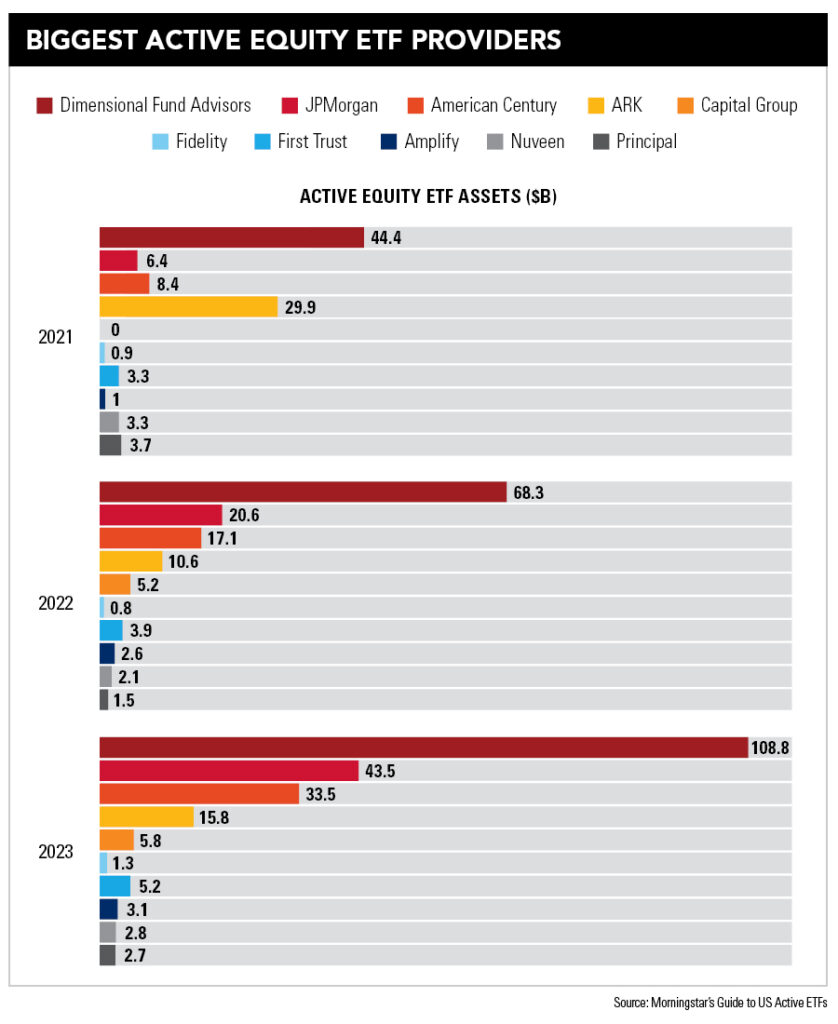
The firm that has been the most successful by far in terms of total active ETF assets is Dimensional Fund Advisors, which began converting several of its mutual funds to ETFs several years ago.
Today, the firm works with 36 percent more financial professionals than it did in 2019, prior to launching any ETFs, which indicates how having active ETFs has opened the door to more investors, said Marlena Lee, Dimensional’s global head of investment solutions.
“We really rely on the investment professionals we work with to identify to us what [they] would love for [us] to launch,” Lee said. “We prioritize based on what we hear. We’re not the type of manager to launch a bunch of products and then figure out which ones we can sell.”
Of the 38 active ETFs the firm launched, seven were mutual-fund conversions that accounted for about $40 billion of the total $133 billion it now has in the category, Lee said.
The firm, which specializes in academic, research-driven investing, emphasizes diversification in its portfolios. One of its newer ETFs includes about 13,000 holdings, or 45 percent more than market indexes that are considered highly diversified, such as the MSCI All Country World Investable Market Index, Lee said.
Compared with passive strategies, investors “don’t want that rigidity that’s decreasing their returns,” she said.
Although the fixed-income side of the active ETF market is what initially drove most of its growth, that has changed, with equity ETFs surpassing them in popularity, according to Morningstar.
The firm with the most fixed-income active ETF assets, First Trust, at $33.8 billion as of March, saw that growth initially and more recently has benefited from demand for strategies that incorporate derivatives. Following poor overall stock market performance in 2022, some investors got out of stocks and have since waded back in with buffered ETFs, said Ryan Issakainen, ETF strategist at the firm.
“Those strategies are designed to protect your downside, and the trade-off is capping some of your upside,” Issakainen said. “That has been a very popular growth driver in terms of active strategies in the equity asset class.”
The second-biggest active ETF provider, J.P. Morgan, whose Equity Premium Income ETF is the largest, at $33.8 billion, expects active ETF sales to keep accelerating across the industry, particularly as investors seek products with lower volatility.
“For active ETFs to be successful, they must address a client need and provide excess returns and strong risk management versus a passive index,” said Jed Laskowitz, chief investment officer and global head of asset management solutions, in comments provided by the company. “We continue to experience demand from investors seeking a lower volatility approach to equity investing, with an income component.”
The firm is also anticipating “significant opportunities in active fixed income ETFs, given the starting point in yields and the likelihood that interest rates will remain high for an extended period due to persistent inflation,” Laskowitz said.
The SEC has not indicated if or when it will approve of active ETF share classes for any providers, but doing so could further open the floodgates for new products.
“Vanguard used to have a decisive edge over other issuers… so it’s no wonder more legacy asset managers want to get in the game. This will allow traditional mutual fund managers to seamlessly move into the ETF space and broaden their investor base,” said Kirsten Chang, senior industry analyst at VettaFi, in an email. “We will likely see more and more firms file for this type of exemption this year, as regulatory clarity improves. It’s a net positive and should help expand the ETF business overall.”

Minneapolis-based mega-RIA adds a $376 million hybrid RIA from Raymond James as its own $7 billion sale process reportedly plays out in the background.

Atlanta-based RIA taps former LPL executive John Rajes to unify systems as the firm looks to build on its 61-acquisition growth record.

Whether it's matching the market or beating its benchmarks, the returns of a portfolio only matter as much as the kind of life it lets clients experience.

Automation, niche focus and smarter regulation will decide which advisory practices scale and which stall, writes Brian Kovack

The Hazel platform uses dedicated calculation programs to deliver personalized financial plans across six disciplines in minutes.
Northern Trust’s Ken Lassner shows advisors how to convert volatility into after-tax portfolio gains
Dan Biagini of American Equity says the steady decline of pensions, longer lifespans and a reset in interest rates are rewriting how advisors build retirement income

