

To any financial adviser struggling to find the best planning software to address complex or nontraditional client needs, Michelle Waymire might say, “Hold my beer.”
Waymire, founder of Atlanta-based advisory firm Young & Scrappy, has built a niche working with the LGBTQ community that defies traditional financial planning programming and honed in even further by expanding that client base to include polyamorous families.
Characterized by the practice of engaging in multiple romantic relationships with the consent of everyone involved, polyamorous clients don’t fit easily on most financial documents, let alone find a place in comprehensive planning programs.
“A lot of financial systems and structures are primarily geared toward one or two people, and the financial planning needs of polyamorous people are different,” Waymire said.
“There’s nothing I’ve found in the planning software to create a financial plan for three or more adults, so sometimes I’ve had to be more crafty with how things are structured,” she added. “I consider who is involved and how can we make you an active participant in a real and loving way. It’s challenging but also fulfilling and satisfying work when you get to help people who might not even feel safe to talk about their lifestyle.”
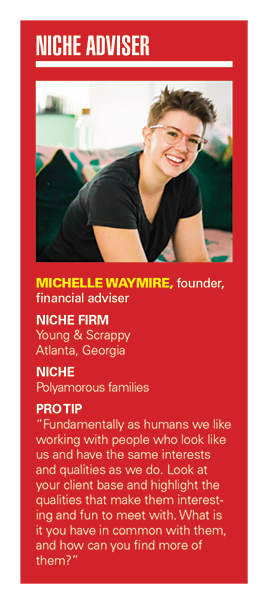
While Waymire, 32, has worked with the LGBTQ community for most of the four years she’s been in the financial planning business, she developed the polyamorous sub-niche since launching her own firm a year and a half ago.
For Waymire, the polyamorous focus just made sense the same way many other advisers find a niche that blends their personal and professional lives.
“I have two partners, we’ve been together for seven years, we own a house together, we fight about what to watch on Netflix, and we order too much takeout,” she said.
For the uninitiated, Waymire cuts right to the chase of the “poly lifestyle.”
“It’s defined as many loves,” she said. “These are folks who have relationship structures that look a little outside just two partners, or spouses, and frequently it’s more than two with the consent of everyone involved, but they aren’t necessarily swingers or cheaters, they just have a relationship structure that’s outside the mainstream.”
Beyond the obvious financial planning challenges that come with multiple involved and committed partners, Waymire explained that there are no standard poly planning strategies because there are no standard poly relationships or families.
“It could be three or four people with a close relationship, or it could be two people in a primary relationship who see other people,” she said. “To get really clear on the relationship structure you have to look for areas that do and don’t overlap. You might have two people who are retirement planning together with three or four more people are all budgeting together.”
Waymire, who offers financial planning and coaching along with asset-based advice, has about 80 clients, half of which are “some flavor of LGBTQ” and about 20% “are or have been poly.”
Citing data showing between 4% and 5% of Americans “have experimented with ethical non-monogamy, including casual encounters,” Waymire estimates there are approximately two million people in the U.S. who are “committed to the poly label and are actively engaged in the lifestyle.”
Acknowledging the small potential client base, Waymire is realizing a dearth of financial planning available to the polyamorous community.
“There are lots of folks living this way and are probably nervous or concerned about having the right fit for the support they need,” she said.
Waymire is measuring demand for her services by the number of client referrals she receives from across the country.
“Poly seems particularly prevalent in the (San Francisco) Bay area,” she said. “When I get a stream of people referring clients from California, it tells me that nobody else is doing this because why else would you refer someone to a financial adviser 3,000 miles away?”
Aside from referrals and a website that clearly caters to the LGBTQ and poly communities by promising to help clients meet their “badass financial goals,” Waymire hasn’t done much in the way of marketing her niche.
She started, then stopped, a podcast, and is planning to restart a regular blog. She also connects with other professionals and centers of influence serving the poly community.
In terms of weeding out clients who might not fit her specialty, Waymire said if they get past the website, they are probably a decent fit.
“If somebody comes on my website and sees a lot of rainbows and lots of LGBTQ and poly comments, and if they feel aligned with my style and approach I’ll work with them,” she said. “And if somebody doesn’t want to work with me because I work with a lot of LGBTQ folks, great. It helps me avoid a bad relationship.”

The financial advice industry has been facing inquiries into its cash sweep programs for years now.

Investor money allegedly went to strip clubs, exotic cars, and landscaping

Procyon adds $415 million in assets under management in New Jersey while Savant picks up a $213 million Southern California planning firm

With a growing number of real estate-rich Baby Boomers aging into retirement, some advisors may be failing to consider all the options available for those clients' assets.

Cornerstone Advisors study reveals compliance bottlenecks stall campaigns weeks after customer opportunities close.
As AI makes financial information more accessible than ever, Lana Hock explains why human judgment, trust, and empathy remain the qualities clients value most in a financial advisor
Northern Trust’s Ken Lassner shows advisors how to convert volatility into after-tax portfolio gains

