
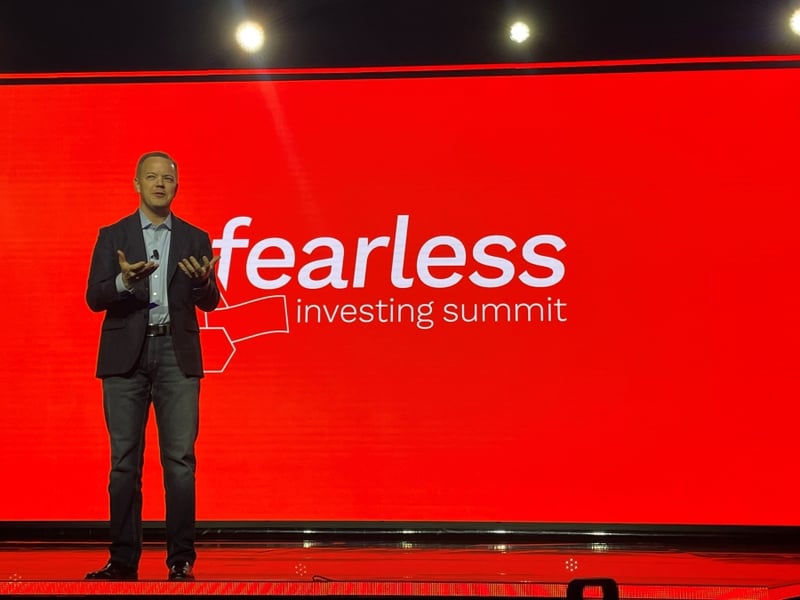
Riskalyze has a new name to reflect the company’s evolution from measuring client risk tolerance toward offering a broader suite of wealth management fintech.
The company, now called Nitrogen, was founded in 2011 in Auburn, California, with a digital questionnaire designed to give advisors a more quantitative way to measure a client’s risk tolerance than the industry’s traditional rules of thumb. More than 5 million investors have received a “Risk Number,” the measurement from Riskalyze's core product, and the company has since expanded into digital marketing, proposal generation, compliance, client engagement and financial planning.
Nitrogen CEO Aaron Klein first announced in October at the company’s annual Fearless Investing conference in Salt Lake City that a name change was coming. The new name is meant to reflect that advisors can use the software to grow their book of business, Klein said in a statement.“It’s an unexpected choice, but Nitrogen is like that — it’s a catalyst, it’s a force multiplier, it’s an essential element for growth,” Klein said. “Over this next decade, we will be known as the only purpose-built growth platform designed to help firms scale by turning leads into meetings, meetings into valued clients and clients into referral champions.”
Apart from market performance and acquisitions, advisory firms grow an average of just 3% per year, Klein said during a livestreamed event Tuesday. With Nitrogen, firms achieve organic growth of 15% to 45%, he said.
“We believe the growth platform is that missing element in the wealthtech stack,” Klein said. “A purpose-built growth platform encompasses the set of tools that wealth management firms use to turn great fiduciary advisors into growth engines without having to twist them into salespeople.”
Beyond the new name, Nitrogen also introduced a digital marketing kit for advisors. To help advisors generate more content for their marketing efforts, Nitrogen has an artificial intelligence engine to generate social media posts, blogs, emails and press releases.
Nitrogen is one of the best risk analytics tools available to analyze market data, customer behavior patterns, and economic indicators.
“This will give you a great head start before you add your personal touch and insights, and make sure everything is compliant,” said Justin Boatman, Nitrogen's chief product officer.
“Growth” has become a key focus in fintech companies’ pitches to financial advisors. During his keynote address during Envestnet’s annual conference in April, CEO Bill Crager said Envestnet’s software can help advisors achieve 31% revenue growth.
New research from the Financial Planning Association found that financial advisors face significant challenges in growing their businesses. While 46% of advisors say they are comfortable with their current growth rate, just 12% “strongly agree” with that sentiment.
The FPA found there are several psychological factors hindering business growth. For example, 43% of advisors said they worry about being perceived as pushy or sales oriented.
The research also identified that fast-growing firms — those that onboarded 10 or more clients over the past year — had identified their ideal clients and designed an experience tailored to those clients’ needs, challenges and preferences.
“As the research suggests, if advisers can shift their mindset and intentionally approach their goals for business growth strategically, they can overcome barriers that may be holding them back,” said James Lee, the FPA’s 2023 president.
The end of a historically long bull market is also likely playing a role. Traditional 60/40 portfolios had their worst performance in 60 years in 2022, so advisors who weren’t bringing in new clients saw their AUM take a hit.

Salespeople at the firm often went beyond the matching algorithm to recommend network advisors on its Zoe Wealth platform, according to the regulator.

The Protect College Sports Act would cap school payments and codify NIL rights, with implications for advisors guiding young athletes.

"I know the number that I want to be able to retire on, and now I just want out," says Wilmington Trust's Marguerite Weese, describing a common refrain among business-owner clients.

Bessemer and Brown Brothers Harriman veteran Robert Ludricks III and private markets specialist Olof Akesson join the ultra-high-net-worth push on the East Coast.

765 investors were promised 260% annual returns on truck leases
As AI makes financial information more accessible than ever, Lana Hock explains why human judgment, trust, and empathy remain the qualities clients value most in a financial advisor
Northern Trust’s Ken Lassner shows advisors how to convert volatility into after-tax portfolio gains

