
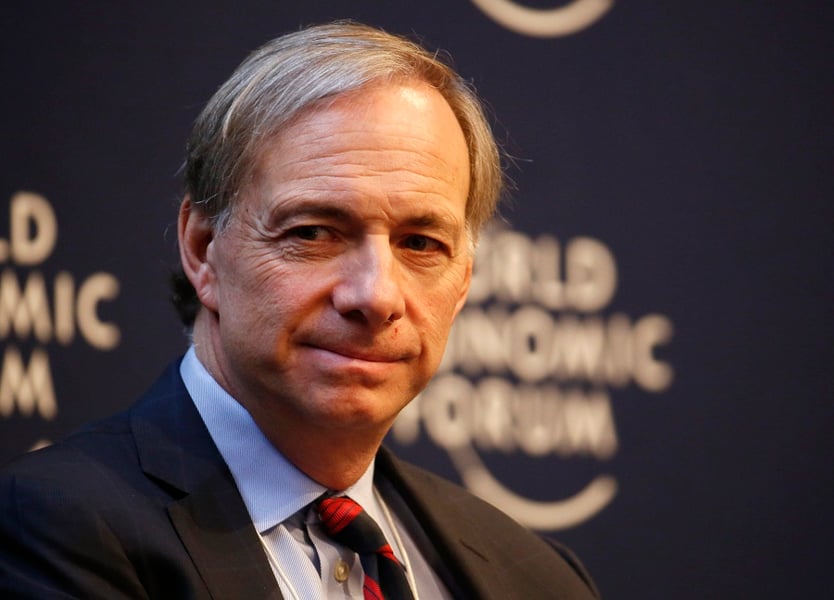
Ray Dalio, founder of Bridgewater Associates, said Monday that the US economy has entered a stagflationary period and cautioned that Kevin Warsh – President Donald Trump's favorite to lead the Federal Reserve next – should resist any temptation to cut interest rates.
Speaking with CNBC, Dalio argued that the combination of persistent price pressures and decelerating economic growth leaves policymakers with little room to ease.
"We are certainly in a stagflationary period," he told CNBC on Monday. "Because of the issues that are here, in terms of a more immediate inflation, farther from the target."
Dalio said a rate cut under those conditions would put the Fed's institutional standing at risk. "Certainly, you would not cut interest rates now," he said. "You will lose your credibility. The Federal Reserve would lose its credibility, particularly now."
Dalio added that a global scan of central bank policy would yield the same conclusion – that the environment simply doesn't support easing. Looking at monetary policies in other countries, he said, policymakers would not be inclined to cut "[given] today's information."
Dalio's comments come as Warsh – the former Fed governor expected to succeed Jerome Powell as Federal Reserve chair in mid-May – navigates a confirmation process that has already signaled his intention to reshape how the central bank approaches inflation. At his Senate Banking Committee hearing last week, Warsh argued the Fed has not fully come to terms with its policy missteps during the pandemic era.
"After Covid, when prices went up to the tune of 25-to-35% for virtually all deciles of the American people, that's an indication that the Fed missed its mark," Warsh said. "We are still dealing with the legacy of the policy errors in 2021 and 2022."
Warsh has called for a new inflation framework and has previously advocated for reducing the Fed's balance sheet, arguing that doing so could eventually open room to lower borrowing costs for households and smaller businesses.
That long-term orientation appears broadly consistent with Dalio's near-term warning: that cutting rates prematurely, before inflation is clearly under control, would be the wrong move.
Dalio's assessment is finding support in recent economic data. S&P Global's April flash Purchasing Managers' Index readings across the G4 economies – the US, eurozone, Japan and UK – showed output growing at only a modest pace as demand softened for the first time since late 2023, weighed down partly by the ongoing Middle East conflict.
Supply chains are tightening at the same time: delivery delays have reached their most widespread levels since 2022 across all four economies, while input costs in both manufacturing and services are rising at their steepest rates in roughly three years. S&P Global noted that those pressures are expected to feed through to marked increases in consumer price inflation in the months ahead.
That backdrop – weakening demand paired with rising prices – illustrates the bind confronting central banks, including the Fed. Elevated inflation typically calls for tighter monetary policy to cool spending, while sluggish growth argues for the opposite. Stagflation puts both pressures on policymakers simultaneously.
For now, market participants appear to agree with Dalio's view. Traders are pricing in a 100% probability that the Fed will leave rates unchanged at its meeting this week, and fed funds futures suggest policy is most likely to remain on hold through the rest of 2026, according to the CME FedWatch tool.
Morgan Stanley economists are tracking first-quarter GDP growth at 2.4%, with core PCE inflation running at a 4.1% annualized rate – a combination that reinforces the case for caution. The firm's baseline scenario calls for the Fed to hold rates steady through much of the year before making modest cuts in the second half, assuming inflation continues to decelerate.
Meanwhile, Dalio said the sharp rebound in equity markets, despite geopolitical volatility, made sense given the strength of corporate earnings. He continues to recommend that investors hold between 5% and 15% of their portfolios in gold as a hedge, describing it as an effective diversifier in the current environment.
Warsh's confirmation is expected to advance in mid-May, though scrutiny from Senate Democrats over his financial disclosures – which show a portfolio exceeding $100 million including stakes in crypto-related ventures – may muddle the path.
Questions also remain about his willingness to resist political pressure from the White House, an issue he addressed at the hearing by pledging he would not serve as a "sock puppet" for the administration.

Retiring RIA seller David Laidlaw alleges the Carnegie valued his stake on $11.7 million EBITA while pitching potential buyers on $21.3 million.

New tool gives RIAs and family offices AI help vetting private market deals, with some users reportedly halving review time.

Investors got projected returns dressed up as real ones, SEC says

Parents must still act to get the $1,000 federal seed and employer contributions, giving financial advisors a role in the rollout.

FINRA booted Rudy Anguiano from the industry for “conversion - the intentional and unauthorized taking of another person’s property.”
As AI makes financial information more accessible than ever, Lana Hock explains why human judgment, trust, and empathy remain the qualities clients value most in a financial advisor
Northern Trust’s Ken Lassner shows advisors how to convert volatility into after-tax portfolio gains

