
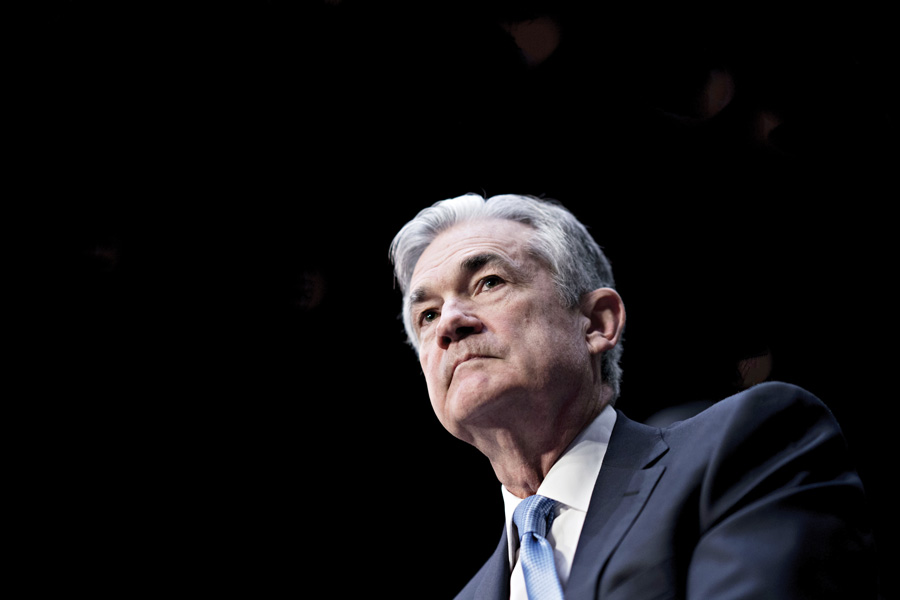
Federal Reserve chair Jerome Powell said the central bank is inclined to hold interest rates steady and “look through” the inflation impulse from a Middle East-driven oil shock, while warning that approach hinges on the public continuing to believe inflation will come back down over time.
“You can have a series of these supply shocks and that can lead the public generally – businesses, price setters, households – to start expecting higher inflation over time. Why wouldn’t they?” Powell said Monday during a question-and-answer session with undergraduate students at Harvard University, reported the Wall Street Journal.
The fresh bout of energy-driven inflation pressure comes as markets and advisors are again gaming out whether the Fed’s next move is a cut, an extended hold, or even another hike – a sequence that can whipsaw bond yields, equity valuations, and client expectations around cash and fixed income.
The Fed elected to hold rates steady for its rate decision this month, voting 11-1 to keep the federal-funds rate in a range of 3.5% to 3.75%. Fed governor Stephen Miran was the lone dissenter in favor of a cut. Powell also pushed back on the idea that rate reductions later this year are a given, framing his colleagues’ projections as contingent on inflation resuming clearer progress toward the Fed’s 2% target.
On top of the tariffs advanced by President Donald Trump, the latest oil shock presents yet another wild card for policymakers at the Fed, as it can lift headline inflation while also acting as a tax on consumers and businesses, weighing on growth.
Powell avoided prescribing a near-term reaction function as the economic data come in. “We will eventually maybe face the question of what to do here. We’re not really facing it yet because we don’t know what the economic effects will be,” he said Monday.
He had already flagged that risk after the March 18 decision, saying higher energy prices would likely raise overall inflation in the near term. “In the near-term, higher energy prices will push up overall inflation. But it is too soon to know the scope and duration of the potential effects on the economy,” he said at the time. He added that “it is standard learning that you look through energy shocks” – but only if inflation expectations stay “well-anchored.”
That assumption may be tested after several years of above-target inflation, Reuters noted, with gasoline prices rising and oil prices hovering around $110 a barrel. There are also indications of investor unease, including higher Treasury yields and weak auction demand that some market participants tied to inflation concerns.
Philadelphia Fed president Anna Paulson said Friday that longer-run expectations are still aligned with the Fed’s target – but potentially less sturdy than in the past. “Long-term inflation expectations are consistent with 2%, but they may also be a little more fragile,” she said at a San Francisco Fed conference.
For advisors, the backdrop raises a practical question: whether clients’ inflation memories are reawakening just as portfolios have been recalibrating to higher-for-longer rates. If surveys and market-based gauges begin to flash persistent inflation expectations, the Fed could face pressure to stay restrictive longer than investors currently hope – even if growth softens.
Powell acknowledged the risk of repeated shocks shifting psychology, noting policymakers’ sensitivity to the 1970s experience. “It’s a repeated set of things, and you worry that’s the kind of thing that can cause trouble for inflation expectations,” he said. “We worry a lot about that.”

Retiring RIA seller David Laidlaw alleges the Carnegie valued his stake on $11.7 million EBITA while pitching potential buyers on $21.3 million.

New tool gives RIAs and family offices AI help vetting private market deals, with some users reportedly halving review time.

Investors got projected returns dressed up as real ones, SEC says

Parents must still act to get the $1,000 federal seed and employer contributions, giving financial advisors a role in the rollout.

FINRA booted Rudy Anguiano from the industry for “conversion - the intentional and unauthorized taking of another person’s property.”
As AI makes financial information more accessible than ever, Lana Hock explains why human judgment, trust, and empathy remain the qualities clients value most in a financial advisor
Northern Trust’s Ken Lassner shows advisors how to convert volatility into after-tax portfolio gains

