
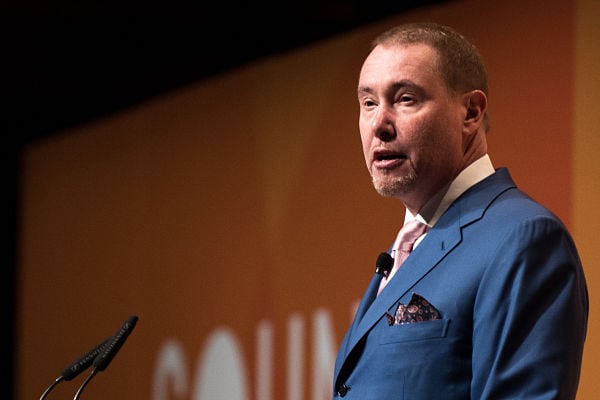
Billionaire money manager Jeffrey Gundlach warned that a 1940s-era central bank policy may make a return if long-dated bond yields continue to rise.
Federal Reserve Chairman Jerome Powell may implement yield-curve control if rates on Treasury securities drive much higher, the DoubleLine Capital chief investment officer said in a webcast Tuesday. Economists have speculated that the central bank could introduce yield targets as soon as September.
“Obviously yield-curve control is lurking in the background of the conversation,” Gundlach said. “I certainly do expect that Jay Powell would follow through on controlling the yield curve should the 30-year rate really get unhinged.”
Longer-dated Treasuries have sold off in recent weeks amid growing optimism that the economic damage from the coronavirus has bottomed and U.S. states will soon reopen. Last week, climbing rates pushed the spread between 5- and 30-year yields to the steepest level since 2016.
Gundlach’s comments come on the eve of the Fed’s June policy decision, where the central bank is widely expected to leave rates on hold. The fund manager said that should the 30-year Treasury rate -- which is now hovering near 1.6% -- move above 2%, the Fed may introduce measures to push yields lower.
“Jay Powell has said he will expand the balance sheet to infinity if need be,” Gundlach said. “Once they move above 2%, the Fed is going to find a blip showing up on their radar screen and they will start thinking about how high do they want rates to go.”
The fund manager also said the stock market is likely to fall from its “lofty” perch and the economy may see a wave of white-collar unemployment.
U.S. stocks have rebounded more than 40% from this year’s lows in March as liquidity from the Federal Reserve and easing lockdowns bolster economic optimism amid the coronavirus pandemic. The S&P 500 index erased its losses for 2020 on Monday, climbing to a 15-week high.
Among his other comments:
Gundlach, who is also DoubleLine’s chief executive, has long been cautious on the economy. He said in March that defaults were likely to accelerate in parts of the high-yield debt market amid low oil prices and the virus outbreak. He put the chance of a recession in the next year at as high as 90% and said the U.S. national debt may swell to $30 trillion in two to three years as spending explodes in response to the crisis.
His $50 billion Total Return fund, which focuses mostly on mortgage-backed securities and has avoided corporate debt, returned 1.4% this year through Monday, beating 27% of its peers, according to data compiled by Bloomberg. Its five-year average return is 3.3%, better than three-quarters of its rivals.
Los Angeles-based DoubleLine oversaw about $136 billion as of the end of March, mostly in fixed-income assets.

CFP, CFA and CPA holders could gain accredited investor status as regulators weigh wider private market access for advisory clients

DeepVest, Vanilla and Libretto roll out tools to help financial advisors launch firms, close estate plans and sharpen planning skills

“People aren't effectively using their wealth in retirement,” said David Blanchett of Prudential.

Second-generation NFL ref Shawn Hochuli co-founded IWM Partners in Irvine, California, a wealth management practice with more than $500M in client assets

U.S. seniors lose $28.3 billion annually as a result of financial exploitation, according to a 2023 AARP study.
As AI makes financial information more accessible than ever, Lana Hock explains why human judgment, trust, and empathy remain the qualities clients value most in a financial advisor
Northern Trust’s Ken Lassner shows advisors how to convert volatility into after-tax portfolio gains

