
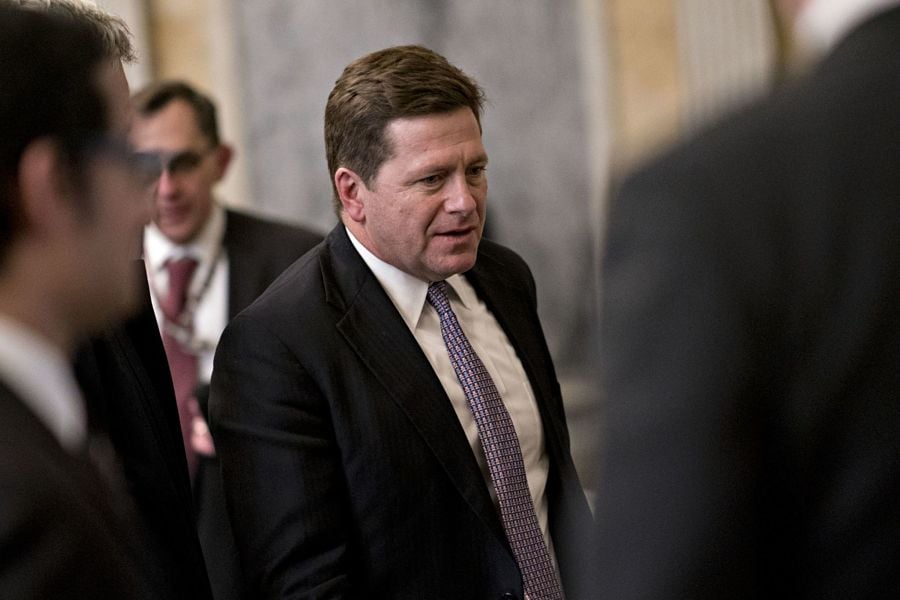
Former SEC chairman Jay Clayton, who is now working in the private sector and has no interest in returning to government work, believes government regulators could do a much better job serving investors and the broader financial markets.
Speaking Wednesday morning in Orlando, Florida, as part of the BNY Mellon Pershing Insite conference, Clayton drew stark contrasts between the Securities and Exchange Commission under the Biden administration and under the Trump administration.
“I think it’s pretty clear we’re in a very highly business-skeptical and commercial-skeptical regulatory environment,” he said. “Any time you go to extremes, either way, you get more bad than good.”
Clayton, who was SEC chairman from May 2017 through December 2020 and is now the nonexecutive chair at Apollo Global Management, said the regulatory whiplash leaves anyone participating in the financial markets with more questions than answers.
“People don’t know what is really happening, how long it is going to last, and what they should do about it,” he said in reference to what has been described as the most aggressive SEC ever.
On the subject of the democratization of alternative investments, which has been a recent SEC focus, Clayton acknowledged that he might be accused of “talking his book” as the representative of a firm that manages private investments, but said retail class investors are being locked out of the party.
“Capital formation these days largely comes from outside the public markets, yet the investing public is largely held outside those private markets,” he said. “All investors should have access to a portfolio that looks like a well-managed pension fund. With the help of a lot of the people in this room, I think we’re going to be able to do it.”
Lowering the hurdles toward democratization of alternative investments, he explained, requires the participation of the regulators, but also will take additional efforts on the part of investment management firms to create products that are suited for a broader universe of investors.
He took particular issue with the current accreditation rules, which haven’t been changed in 40 years, and don’t jibe with the current reality of individual investors being responsible for their own retirement income.
For example, he pointed out the absurdity of qualified retirement accounts giving retail investors access to highly liquid mutual funds and ETFs but not less liquid investments that would be better suited for long-term investing objectives.
“You’re paying for liquidity that you don’t need and can’t access,” he said. “Pick a target-date fund, for example. Why wouldn’t there be a sliver of privates or alternatives in there? If I’m a 401(k) investor, I should be able to get something that looks like a Calpers portfolio. Why wouldn’t you have a 10% slice of privates in your retirement portfolio when you’re 50 years old?”

Eric J. Stone was fired by Fidelity in 2021 after facing claims he took loans from clients.

Chicago-based Curi Capital gets new majority owner as $14 billion RIA eyes acquisitions and expanded family office services

Partnership pairs organic lead detection with paid ad targeting to help end "spray-and-pray" marketing for growth-seeking advisory firms.

Jonathan Lewis joins the wealth management giant as it proceeds with a $2 billion AI and technology push for advisors.

Once focused on retirees, pre-retirees and risk-conscious investors, the category has widened into a wider toolkit to help reassure clients in choppy markets.
Northern Trust’s Ken Lassner shows advisors how to convert volatility into after-tax portfolio gains
Dan Biagini of American Equity says the steady decline of pensions, longer lifespans and a reset in interest rates are rewriting how advisors build retirement income

