
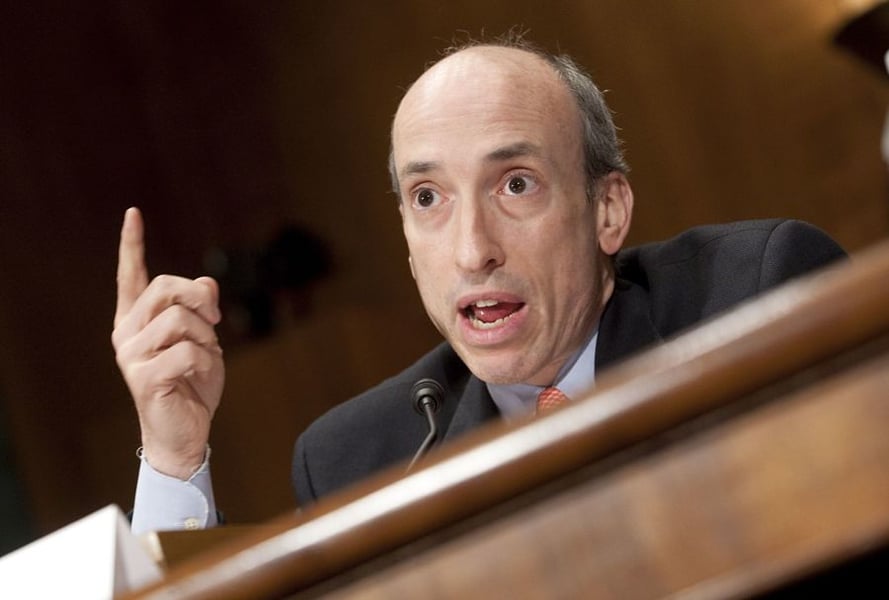
Gary Gensler, the Biden administration’s nominee to chair the Securities and Exchange Commission, indicated Tuesday he supports greater corporate disclosure about climate risk and might be open to rethinking mandatory arbitration in brokerage contracts.
But during a remote three-hour confirmation hearing before the Senate Banking Committee, he did not receive a question about the SEC’s broker investment advice standard, Regulation Best Interest. The hearing featured Gensler and the nominee to be director of the Consumer Financial Protection Bureau, Rohit Chopra.
Last week, acting SEC Chair Allison Herren Lee directed the agency's Division of Corporate Finance to ramp up its scrutiny of company disclosures about the risks that climate change poses to their business.
The committee chairman, Sen. Sherrod Brown, D-Ohio, asked Gensler if he plans to push the agency beyond that directive.
[Webcast: What Biden means for ESG investing in 2021]
“Increasingly, investors really want to see – tens of trillion of dollars in assets behind it – climate risk disclosure,” Gensler told Brown. “Issuers would benefit from such guidance. So, I think through good economic analysis, working with the staff, putting out to the public to get public feedback that is something the commission, if I’m confirmed, would work on.”
But Republicans pressed Gensler on the extent to which climate change and other issues, such as corporate political spending and racial diversity, are relevant to financial performance.
“The securities laws are not the appropriate vehicle to regulate climate change nor to correct racial injustice or intimidate companies regarding political spending,” Sen. Patrick Toomey, R-Pa. and ranking member of the committee, said in his opening statement. “That is why we have environmental, civil rights, and political spending laws.”
Gensler responded to similar GOP assertions by emphasizing that investors are demanding such disclosures.
“It’s the investor community that gets to decide what’s material to them,” said Gensler, a former chairman of the Commodity Futures Trading Commission and a former Goldman Sachs executive.
The focus on the climate and finance at the hearing likely was a harbinger of the priority the SEC will place on environmental, social and governance investing under Gensler.
Prior to the hearing, many anticipated Gensler would get questions from lawmakers about Reg BI. Investor advocates are pushing the agency to revise the measure to define what “best interest” means and to delineate how brokers should mitigate conflicts of interest.
Barbara Roper, director of investor protection at the Consumer Federation of America, said she isn’t concerned that Reg BI was ignored, citing the five-minute limitation on lawmakers’ questions.
“I don’t read too much into the lack of questions on Reg BI,” Roper wrote in an email. “Members obviously had other issues they wanted to emphasize, particularly with regard to ESG issues, and five minutes isn’t a lot of time.”
Although Reg BI was passed over, the topic of mandatory arbitration clauses in brokerage contracts was raised by Sen. Elizabeth Warren, D-Mass., who is a leading critic of the industry-wide practice.
“Hypothetically, for example, if Robinhood cheated individual investors, hypothetically, should that company be able to use forced arbitration clauses to avoid getting sued and held accountable?” Warren asked Gensler.
The Dodd-Frank financial reform law gave the SEC the authority to end mandatory arbitration. Gensler didn’t commit to doing so, but he did indicate an open mind about the issue.
“While arbitration has its place, it’s also important that investors – or, in that case, customers – have an avenue to redress their claims in the courts,” Gensler said.
Similarly, Gensler didn’t make any promises about how the SEC would address the recent GameStop trading frenzy. But he did outline issues it needs to tackle.
“How to ensure that customers still get best execution in the face of payment for order flow,” Gensler said. “How to protect investors using trading applications with behavioral prompts designed to incentivize customers to trade more. How to ensure customers’ access to markets when those apps may, at times, fall short of needed margin funds. How to promote competition in markets...and how to update back-office infrastructure to lower risks and costs.”
There didn’t appear to be any resistance to Gensler’s or Chopra’s nominations, which Brown said he wants to advance quickly. Both need approval by the full Senate.
‘There was virtually no political theater baked into the questions directed to Mr. Gensler, though political differences on issues like the meaning of ‘materiality’ and certain market structure features were on full display,” Kurt Wolfe, a securities attorney at Troutman Pepper, wrote in an email. “I think it was a good signal that the senators asked substantive questions – including some about how Mr. Gensler will work with GOP senators and his fellow commissioners.”

New launches tackle succession planning, AI-driven email management and heir retention ahead of the great wealth transfer

For sellers weighing PE deals, due diligence shouldn't end with the offer on the table – the acquiring platform and the M&A advisor deserve a hard look as well.

South Carolina estate planning firm joins Osaic’s IBD network, citing succession planning tools and multigenerational growth resources.

A new SIFMA and KPMG study of more than 2,100 US investors finds satisfaction high, AI-only trust falling, and demand for human guidance growing across every generation.

Retail banks and private wealth firms scored 40 in Fitch's AI stress test, signaling possible one-notch downgrade risk under an adverse scenario.
Knighthead Life entered the market with a competitive MYGA. A strong launch earned advisor confidence and paved the way for FIAs.
As AI makes financial information more accessible than ever, Lana Hock explains why human judgment, trust, and empathy remain the qualities clients value most in a financial advisor

