
Estate planning is important for everyone who wants to protect their assets and ensure that their loved ones are taken care of after they pass on. More so for high-net-worth individuals whose estates are larger and more complex.
But to get things right, wealthy families often need the guidance of qualified professionals, which include RIAs.
In this guide, we’ll explore different estate planning strategies to make sure that your clients’ assets are protected and distributed according to their wishes. We’ll also go over the different factors to consider to avoid complications and costly mistakes.
A well-constructed estate plan guarantees that heirs and beneficiaries receive assets the way your client intended them to. It also reduces the estate’s tax burden. But to create one, several factors must be accounted for.
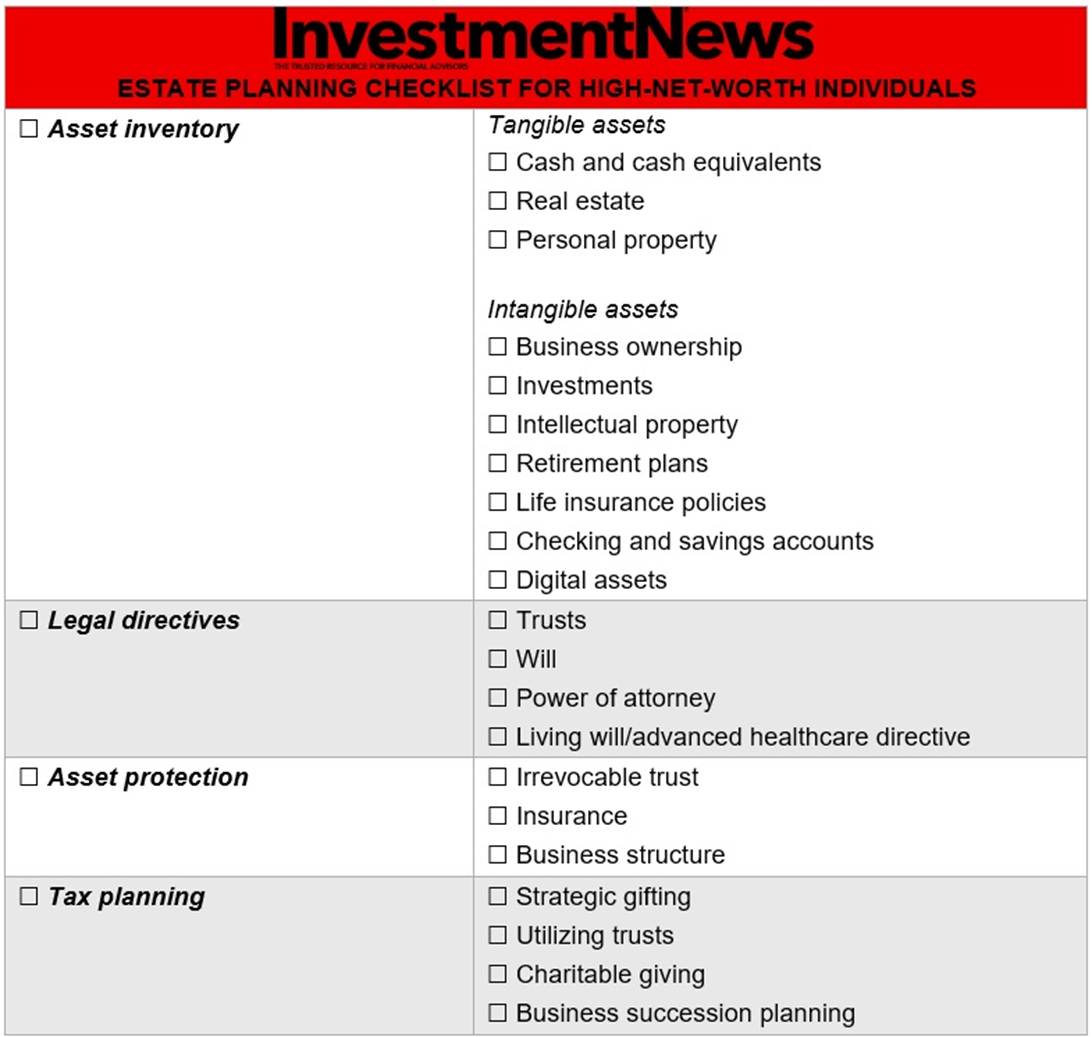
Here’s a downloadable checklist. We’ll delve deeper into these strategies in the succeeding sections.
A high-net-worth individual is generally defined as someone with at least $1 million in liquid assets, excluding their primary residence. Some institutions, however, further categorize wealthy individuals beyond this standard definition:
An HNWI’s estate consists of tangible and intangible assets. Here’s a breakdown of what comprises each category:
These are physical assets that have monetary value, including:
These are non-physical assets that hold significant value and contribute to the individual's overall wealth. These include:
Part of a solid estate planning strategy is establishing important legal directives. Among the core components of a strong estate plan are:
A trust is a legal contract that allows an assigned person or trustee to hold property for your client who creates the trust, aka the grantor. Trusts are often created so that the beneficiaries, who can be individuals or institutions, can make use of the property sometime in the future. Clients can fund the trust with money, physical assets, or any item that is of value.
Trusts are also useful legal instruments for holding property when the beneficiaries are minor children who are still unfit to receive and handle their full inheritance. In such a situation, the property will stay in the trust (“be held in trust”) until the beneficiaries reach a certain age, usually the age of emancipation.
Another advantage of using a trust in estate planning: the property in a trust is distributed faster, since your client can avoid probate court.
There are different types of trusts, so be ready to recommend tax-advantaged trusts – such as an irrevocable life insurance trust – to your clients.
When it comes to high-net-worth estate planning, your client can choose from two of four commonly used types of trusts:
Also known as the inter vivos trust, a living trust is designed to hold the property of the grantor before and after they pass away. A testamentary trust, meanwhile, is a type of trust that is created by a will, making it go into effect only after the grantor’s death.
The main difference between these two kinds of trusts is that a living trust is effective for as long as the grantor is alive. A testamentary trust only takes effect after the grantor dies.
In a revocable living trust, the grantor keeps the right to modify, change, revoke, or terminate the trust altogether. An irrevocable trust, meanwhile, does not allow the grantor to make any changes to the trust, although some US states allow the trustee to transfer property. However, the trustee can only do so with the consent of all the beneficiaries, when applicable.
A revocable trust turns into an irrevocable trust once the creator (your client) dies, as they can no longer make any changes or revoke the trust.
Here’s an article on revocable vs. irrevocable trusts for more on these differences.
Since placing their assets can help their beneficiaries avoid the potentially lengthy and costly probate, your client may likely choose to use a trust. Talk to your client about which type of trust is best for their needs, their wishes for their assets, and their beneficiaries.
Also known as last will and testament, a will is an essential part of an estate plan. This legal document specifies:
Wills are often used alongside other estate planning strategies, including trusts, to manage wealth and potential tax implications.
Wills must go through probate, which is a public process. This means that the details of the will become part of the public record. Wills can also be superseded by beneficiary designations on certain assets such as life insurance policies and retirement accounts.
Power of attorney
The power of attorney (POA) is the authority that your client gives to someone to make legal, financial, or medical decisions on their behalf. It is often seen as one of the most important documents in estate planning.
A POA outlines your client’s wishes for their assets and medical treatment should they become mentally incapable and unable to relay their wishes.
The person who is given the power of attorney by your client is their agent. Your client must identify their agent in a document that only takes effect once they are considered unable to act on their own. They may also grant someone a POA for a specific purpose, such as accessing accounts to pay medical bills.
Should your client become unable to manage their legal or financial affairs and have not designated an agent, a court may appoint one for them. Each state has its own laws on POAs, but the general types are:
Also called medical directive or advanced healthcare directive, a living will is key in ensuring that your client’s medical wishes are followed if they become incapacitated. This legal document contains:
A living will can also include specific instructions related to medical care. State laws on living wills, however, can vary. So while most states recognize living wills, their validity isn’t guaranteed. To ensure that your client’s living will is enforceable, it’s best to work with an estate planning attorney who knows state-specific requirements.
Good end-of-life planning involves more than just the financial aspects of the estate. This article lists ways on dealing with the emotional aspects of estate planning.
Asset protection involves structuring your client’s assets to protect them from potential creditors, lawsuits, and other financial risks. This is also intended to minimize estate taxes and ensure a smooth transfer of wealth to heirs and beneficiaries.
This estate planning strategy requires an assessment of all assets to determine their potential exposure to legal claims and tax liabilities. You will play a key role in helping your high-net-worth clients understand which assets are vulnerable and which ones are protected under state laws.
Asset protection can involve several legal structures and strategies, including:
Learn more about building a strong estate planning strategy in this guide.
Tax planning is an important aspect of estate planning, especially for high-net-worth individuals, as estate taxes can significantly eat into their heirs’ inheritance.
In 2025, federal estate tax is levied on individuals whose assets are worth $13.99 million or greater at the time of their death. Some states also charge an estate or inheritance tax on top of this.
However, there are several ways for your clients to minimize estate taxes, including:
Individuals can gift a certain amount each year without incurring gift or estate taxes. For 2025, the gift tax exemption is $19,000 per recipient, a $1,000 increase from last year.
Some types of trusts help reduce estate taxes:
Donating to qualified charities can reduce your client’s taxable estate and may provide income tax deductions.
High-net-worth individuals with closely held businesses may face tax liabilities if they die before transferring their businesses. Strategic planning using trusts or other estate tools can help minimize these obligations.
Estate planning plays an important role in helping high-net-worth individuals protect and distribute their wealth, minimize taxes, and ensure their wishes are carried out. A strong plan prevents large estates from being subject to high taxes, lengthy probate processes, and potential family disputes.
Visit and bookmark our GoRIA section for more news and information on an RIA’s role in estate planning.
See the latest estate planning news from the InvestmentNews team below!

The latest powerhouse group to leave Osaic is moving at an interesting time, with Commonwealth is set to be absorbed by IBD behemoth LPL.

Celebrating the best independent financial advisors for the exceptional quality of service and support they provide to clients

Also, New York-based Withum Wealth Management has named a 45-year veteran professional to fill a C-suite role.

"We are making sure to pivot away from companies disproportionately exposed to the lower-end consumer," says F.L.Putnam's Ellen Hazen, as her RIA's investment strategy prepares to react to proposed cuts to medicaid and SNAP.

The private capital provider looks to make good on its promise as a lifecycle partner to advisors as it hires the former M&A head at Hightower Advisors.

As families demand holistic guidance, boutique advisors are stepping into a role Wall Street can't fill.

Also in the West Coast, San Francisco-headquartered Parallel Advisors has bolstered its leadership with two executive hires.

The newly appointed leader will be responsible for overseeing fiduciary governance, regulatory compliance, and risk management at Cetera's trust services company.

The RIA behemoth overseeing more than half a trillion dollars in client assets is adding to that book with a $1.4 billion firm focused on pro athletes in New York.

With over 600 clients, the $71 billion RIA acquirer's latest partner marks its second transaction in Oklahoma.

Also, wealth.com enters Commonwealth's tech stack, while Tifin@work announces an expanded partnership.

Arax acquires a boutique firm's $4 billion RIA business in Michigan as Steward Partners continues its Southwestern expansion.

Elsewhere on the East Coast, a Boca Raton-headquartered shop has acquired a fellow Florida-based RIA in "a natural evolution for both organizations."

The money comes fast for some but then what? Advisors are scrambling to protect young clients from the long-term traps of private markets.

Long-term gifting plans remain as wealthy clients stay focused.
