
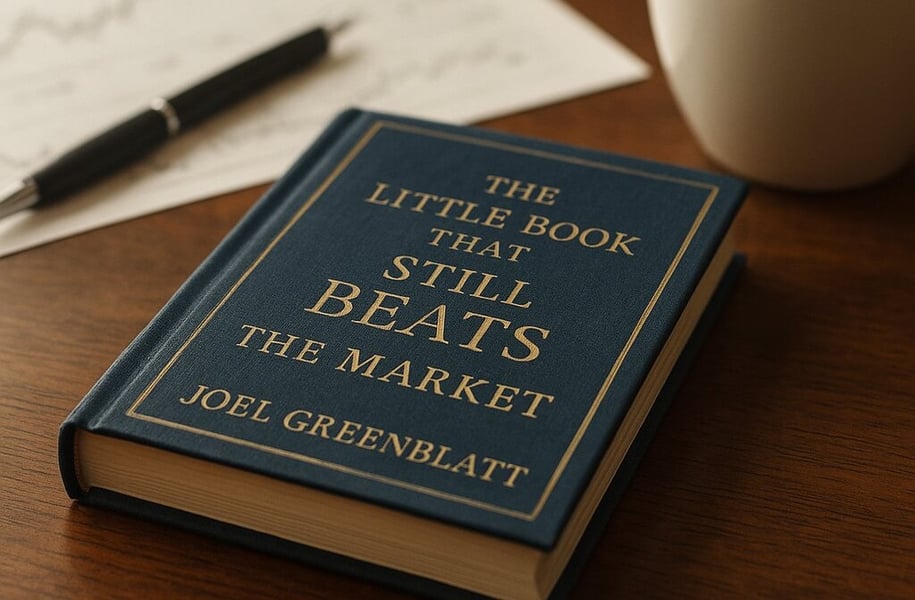
Hundreds of books offer useful investing tips that both new and experienced investors can use to build or preserve wealth. They cannot replace years of study, hard work, and experience, but they can serve as a solid source of sound investment advice.
Among these investment classics is Joel Greenblatt’s The Little Book That Still Beats the Market. This article reviews the book, examines its core principles, and assesses whether those principles still hold up today.
The Little Book That Still Beats the Market is a revised edition of The Little Book That Beats the Market, first published in 2005. It went on to become a New York Times bestseller with 300,000 copies in print. The updated version came out in 2010 from Wiley as part of the Little Books, Big Profits series.
Greenblatt is a hedge fund manager and founder of Gotham Capital, which achieved 40 percent annualized returns for 20 years after its founding in 1985. He is also a professor at Columbia Business School. The book targets everyday investors rather than finance professionals and is written in plain language.
The book introduces the "magic formula," a systematic investment approach rooted in value investing principles. The core idea is straightforward: most professional fund managers fail to beat the market over time and a rules-based formula gives ordinary investors a better shot.
The formula focuses on two metrics – a firm’s return on capital and its earnings yield – to identify strong, undervalued companies. The full mechanics of how it works are covered in the core idea section below.
The formula has been extensively tested and is considered a breakthrough in academic and professional investing circles. Greenblatt still explains it using sixth-grade math, straightforward prose, and humor. The book walks readers through value investing principles step by step, giving them a strategy they can follow through both strong and weak markets.
The magic formula has shown strong historical returns, but Greenblatt cautions that investors must stay disciplined and patient when it underperforms. The strategy demands a long-term outlook and the resolve to hold the course when short-term results disappoint.
Greenblatt’s magic formula is a systematic way to buy good companies at bargain prices. It has two inputs:
Return on capital measures how efficiently a business generates profit from its assets. Earnings yield measures how much a company earns relative to what it costs to buy the stock.
The formula ranks all companies in the investable universe by both metrics separately, then adds those two ranks together.
For example, the investor buys 20 to 30 companies with the best combined scores, holds each for one year, and then rotates into new top-ranked companies. The process repeats annually over a long-term horizon of five to 10-plus years.
Depending on an investor’s time horizon and investment goals, there are many other investment strategies that can be derived from other books on investing.
The magic formula is a systematic method of selecting stocks based on two financial ratios that measure a company’s quality and its price relative to its earnings. It belongs to the school of value investing, pioneered by Benjamin Graham, but replaces subjective analysis with a clear, replicable quantitative screen.
Greenblatt suggests buying 30 good companies or cheap stocks with a high earnings yield and a high return on capital. He describes this as a simplified version of the strategy used by Warren Buffett and Charlie Munger of Berkshire Hathaway.
Greenblatt measures the strength of a business by examining its return on capital. He defines this as operating profits – earnings before interest and taxes (EBIT) – divided by tangible investment capital: net working capital plus net fixed assets.
Companies that earn a high return on capital over time generally have a special advantage that keeps competition from destroying them. This could be name recognition, a new product that is hard to duplicate, or even a unique business model. In most cases, return on tangible capital alone, excluding goodwill, is a more accurate reflection of a business’s prospects.
The earnings yield measures how much the company earns compared to how much it costs to purchase the stock. Greenblatt defines this as earnings before interest and taxes (EBIT) divided by enterprise value. Greenblatt prefers this ratio over the narrower price-to-earnings (P/E) ratio as it allows for a better comparison of businesses with different capital and tax structures.
Here’s how the book prescribes using the formula in practice:
Start with a large universe of companies. This usually means starting with 3,500-plus US stocks, excluding financial and utility companies, as their financial structures can distort the core metrics.
Rank all remaining companies from best to worst based on their return on capital. The company with the highest ROC gets the top ranking.
Rank the same companies from best to worst based on their earnings yield. The company with the highest earnings yield gets the top ranking.
Rank the companies based on their return on capital and earnings yield separately, then add the two ranks together. A company that is good but not great on both scores might rank higher than one scoring very highly on one metric but poorly on the other.
Invest in 20 to 30 of the highest-ranked companies, building two or three positions per month over a 12-month period.
Rebalance the portfolio once per year, selling losers one week before the year-mark and winners one week after the year-mark. This timing matters for tax efficiency. Selling losses just before a year offsets taxes, while holding winners slightly past a year qualifies for long-term capital gains rates.
Continue the process over a long-term period of five to 10-plus years.
These are among the most cited excerpts from The Little Book That Still Beats the Market:
This line appears in many book reviews as the most memorable line in the book. Greenblatt writes that choosing individual stocks without knowing what to look for is like running through a dynamite factory with a burning match. Companies that achieve a high return on capital are likely to have a special advantage that keeps competitors from eroding above-average profits.
The warning holds up well today. For decades, investors have searched for a systematic, foolproof method for finding high-quality, undervalued stocks. Many value investing strategies are complex, requiring deep financial statement analysis that intimidates individual investors.
Greenblatt’s point is that random stock picking without a clear framework is just as risky now as it was when the book was written. The formula is designed to strip away emotions, helping everyday investors avoid common pitfalls like panic selling or impulsive decisions based on market swings.
Greenblatt’s use of the "Mr. Market" metaphor, originally from Benjamin Graham, is among the most cited concepts in the book. Stock prices move wildly over short periods, but that does not mean the underlying companies’ values have changed much during the same period. The stock market acts much like an erratic character who names a different price every day, driven more by mood than by logic.
The Mr. Market concept is now widely taught across business schools and financial media. Financial podcasts such as Invest Like the Best frequently reference Mr. Market to dissect behavioral pitfalls in real-time markets, and discussions have extended to AI-driven market fluctuations as of 2025.
Instead of being fearful when Mr. Market is pessimistic and selling stocks at low prices, investors can seize the opportunity to buy quality companies at a discount. Conversely, when Mr. Market is exuberant and driving prices to unsustainable levels, investors can exercise caution and consider selling or holding their positions.
Although Mr. Market may set stock prices based on emotion in the short term, over the long term it is the value of the company that matters most. After more than 25 years of investing professionally and nine years of teaching at an Ivy League business school, Greenblatt says he is convinced of at least two things:
This passage speaks directly to the ongoing underperformance of actively managed funds. An investor will succeed by coupling good business judgment with the ability to insulate thoughts and behavior from the super-contagious emotions that swirl about the marketplace.
Warren Buffett has noted that keeping the Mr. Market concept firmly in mind is one of the most useful mental tools for staying insulated. In fast-moving markets shaped by algorithmic trading and social media sentiment, the ability to separate price from value remains a core skill.
Greenblatt writes that investing is hard. Having a disciplined, methodical, long-term investment strategy that makes sense is what gets investors through almost any market. But it cannot just make sense in theory. It must make sense to the investor personally because a deep understanding is the only way to stick with a long-term strategy that might not work over shorter time periods.
This is where the formula faces its biggest real-world test. Greenblatt himself notes that the "magic" works because most investors lack the patience and discipline to stick with the formula during difficult times.
The strategy requires a commitment to the system, holding stocks for the full one-year period even when the market seems to be saying the formula is broken. The systematic process forces investors to sell losers and buy new, cheap stocks every year, which is what drives long-term outperformance.
Greenblatt’s research shows that while beating the market is hard, it does not have to be complicated. The hard part comes not in developing a complex strategy, but in finding a proven approach and sticking with it through good times and bad.
So, does this little book still live up to its hype and more importantly, should you recommend it to investors? The answer to this question is more of a yes, but with very important caveats.
The book’s core premise is sound, since Greenblatt tested his formula over 17 years and found an average annual return of 30.8 percent, holding 30 stocks at a time for a year each. That track record is legitimate, and the underlying value-investing logic holds up.
Recent data, however, tells a different story. Independent back tests from 2003 to 2015 show an 11.4 percent compounded annual return, compared to 8.7 percent for the S&P 500. That is decent outperformance, but far from the 30 percent the book implies.
Greenblatt’s own Gotham Large Value Fund gained only 9.15 percent over five years, compared to 12.31 percent for the S&P 500. In European markets, the strategy did better, with a CAGR of 10.7 percent against 9.5 percent for the Euro STOXX Index.
There was a notable rebound in 2025. As of September 30, 2025, the Magic Formula screen posted a year-to-date gain of 11.3 percent, well above the S&P SmallCap 600’s 4.2 percent and S&P MidCap 400’s 5.8 percent.
As for whether RIAs should still recommend this book: it works well as a primer on value investing and behavioral discipline. Its rules-based, mechanical approach helps clients avoid panic selling, market timing, and chasing trends. For clients who lack the time for deep stock research, the formula offers a structured starting point.
The best use case for RIAs is to recommend the book as a conversation starter, not as a turnkey system.
It opens useful discussions about value investing, patience, and realistic return expectations, which are lessons most retail investors genuinely need.
Did you find this book review helpful? Apart from books on investing, you can browse our Best in Wealth section to know which firms and professionals are the best in implementing investment strategies.

Meanwhile, DPL Financial Partners adds two annuity executives and Prime Capital Financial hires a Mid-Atlantic retirement plan consultant

Andrew Komarow pleaded guilty Thursday in federal court in Hartford to defrauding three financial services companies of close to $3.3 million.

Elsewhere, Cetera picks up a $210 million Connecticut team from MML, while Wells Fargo FiNet adds a San Diego family practice from LPL

Celebrity endorsements, $500M in claimed assets, and a state regulator stepping in.

“We needed to become a more agile and efficient organization,” said American Express CEO Stephen Squeri.
Knighthead Life entered the market with a competitive MYGA. A strong launch earned advisor confidence and paved the way for FIAs.
As AI makes financial information more accessible than ever, Lana Hock explains why human judgment, trust, and empathy remain the qualities clients value most in a financial advisor

