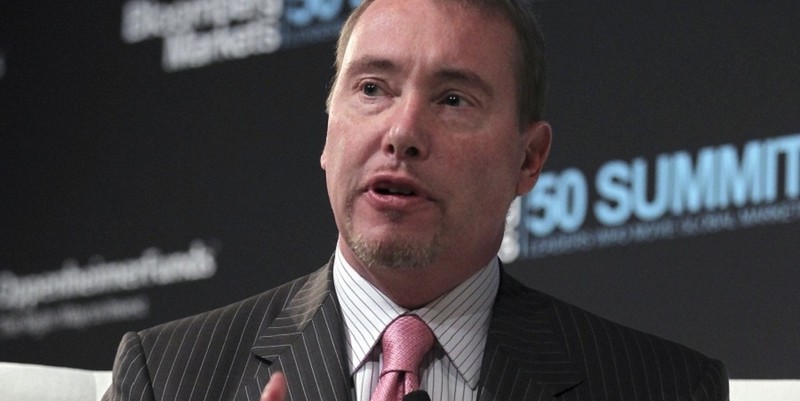
Jeffrey Gundlach, chief executive of DoubleLine Capital, believes investors and financial advisers should not get too comfortable with the recent pattern of
Federal Reserve monetary policy.
In a punchy presentation in front of a packed ballroom Tuesday in San Diego, Mr. Gundlach took shots at Fed policy, the presidential election, and what he described as the “bizarro world” of both U.S and global monetary policy.
“We're at the moment where it's nearly certain we're going to pass the baton to fiscal stimulus,” Mr. Gundlach told the audience at the
Schwab Impact conference in San Diego.
The conference has drawn about 4,000 attendees, most of whom are independent investment advisers who custody their client funds with Schwab.
(Also from the conference: Schwab CEO: Advisers face challenge of keeping fiduciary edge over brokers in post-DOL rule world)
While Mr. Gundlach doesn't support fiscal stimulus or believe it's the answer, he sees the Fed as doing everything possible to steer clear of a significant pattern of higher interest rates, which brings the U.S more in line with much of the global economy.
“More than three-quarters of all the sovereign bonds in the world now have negative yields, and I think this trend is going to continue,” he said. “It has just hampered the banking system, and you cannot save your economy by destroying the banking system. And if you keep these rates there long enough you will destroy the banking system.”
On that point, in terms of U.S monetary policy, he called out the Federal Reserve Board of Governors in general, and Fed Chair Janet Yellen in particular.
Regarding the closely watched dot patterns that show the way Fed members are forecasting future rate hikes, Mr. Gundlach said, “I bet they wished they had never invented the dots,” which for the past four years have shown patterns of Fed rate hikes.
The Fed cuts rates to zero during the 2008 financial crisis, which was followed by three rounds of quantitative easing that loaded the Fed's balance sheet with more than $4 trillion worth of bonds.
The Fed hiked rates 25 basis points last December, and is expected to introduce another 25-basis-point hike this December.
“The dots have completely destroyed the Fed's credibility,” Mr. Gundlach said. “They have cried wolf too many times.”
Mocking pundits who believe the Fed's dovish monetary policies are largely responsible for driving riskier investments like stocks higher, Mr. Gundlach reminded that audience that since July the yield on the 10-year Treasury has climbed 50 basis points.
“The Fed's monetary policies are shown to not work,” he said, citing recent comments by Ms. Yellen about altering the Fed's mandate on unemployment as a factor in deciding interest rates.
“Yellen, who will own this, is now the most dovish member of the Fed,” he said. “ Quietly she has moved the goal posts from 5% unemployment rate to 4%” before the Fed will raise rates.
(Also from the conference: Will Hillary Clinton-Donald Trump slugfest permanently alter US politics?)
On the fiscal stimulus debate, Mr. Gundlach joked that the government could pay people currently on welfare to go out and dig, then refill, holes in their yards. .
“It's the thought that counts,” he quipped.
The more likely scenario, which is being presented by both presidential candidates, is for billions of dollars worth of infrastructure spending.
The problem with that, he said, is the cost it adds to the deficit.
“Medicaid,
Social Security and the rising cost of Obamacare have all been in quiet periods,” he said. “Nobody talks about the deficit anymore, but the deficits are exploding and with hundreds of billions coming due for QE 1, 2 and 3, the deficit could easily reach $1.5 trillion.”
Mr. Gundlach's lighter side showed most when he was discussing politics, even poking fun at himself for once forecasting that Republican nominee Donald Trump would defeat Democratic nominee Hillary Clinton.
He compared Mr. Trump to the sudden recent popularity of unconstrained bond funds.
“If everything sounds bad, just invest in something you don't understand,” Mr. Gundlach said. “Trump is the same thing. Who the heck knows what he would do.”