
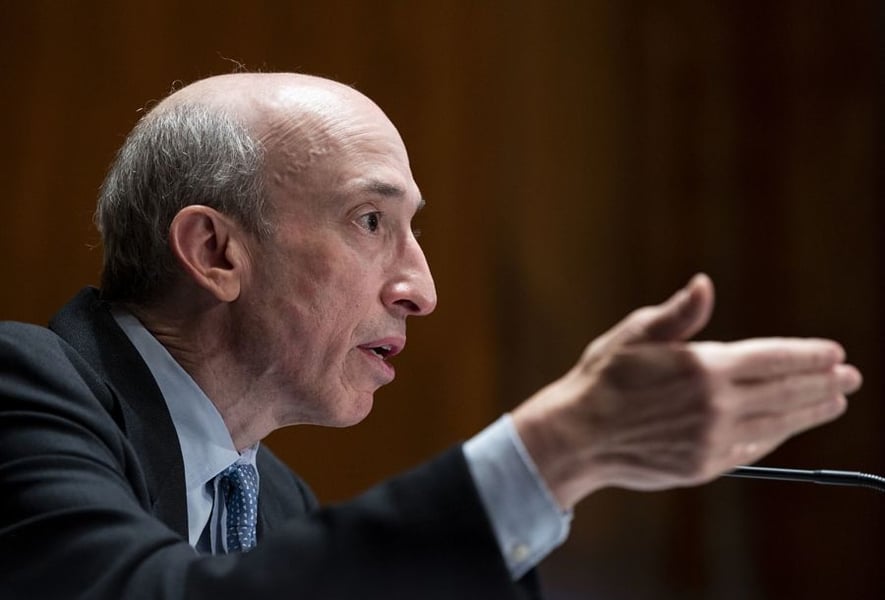
SEC Chair Gary Gensler faced rounds of grilling and scolding at a House Financial Services Committee hearing Wednesday, with Republicans focused on the agency’s efforts on climate-related disclosures, crypto regulation, artificial intelligence, the Consolidated Audit Trail and overall pace of rulemaking.
The hearing occurred just ahead of a likely government shutdown, the effects of which accounted for much of Democrats’ lines of questioning.
This weekend, unless a federal budget fix or temporary agreement is reached, government agencies' staff will largely be furloughed indefinitely, including those at the Securities and Exchange Commission. About 7% to 8% of SEC personnel, a “skeletal staff,” would remain active during a shutdown, Gensler told House committee members.
“The public won’t have somebody in full force overseeing the market,” he said. Examinations, enforcement and disclosure review would effectively stop. While the public could submit tips, complaints or comments, they would not be reviewed, Gensler said. And initial public offerings would be on hold, as no one would be around to review documents.
“If there were a market event … senior leadership would be there,” he said. “But again, we’d be down to a skeletal staff.”
The country has been through this 21 times since 1976. Prior shutdowns have hurt morale, Gensler noted.
“It’s hard on people. They’re not getting a paycheck,” he said. “They could get jobs at law firms and go elsewhere. They are dedicated public servants.”
Republicans peppered the SEC leader as they have in prior hearings, taking issue with what they said was a lack of response to records requests they made earlier this year. They also accused the SEC of recklessly moving forward on numerous proposals without considering the economic effects that some of the interrelated rules would have in aggregate.
“Our patience is wearing thin. The SEC is not above the law, nor is it unique. Other financial regulators have routinely complied with congressional oversight,” Patrick McHenry, R-N.C. and chair of the committee, said in prepared remarks. “I do not want to be the first chairman of the Financial Services Committee to issue a subpoena to the SEC.”
Among documents Republicans have requested are records showing interactions with the failed crypto exchange FTX and its founder and former CEO Sam Bankman-Fried.
House reps also pointed to about 50 rule proposals the agency has made under Gensler’s watch, alleging that it has moved too quickly and hasn’t taken enough time to allow for comments.
“You have 30 major rulemakings, but you won’t even provide documents to us,” McHenry said. “We intend to get your compliance, and we can do it the easy way or the hard way.”
Conversely, Democrats cited a Bloomberg Law analysis of the SEC’s rulemaking process, which called out Gensler for moving more slowly than his predecessors.
Currently, the SEC has 24 rules that have been finalized under Gensler, compared with 64 that were approved under former Chair Jay Clayton (2017 to 2019), 28 under Mary Schapiro (2009 to 2011) and 34 under Harvey Pitt (2001 to 2003), according to the Bloomberg Law data cited by Democrats.
Among the proposals are four that would focus on equity market structure, including payment for order flow. Late on Tuesday, a bipartisan group of House reps reportedly sent Gensler a letter outlining concerns about the SEC’s work on those rules. The group did not intend to discourage the SEC’s work and encouraged it to get order execution disclosures updated so that market participants would be able to compare the quality of order execution, said Rep. Bill Foster, D-Ill.
Both sides of the aisle prodded Gensler about the SEC’s climate-related disclosure proposal, which would require public companies to standardize their reporting of greenhouse gas emissions and other data. The right generally wants the SEC to abandon the proposal, while the left is urging that it be expedited and more encompassing.
“Investors today are making decisions based on climate-risk disclosures. We’re trying to bring some comparability,” Gensler said.
Most large public companies voluntarily provide climate-related data to investors, but how they do so is not standardized, so the SEC needs to step in, he said.
The regulator is expected to finalize its rule as soon as next month, just as California Gov. Gavin Newsom is poised to sign a bill that would supersede the SEC’s requirements. Gensler had noted that the SEC will move forward regardless, but he has also indicated that it's revisiting a potential requirement for very large companies to disclose Scope 3 emissions, which include greenhouse gases associated with their supply chains and end users.
“We understood even in the proposal that so-called Scope 3 is less developed. It’s less used,” Gensler said. “We’ve gotten a lot of feedback, and we’re taking that into consideration.”
While Republicans and some Democrats jabbed Gensler over his stance on cryptocurrency and the agency’s proposal to address artificial intelligence, predictive analytics and other technology used by brokerages and investment advisors, a greater concern was the agency’s rollout of its Consolidated Audit Trail. That surveillance system, which the SEC approved in 2016, is designed to collect data on customers and orders for equities and securities, and to be run by about two dozen self-regulatory organizations. That has led to privacy concerns.
“This is a massive overkill. This is unnecessary invasion of privacy. This is a massive tax on the brokerage accounts of ordinary American citizens … This is another large American database that is going to be hacked,” said Rep. French Hill, R-Ark. “You inherited this albatross. Why don’t you just kill it?”
Foster pointed out that Gensler was chair of the Commodity Futures Trading Commission during the 2010 flash crash. While the CFTC readily had access to data to understand the crash, the SEC struggled to get information four days later, Foster noted.
“It was the very next morning that the CFTC had that information that the SEC did not,” Gensler said.

After years of encouraging sacrifice and delayed gratification, advisors have to do the next emotional lift: helping clients let go of a potentially harmful scarcity mindset.

A new JPMorganChase Institute report reveals how deeply stock market wealth now drives everyday American spending, especially for retirees.

A survey of 507 solo agers finds most lack confidence in their plans and that systems, not just individuals, need to change.

A new Schroders survey exposes a widening gap between what Americans expect in retirement and what they're actually on track to receive.

Two wealthtech providers are handing advisors the controls, letting firms design their own workflows and AI agents in plain language.
Northern Trust’s Ken Lassner shows advisors how to convert volatility into after-tax portfolio gains
Dan Biagini of American Equity says the steady decline of pensions, longer lifespans and a reset in interest rates are rewriting how advisors build retirement income

