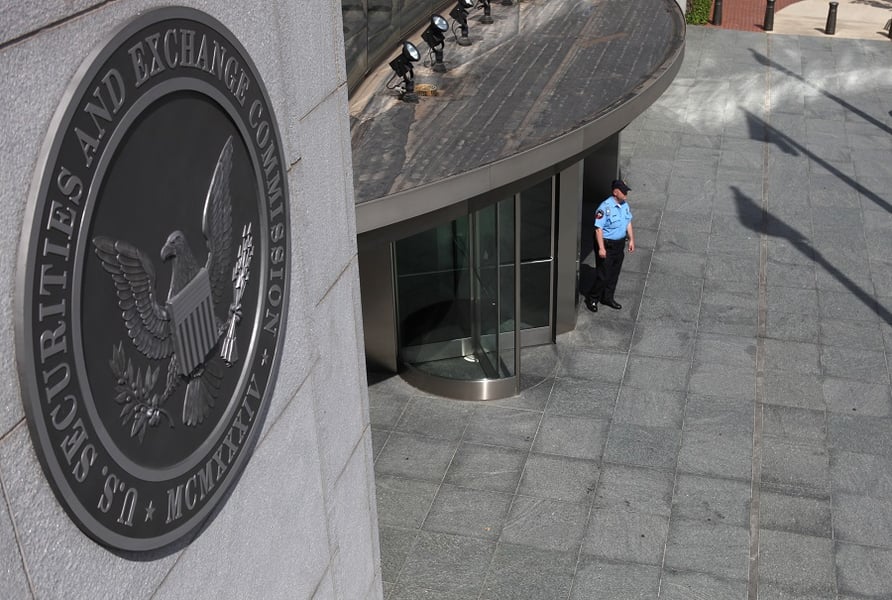
The Securities and Exchange Commission is fighting a decision by an in-house agency judge to dismiss charges accusing two financial advisers of
not informing clients they were paid by
Fidelity Investments to sell certain mutual funds.
In a filing posted on the SEC website Monday, two of the regulator's employees argued that an SEC administrative law judge's
June 4 decision in favor of the Houston-based financial-advice firm Robare Group set a troubling precedent.
“It shifts the burden of fully disclosing a conflict of interest from an investment adviser, who has a fiduciary duty to and a relationship with its clients, to a compliance consultant,” the SEC staffers said in
the appeal, which is dated June 25. “As a practical matter, such a rule would improperly mean that an investment adviser may be excused from securities violations so long as he retains a compliance consultant, who does not affirmatively object to a particular disclosure.”
The two staffers who wrote the appeal work in the agency enforcement division's Fort Worth, Texas, regional office.
The judge's decision dealt regulators one of very few losses it's seen in often-criticized, court-like proceedings it administers itself. The SEC has the authority to bring some cases in its own hearings, as well as in traditional, civil court trials.
The 29-page appeal seeks a review of the judge's decision by the full five-member commission.
CONTROVERSIAL PRACTICE
The new appeals process launches into an unpredictable new phase a case that underscores a
controversial practice by custodians that pay affiliated, independent advice firms to sell certain third-party funds.
Since 2004, the Robare Group has been enrolled in a program in which Fidelity pays a share of the revenue it earns on some third-party mutual fund sales to the advisers who sell the funds. The funds also are made available to the advisers without transaction fees.
Transaction-free platforms are popular with advisers and lucrative for custodians, who receive payments from fund companies to participate. Custodians sometimes pay financial advisers who participate.
But Fidelity does not describe the payments as a commission; instead it calls them compensation for “shareholder administrative services.” That's despite the fact that advisers provide the exact same services to other funds not enrolled in the program.
NOT ALWAYS DISCLOSED
Robare did not always disclose those payments in its Form ADV, a filing with regulators that's made available to clients. Separately, it provided to new clients a Fidelity document that more explicitly acknowledged the payments. But Fidelity determined the firm's disclosures were inadequate and told Robare to update its filings in 2011.
While the advisers argued that the disclosures of the Fidelity payments were not “material,” administrative law judge James E. Grimes disagreed.
But he said the evidence didn't suggest the advisers were acting fraudulently. He noted that a high percentage of their clients' assets were in funds not offering revenue-sharing, including, at times, Fidelity-managed index funds. Robare manages $160 million for clients.
In
a 44-page decision, Mr. Grimes wrote that the owners, advisers Mark L. Robare and his son-in-law Jack L. Jones Jr., “came across as honest and committed to meeting their disclosure requirements,” including relying on their broker-dealer and compliance advisers.
The judge said testimony during the proceedings in February showed that advisers “operate in a difficult environment” for compliance with securities law. The ruling suggested that advisers are in many cases right to rely on advice from compliance specialists, including that from broker-dealers.
"Judge Grimes made so many credibility determinations in favor of my clients they might be difficult to reverse,” said Alan M. Wolper, a lawyer at Ulmer & Berne who represents the advisers. “It is my hope that the commission will recognize that.”
The advisers decided not to settle the case because they “couldn't stomach” admitting that they committed fraud, their lawyer has said.
A Fidelity spokeswoman, Nicole Abbott, did not respond to a request for comment.
COMMISSIONERS TO HEAR APPEAL
An appeal in this matter will now be reviewed by the five SEC commissioners, who can decide to reverse the judge's decision. If the commissioners' decision is appealed, the case would move to a more traditional venue, a federal appeals court.
The agency
has faced criticism over its administrative-law court hearings from politicians and securities lawyers, as well as former SEC commissioners and staff members. Those critics have argued the increasing practice of relying on its own judges comes at a cost to defendants, who lose cases more often during in-house proceedings than in cases taken to trial.