
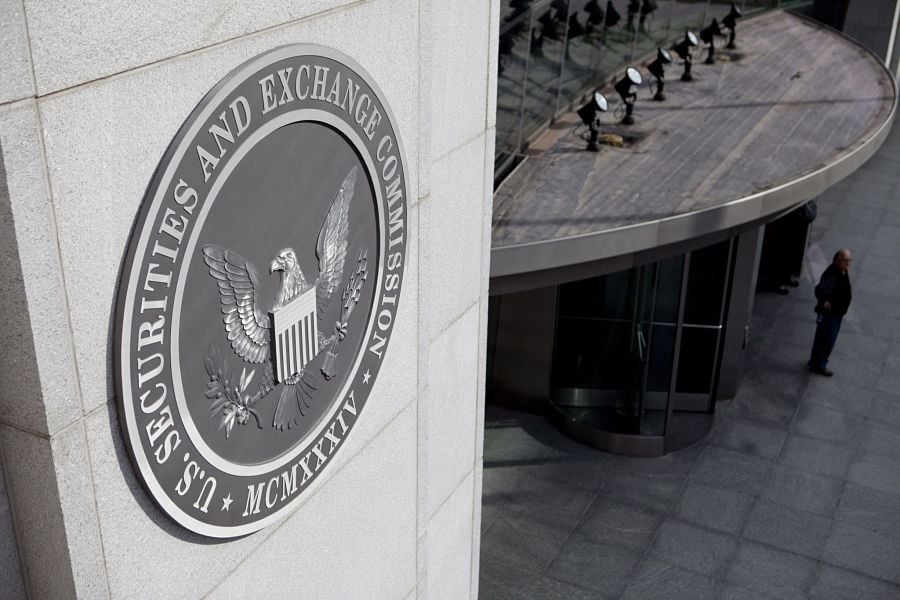
The Securities and Exchange Commission announced Friday that it imposed a $5.8 million penalty on Private Advisor Group for recommending high-fee mutual funds to clients and failing to disclose related conflicts of interest.
The SEC alleged that since July 2014, the firm had invested client assets in mutual funds that charge 12b-1 fees. Those funds were used in wrap accounts where Private Advisor Group deducted transaction fees from the compensation of its investment adviser representatives, according to a order posted Thursday.
But the firm, which is LPL Financial's largest affiliated branch office, avoided transaction fees by purchasing mutual funds that charged 12b-1 fees, whose costs were borne by investors. The SEC said that lower-cost share classes of the same fund were available to clients through Private Advisor Group’s clearing firm for a transaction fee. The SEC said Private Advisor Group did not receive any 12b-1 payments.
The firm “failed to disclose the conflicts of interest that arose from the decision to invest wrap program client assets in [no-transaction-fee] shares — where PAG, and ultimately its IARs, avoided paying transaction fees — over lower-cost [transaction-fee] shares of the same mutual funds,” the SEC order states.
The SEC also found that the firm breached its fiduciary duty of care by failing to give its clients best execution when it recommended the high-cost rather than less expensive mutual fund share classes.
The SEC charged Private Advisor Group with violating anti-fraud and compliance provisions of the Investment Advisers Act.
Private Advisor Group agreed to a cease-and-desist order, a censure and the $5.8 million fine, which will be distributed to investors. The firm neither admitted nor denied the SEC’s findings.
The SEC’s enforcement action is the latest in a years-long campaign by the agency to crack down on inadequate disclosures surrounding the recommendations of high-fee mutual funds. Over the last several months, the SEC also has been making best-execution charges.
“As part of an ongoing mutual fund share-class review initiative, Private Advisor Group has agreed to a settlement with the SEC regarding disclosures of certain historic practices,” firm spokesperson Kelly Coulter said in a statement. “We are pleased to put this matter behind us.”
The SEC order notes that beginning in 2017, the firm no longer allowed mutual funds with 12b-1 fees to be purchased in wrap fee accounts.
The firm requires the purchase of the lowest-cost share class, Coulter said. “This requirement is a still an industry-leading policy.”
But the SEC said the reform didn’t go far enough.
“While these changes, when implemented, began to mitigate the conflict of interest, they did not eliminate it and the conflict was never disclosed to clients,” the SEC order states.
But because the policy was updated in 2017, the vast majority of the settlement amount credited to clients will cover the period from July 2014 to December 2016, Coulter said.
“To highlight the historical nature of this issue, less than 4% of our current accounts will receive a credit of more than $100,” Coulter said.
U.S. seniors lose $28.3 billion annually as a result of financial exploitation, according to a 2023 AARP study.

Cornerstone Capital and Echo Wealth Management add about $1.7 billion as RIA M&A heads for a record year.

As Robinhood and Schwab roll out AI agents and assistants, a new survey finds advisors still edge out chatbots in terms of client trust.

See which platforms and providers earned 5-Star recognition this year

Meanwhile, a multigenerational Cambridge team has hopped to LPL in Michigan, and Cetera's run of Commonwealth recruitment continues in New Jersey.
As AI makes financial information more accessible than ever, Lana Hock explains why human judgment, trust, and empathy remain the qualities clients value most in a financial advisor
Northern Trust’s Ken Lassner shows advisors how to convert volatility into after-tax portfolio gains

