

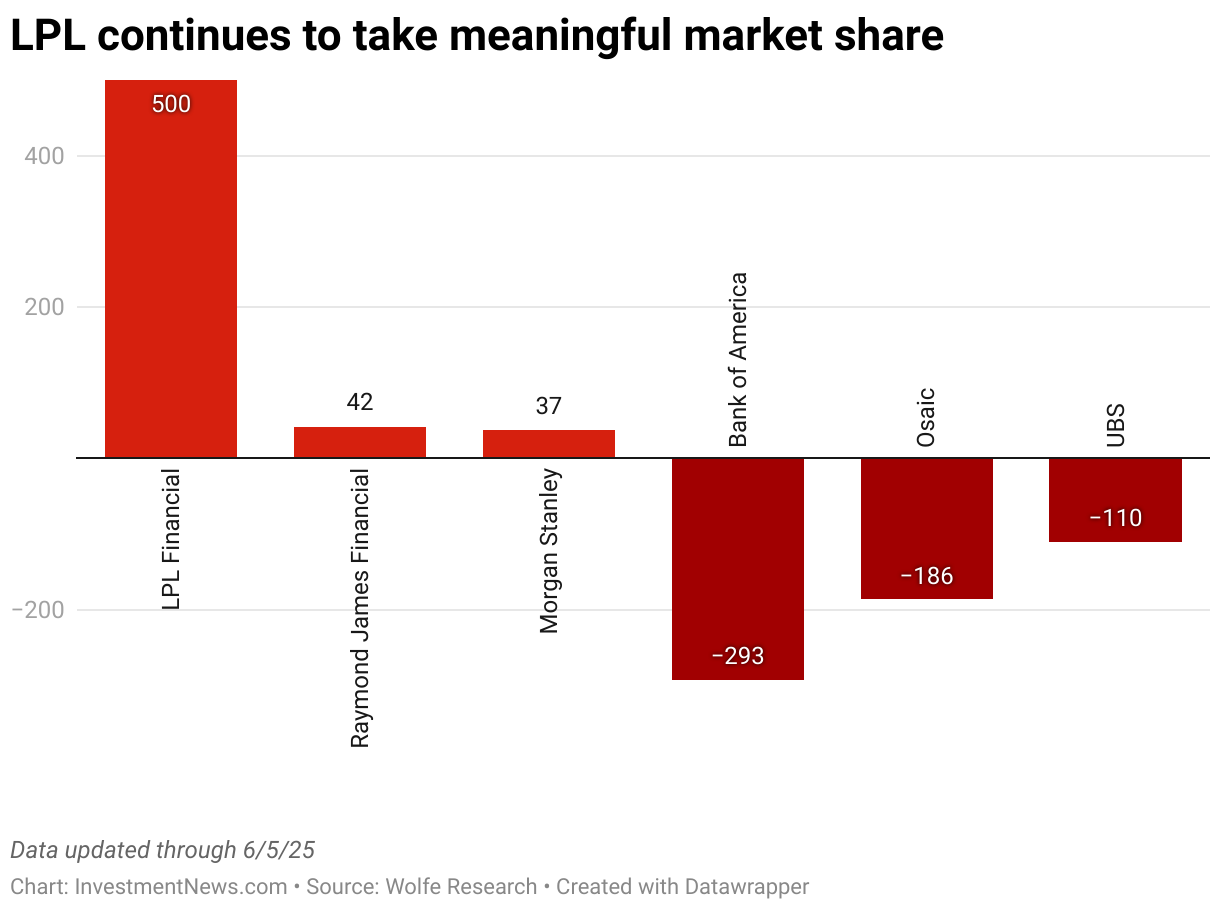
Bank of America, which includes Merrill Lynch, Osaic and UBS have all seen the largest net loss or attrition of financial advisors this year through the first week of June, according to a new report from Wolfe Research.
Based on Wolfe Research analysis, Bank of America and Osaic, formerly Advisor Group, are seeing the greatest attrition, down 293 and 186 net departures, respectively.
They are followed by UBS, which is down 110 financial advisors. It is worth noting that “UBS departures appear to be accelerating following recent comp changes,” according to Steven Chubak, managing director of Wolfe Research and a leading brokerage analyst, in a research note Sunday.
All figures are through June 5.
A spokesperson for Bank of America said it does not comment on analysts’ notes, while a UBS spokesperson declined to comment. A spokesperson for Osaic did not return a call Monday morning to comment.
Counting advisors moves in and out of firms requires some art as well as science. For example, Bank of America relies heavily on trainees, and such advisors are not always included in tallies of advisors moving from one firm to another. Also, new advisors at firms sometimes don’t show up immediately in employment records and databases because there is a lag in reporting.
But advisor moves are one indication of a firm’s overall base of revenue, which comes from advisors’ fees and commissions.
Toward the end of last year, UBS said it was redrawing its pay plan for advisors and in 2025 would cut a bonus for teams that was unique in the industry, according to industry sources. It also cut rates on its pay grid that will squeeze advisors who are the lower producers of revenue, a long-running tactic by large firms to boost margins.
That caused some to expect advisor attrition to accelerate at the US wealth management arm of the Swiss banking giant.
“After the changes to compensation to advisors, we’re seeing both anecdotally and looking at data,” said Louis Diamon, an industry recruiter. “UBS just happens to be the wirehouse in the spotlight, and that seems to be a part of the cycle that last every couple years for the wirehouses.
“But the kind of financial advisors UBS is losing is much more significant because they are very large teams,” Diamond said. “They have larger teams, in terms of assets and revenues.”
On the other side of the ledger, LPL Financial Holdings was the biggest net gainer of financial advisors, adding approximately 500 advisors, according to Wolfe Research. LPL was followed by Raymond James Financial, gaining 42, and Morgan Stanley, with 37.

The financial advice industry has been facing inquiries into its cash sweep programs for years now.

Investor money allegedly went to strip clubs, exotic cars, and landscaping

Procyon adds $415 million in assets under management in New Jersey while Savant picks up a $213 million Southern California planning firm

With a growing number of real estate-rich Baby Boomers aging into retirement, some advisors may be failing to consider all the options available for those clients' assets.

Cornerstone Advisors study reveals compliance bottlenecks stall campaigns weeks after customer opportunities close.
As AI makes financial information more accessible than ever, Lana Hock explains why human judgment, trust, and empathy remain the qualities clients value most in a financial advisor
Northern Trust’s Ken Lassner shows advisors how to convert volatility into after-tax portfolio gains

