Pimco boss doesn't foresee full unwinding of obligations from quantitative easing
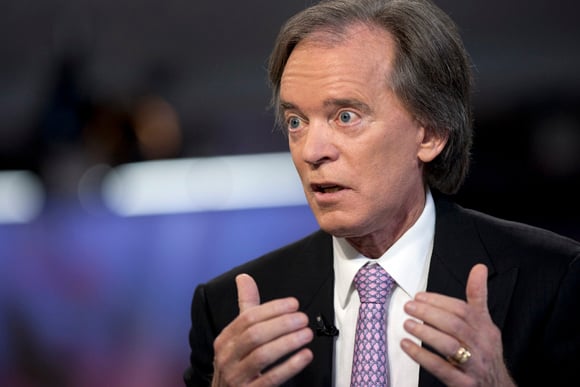
In wide-ranging comments on Thursday, Pimco founder Bill Gross detailed what the unwinding of quantitative easing might look like.
Speaking at the IndexUniverse Inside Fixed Income Conference in Newport Beach, Calif., Mr. Gross told
advisers that central banks would likely be successful in igniting some inflation via loose monetary policies, and suggested weighting portfolios toward inflation-protected assets.
When asked what the ultimate unwinding of the Fed's inflation trades might look like, Mr. Gross predicted there would be no exit -- that the Fed would be stuck with "dead" bonds.
His full comments:
"There are a number of ways it can play out. An exit at the moment is dependent on unspecified but increasingly specific targets. [Federal Reserve] governor [Narayana] Kocherlakota [president of the Minneapolis Fed on Thursday] basically said the Fed's target is 5.5% unemployment. That seems a little bit of a stretch to me, but clearly at 8.1% or 8.2% [unemployment now], I think they have 6% unemployment targeted. So the exit … won't occur until we get to 6% or lower unemployment, or as [Mr. Kocherlakota] couched it, inflation at 2.25% or 2.5% and accelerating. So, those are the two conditions. … I'm basically going so far as to say [the Fed is] not going to exit, that all those mortgages, all of those Treasuries on the balance sheet, they're never coming off. That's why I tweeted yesterday or the day before, 'Central banks are where bad bonds go to die.' Think about it. In euro land, the ECB has been buying Greek bonds, and now they're buying Italian and Spanish bonds, and we can accurately say those are dead bonds. But in the U.S., a 10-year Treasury at 1.7% and a 30-year Treasury at 2.8%, those are bad bonds, because they're bubbled and they're overvalued. And so, a central bank is where bad bonds go to die. So is it like a zombie -- do they spring alive again, and come back out of the balance sheet and go home to the private market? It's possible. And that's what [Fed chairman Ben] Bernanke speaks to all the time, about the exit strategy. I think basically an investor has to understand there's no exit. That those bonds are there, they're going to mature, and that it's only a question of how long the central bank continues the process of QE3.
"When would the central bank stop all this nonsense? When would a central bank realize you can't cure a debt crisis with more debt? Well, probably only at the point where inflation begins to accelerate as [Mr.] Kocherlakota talked about [Thursday]. And realistically, to 3% and 4% and 5% [inflation], at some point the Fed would say, 'Hey, we've got a dual mandate here and at least we've got to stop buying, I may not be able to sell these things, but at least I have to stop buying.' So the ultimate outcome of all of this is, as I spoke to [earlier], in terms of the reflationary versus the deflationary tilt, if the Fed writes checks over the next 12 months of a trillion dollars, and they probably will, if the ECB writes another trillion dollars of checks, then ultimately it comes out in inflation. It might not come out in real growth. … Ultimately monetary policy ends when inflation begins to accelerate, when the dollar begins to go down and is trashed, and investors like the Chinese and Pimco and others … basically say a 1.7% yield in a 4% inflationary world is not my cup of tea. … So that's how it ends.
"How long is that from now? We'll just have to see. [Mr.] Bernanke has promised that in addition to QE3, if this doesn't work, there's more behind this. And I'm not sure what that might be, because the Fed basically is limited to Treasuries, mortgages, and short-term municipals believe it or not. And to buy foreign bonds which I can't believe Bernanke would ever do because that's a political type of thing. So there's only so many mortgages [and] Treasuries to buy before all of the sudden they become handcuffed in terms of more buying. So maybe that's an outcome, too. … It's not an outcome an investor really wants to face unless they're protected with inflationary-protected types of assets."