

The booming ETF industry may be set to lure even more cash in the coming years as rich Americans facing higher capital gains taxes look to limit what they owe Uncle Sam.
President Joe Biden’s plan to double the rate those making more than $1 million a year pay on investment profits would accelerate a shift that’s already seen hundreds of billions of dollars migrate from mutual funds to exchange-traded funds, market watchers say. That’s because ETFs are generally more tax-efficient, spinning off fewer capital-gain disbursements that for some could soon become a lot more costly.
In fact, by one measure, the tax efficiency of ETFs has been the single most important driver behind the tectonic shift in asset allocations in recent years. While the administration’s plan remains in its infancy and is sure to face intense scrutiny from lawmakers in the months ahead, even an incremental hike in the capital-gains rate would likely spur further ETF usage, according to David Perlman, an ETF strategist at UBS Global Wealth Management.
“If capital gains tax rates are going to be higher, if you have a choice of a structure that helps to defer capital gains and gives you more control over when to recognize those gains, you’d be more inclined to go in that direction,” Perlman said.
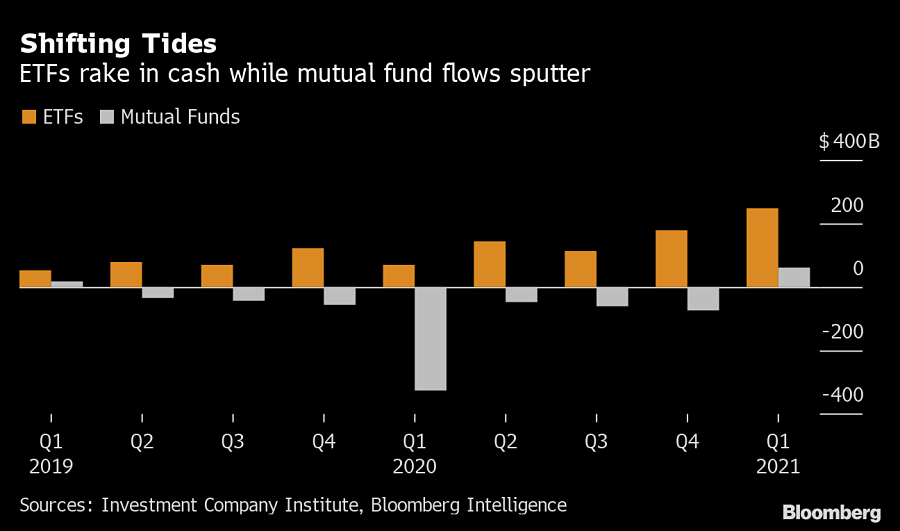
When an investor exits a mutual fund, the fund’s manager must sell securities to raise cash for the redemption. The same investor leaving an ETF can sell their shares on to another investor, meaning neither the fund nor its manager has made a taxable transaction.
Meanwhile, the “in-kind” process used to create and redeem shares in an ETF -- in which the ETF issuer exchanges the fund’s underlying securities with a market maker rather than transacting in cash -- means the ETF rarely executes a taxable sale.
A December study by researchers at Villanova and Lehigh universities found that over the past five years, ETFs have averaged a tax burden 0.92% lower than active mutual funds. Moreover, particularly for high-net-worth investors, tax considerations have outweighed both performance and fees as the primary driver of flows out of active mutual funds and into ETFs, the findings showed.
“There’s no question Biden’s plan to hike the capital gains tax could be a boon for ETFs,” Nate Geraci, president of the ETF Store, an advisory firm, said via email. “Despite significant market share gains by ETFs over the past decade, there are still trillions of dollars locked in less tax efficient mutual funds.”
Last year alone, the ETF industry took in almost $500 billion, while mutual funds lost about $362 billion, according to data compiled by Bloomberg.
Most ETFs hardly pass along any capital gains to shareholders nowadays. Only three of 585 in a CFRA analysis made disbursements in 2020, Todd Rosenbluth, head of ETF & mutual fund research at the firm, wrote in an April 26 report. Over the same span, 37 of 39 domestic equity mutual funds from T. Rowe Price Group Inc. incurred a capital gain, the analysis showed.
“We expect more people that mix ETFs and mutual funds together will be more inclined to shift toward strategies to avoid paying higher capital gains taxes in the future,” Rosenbluth wrote.
Even investors not affected by the higher rate could migrate toward ETFs, he added. Simply the discussion of capital gains reminds investors of the industry’s innate tax advantages over mutual funds.
Others aren’t convinced a higher capital-gains rate will do much to boost inflows into ETFs. Wealthy investors would have to sell their mutual fund holdings to make the switch, triggering significant tax liabilities in the process, said Michael Zigmont, head of trading and research at Harvest Volatility Management.
“I see this tax hike not being good or bad for ETFs,” he said.
Meanwhile, ETFs don’t suit every investment need. The U.S. retirement system remains heavily geared toward mutual funds, for example.
Nonetheless, Perlman agrees with Rosenbluth that the potential tax change could even have an impact on investors below the $1 million annual earnings threshold.
Those expecting to soon find themselves in the upper tax bracket, or concerned the threshold could be lowered down the road, are also likely to shift their future allocations, he said.
“The incentives apply more broadly than just to those impacted by the proposal,” Perlman said.

MyComplianceOffice's AI-assisted surveillance links employee chats on Slack and Telegram with prediction market trades as Wall Street tightens rules

Elsewhere, Raymond James absorbs a family-run practice from Commonwealth into its independent channel, while RBC welcomes a father-son tandem formerly from UBS.

Fuel-driven inflation drove the supersized adjustment, but advocates say retirees are still losing ground as trust fund insolvency nears.

State mandates and plan complexity are opening doors for financial advisors in the 401 market.

New LIMRA data reveal a stubborn advice gap that financial professionals are well-positioned to close.
Knighthead Life entered the market with a competitive MYGA. A strong launch earned advisor confidence and paved the way for FIAs.
As AI makes financial information more accessible than ever, Lana Hock explains why human judgment, trust, and empathy remain the qualities clients value most in a financial advisor

