

It wasn’t long ago that the odds of successfully launching an ETF were stacked heavily against the little guy. To survive, a fund needed scale, early cash and wide distribution, and that gave larger issuers a built-in advantage.
The retail investing revolution may be changing all that.
Suddenly, newcomers are luring big chunks of cash from the outset with exchange-traded funds built to surf the trends beloved by the day-trading masses.
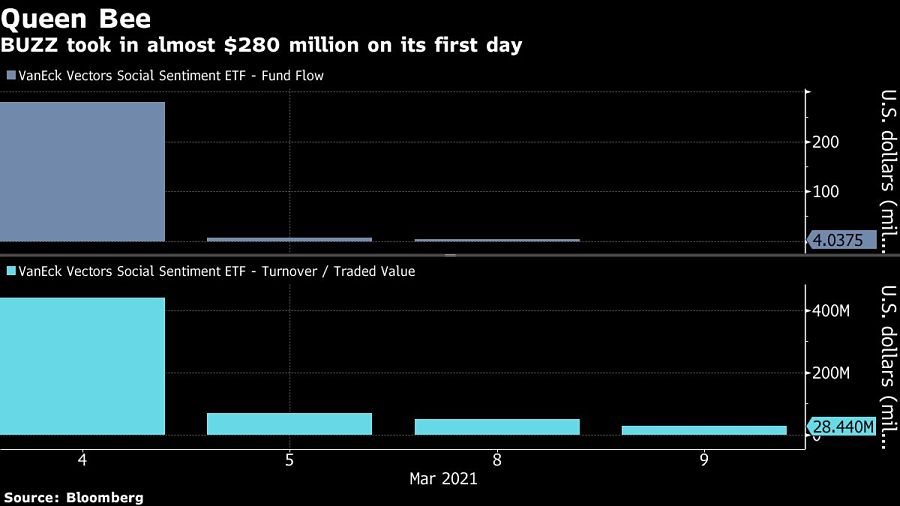
Just look at BUZZ, otherwise known as the VanEck Vectors Social Sentiment ETF. The fund, which targets stocks getting positive mentions online, posted one of the most active first days of trading in ETF history last week after an endorsement from Barstool Sports Inc. founder Dave Portnoy.
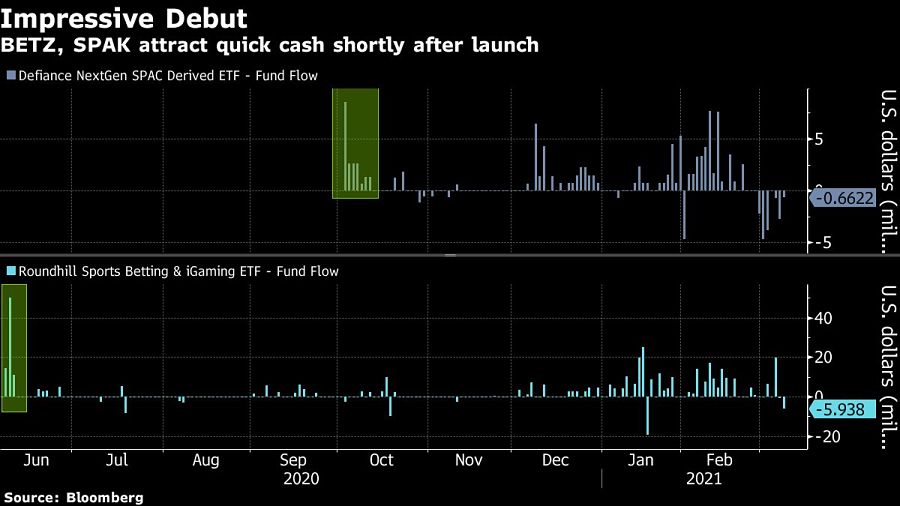
Even without promotion from day-trading royalty, funds tapping into other interests of Redditors, like the Roundhill Sports Betting and iGaming ETF (BETZ) and the Defiance Next Gen SPAC Derived ETF (SPAK), have quickly raked in assets since launch. The AdvisorShares Alpha DNA Equity Sentiment ETF (SENT), saw more than $44 million worth of shares traded when it first launched in early February. Small wonder that one of the latest filings is for an actively managed product that will go by the name FOMO.
At the heart of all this is an uncomfortable fact of life in the $5.9 trillion U.S. ETF industry: The initial cash infusion can make or break a new fund. That’s because wirehouses -- brokerages like Morgan Stanley and Bank of America where clients can execute trades -- usually require a minimum of assets before offering a product.
Day traders known for chasing the latest shiny object have therefore become obvious marketing targets for ETFs containing buzzy stocks, since their flows can help a fund rapidly reach the survival threshold. And while issuers have long given funds cutesy names in a bid for assets, the pandemic-fueled explosion in do-it-yourself investing has made it even more important to attract retail cash.
“We’ve seen this brazen new investment class that’s been fueled by the intersection of technology, zero commissions and fractional share trading,” said Michael Arone, chief investment strategist for the U.S. SPDR exchange-traded fund business at State Street Global Advisors.
While it’s impossible to determine the exact breakdown between retail and institutional buying in a fund’s flows, quick bursts of activity in an ETF shortly after its debut usually signal small-time traders jumping in.
Meanwhile, as new ETFs grab more cash, and perhaps because of the perceived fickle nature of retail investors, the big players are choosing to wait longer to engage with these funds.
In a recent survey of almost 400 institutional investors, financial advisers and fund managers from Brown Brothers Harriman & Co., more than 40% of respondents said they are looking for a new ETF to have least $100 million in assets before investing in it, up 11 percentage points from 2020.
To understand the shifting environment, look no further than BUZZ. It’s based on an index that was previously used in a similar fund called BUZ. Launched in 2016, the BUZZ US Sentiment Leaders ETF (BUZ) was killed off in 2019 after attracting just $8.8 million in assets.
Fast forward to 2021. After Portnoy promoted BUZZ directly to his 2.4 million followers via a Twitter video, about $438 million worth of shares changed hands in the first day.
“There are lot of eyeballs looking at the market that are retail,” said Eric Balchunas, ETF analyst for Bloomberg Intelligence. “It’s like going fishing and the fish are just biting like crazy.”
Everyday investors also fueled the initial pop in BETZ after its June launch, according to Will Hershey, chief executive at Roundhill Investments. The fund took in about $75 million in its first four days of trading.
“You’d be foolish not to target the retail audience,” he said. “They’re too significant a part of the market right now for issuers to ignore.”
Day traders now account for 23% of all U.S. equity trading, up from 14.5% in 2019, according to estimates from Bloomberg Intelligence’s Larry Tabb.
New funds aren’t the only ones benefiting from this shift. Cathie Wood’s flagship Ark Innovation ETF (ARKK) had been running 6 years before suddenly rocketing in the past year. Its pitch is a bet on disruptive technology, with holdings like Tesla Inc. that are catnip to the Reddit crowd.
And since retail clients now make up one-third of all ETF ownership, according to Bloomberg Intelligence data, issuers looking to gain market share want to grab their attention.
That’s part of the strategy that Sam Masucci, CEO and founder of ETF Managers Group, is pursuing for his funds, which include the $1.8 billion ETFMG Alternative Harvest ETF (MJ) and $2.1 billion ETFMG Prime Cyber Security ETF (HACK). Although his firm markets directly to the professional community, it’s also heavily investing in social media advertising and campaigns on Google.
“We see our products fitting squarely in retail’s interest and investing in hot new themes,” he said.

New Allspring research finds 401(k) participants want guidance on income and rollovers, not just portfolio automation.

Aging homeowners hold record housing wealth - but most advisors still aren't bringing it into retirement plans

$1.7M invested from an inheritance. Then the phone went dead.

The pre-IPO platform sold $430M in units while allegedly rigging prices behind the scenes.

A Nationwide survey finds 47% of GLP-1 users have never discussed the drugs’ financial impact with an advisor, even as many dip into savings.
Knighthead Life entered the market with a competitive MYGA. A strong launch earned advisor confidence and paved the way for FIAs.
As AI makes financial information more accessible than ever, Lana Hock explains why human judgment, trust, and empathy remain the qualities clients value most in a financial advisor

