

After years of rapid growth, the exchange-traded fund universe is shrinking.
So far in 2020, the number of ETFs trading in the U.S. has declined by 15, a drop of less than 1%, according to data compiled by Bloomberg. While it’s just a tiny decline, if the trend holds for 2020, it would mark the first year ever to see a contraction in the number of ETFs.
The funds that are disappearing are mostly small, niche offerings that failed to gain much traction, and the coronavirus pandemic sealed their fate as investors sought out safety.
While the U.S. currently has about 2,165 ETFs, a handful of funds make up a large share of the $4 trillion market, with five ETFs currently holding more than $100 billion each. Most recently, the Invesco QQQ Trust Series 1, or QQQ, reached the milestone as bets on tech stocks soared.
“The ETF world is quite crowded,” said Nicholas Colas, co-founder of DataTrek Research, a New York-based newsletter publisher. “Once an industry gets fairly mature, you’re going to see that in periods of stress when AUM declines, some go away.”
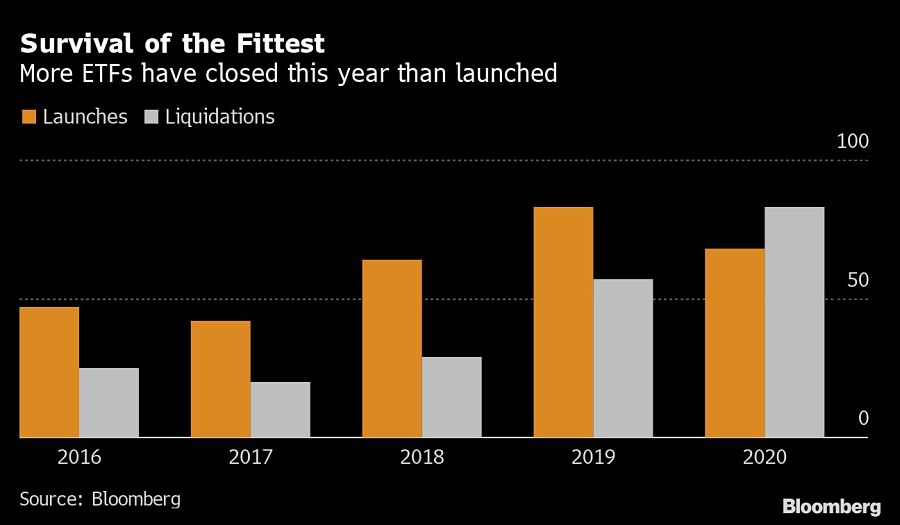
This year, 68 new funds got off the ground, but 83 delisted, including the Forensic Accounting Long-Short ETF, the Invesco Shipping ETF and WisdomTree’s CBOE Russell 2000 PutWrite Strategy Fund. At this time last year, 83 ETFs had started trading and only 57 had closed, according to data compiled by Bloomberg.
One reason for the recent drop-off in new funds is concern among issuers that any new offering would be lost amid all the focus on the coronavirus. But another factor behind the decrease is that it’s getting harder for new offerings to gain traction, Colas noted.
“Despite the growing suite of thematic, actively managed and smart-beta ETFs, the industry’s growth has been primarily driven by demand for a concentrated few low-cost or highly liquid ETFs,” said Todd Rosenbluth, head of ETF and mutual fund research at CFRA. “The pie has been expanding, but a handful of ETFs are taking extra slices.”
Celia Cazayoux, senior investment strategist at People’s United Advisors, is one of the managers favoring ETFs tracking larger swaths of the market, rather than more niche ones.
“I’m not surprised to see some kind of shakeout of things that maybe were a little too specialized and didn’t gain traction,” she said. “We’ve shied away from more specialized ETFs.”
Still, some firms are forging ahead with new products. American Century launched two long-awaited ETFs in April that use active management and operate under rules that allow them to avoid disclosing their holdings on a daily basis. One is focused on growth and the other on value.
Active ETFs could be an area of growth if investors seek out professional money managers to help them get through the market volatility, said Shawn Snyder, the head of investment strategy at Citi Personal Wealth Management.
“For some people, it might be more appealing to find an active investing approach right now,” Snyder said.

Retiring RIA seller David Laidlaw alleges the Carnegie valued his stake on $11.7 million EBITA while pitching potential buyers on $21.3 million.

New tool gives RIAs and family offices AI help vetting private market deals, with some users reportedly halving review time.

Investors got projected returns dressed up as real ones, SEC says

Parents must still act to get the $1,000 federal seed and employer contributions, giving financial advisors a role in the rollout.

FINRA booted Rudy Anguiano from the industry for “conversion - the intentional and unauthorized taking of another person’s property.”
As AI makes financial information more accessible than ever, Lana Hock explains why human judgment, trust, and empathy remain the qualities clients value most in a financial advisor
Northern Trust’s Ken Lassner shows advisors how to convert volatility into after-tax portfolio gains

