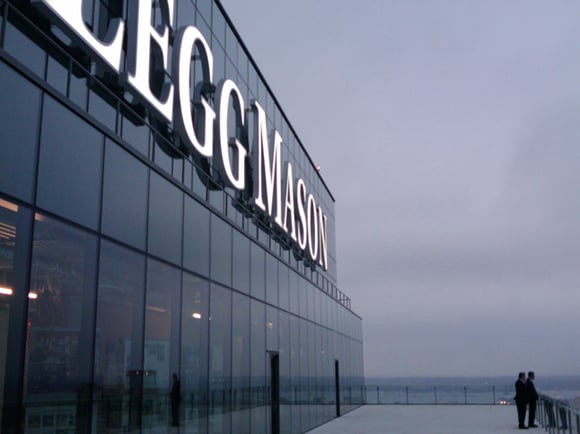
Legg Mason Inc. fell as much as 3.6 percent in New York trading after reporting that fund withdrawals more than doubled from the prior quarter.
Customers took out $23.1 billion, led by $14.4 billion from money-market and cash funds, in the three months ended June 30, the Baltimore-based company said yesterday in a statement. Legg Mason fell 91 cents, or 3 percent, to $29.17 at 12:47 p.m. in
New York Stock Exchange composite trading. The shares have declined 3.2 percent this year, while the Standard & Poor's 500 Index is almost unchanged.
Chief Executive Officer Mark Fetting is trying to reverse redemptions from Legg Mason's biggest unit, Western Asset Management, which oversees fixed-income and money-market assets. Withdrawals at the unit and stock-market declines pushed the firm's assets down 6 percent from the prior quarter to $645.4 billion. Fetting has started share buybacks and cut jobs after the firm suffered the biggest losses among publicly traded money managers during the credit crisis of 2008.
Legg Mason, at the end of April, ranked as the 19th largest retail fund manager.
“Bad continues to outweigh the goods,” Doug Sipkin, an analyst with Ticonderoga Securities in New York, said in a note to clients today, repeating his “sell” rating on Legg Mason. “Emerging negatives include bigger outflows in money markets,” he wrote.
Legg Mason plans to liquidate $23 billion in money funds it oversees for Morgan Stanley Smith Barney later this year. Investors pulled $9.4 billion from Legg Mason's bond funds during the quarter. They deposited $700 million into stock funds, the first positive flows in more than four years, as the firm raised $1.3 billion for a new closed-end fund.
Bond Funds
Fetting, in an interview yesterday, said withdrawals from bond funds at Western Asset were client-specific and are likely to reverse in the next two quarters. The unit's nine funds outperformed benchmarks in the past year.
Legg Mason's fiscal first-quarter earnings fell 4.2 percent to $47.9 million, or 30 cents a share, in the period ended June 30, from $50.1 million, or 35 cents, a year earlier. Excluding an expense of 7 cents a share to open its closed-end fund and 1 cent of restructuring costs, Legg Mason earned 38 cents a share, compared with the 31-cent estimate of 15 analysts surveyed by Bloomberg News.
The company said on May 10 that reducing 350 jobs and moving certain technology functions to its investment affiliates will help save $130 million to $150 million by the end of fiscal 2012. The measures will add 6 percent to 8 percent to its operating margin, which was 23 percent in the quarter. The restructuring will cost $125 million to $135 million to implement, the firm said yesterday.
$82 Billion
Legg Mason had about $82 billion in net withdrawals in the 12 months through March after stock and bond funds, including those managed by Bill Miller and the firm's Western Asset Management unit, lagged behind peers in 2008. Withdrawals slowed to about $10.9 billion in the quarter ended March 31 from $32.7 billion in the previous three months, as performance rebounded starting last year.
Legg Mason's bond funds accounted for about 55 percent of the firm's assets under management as of June 30, according to the company. Equity funds made up about 24 percent, and money funds represented the rest.
Cash invested in structured
investment vehicles contributed to a streak of five quarterly losses that ended in March 2009, after the firm eliminated the mortgage-linked debt from its money-market funds. Activist investor Nelson Peltz last year raised his stake to become the largest shareholder in the company. He was named a director in October.
Returns improved in 2009, after being dragged down in 2008 by Miller's investments in financial companies. Miller's Capital Management Opportunity Trust fund soared 83 percent in 2009, while his Capital Management Value Trust climbed 41 percent, beating the 26 percent gain in the Standard & Poor's 500 Index of large U.S. stocks, including dividends. The $1.8 billion Opportunity Trust fell 0.4 percent this year through July 22, while the $4.1 billion Value Trust declined 5.8 percent.