
As investor interest in ETFs that promote higher environmental, social and governance standards fades, more issuers are shutting down these funds.
Just 58 sustainable exchange-traded funds launched globally in the first quarter of 2023, a far cry from the 101 funds that were introduced during the same period last year, according to data compiled by Bloomberg Intelligence. While fewer sustainable funds are coming to market, owning those that are already available is becoming more expensive, with the median fee creeping up to 0.35% in the previous quarter.
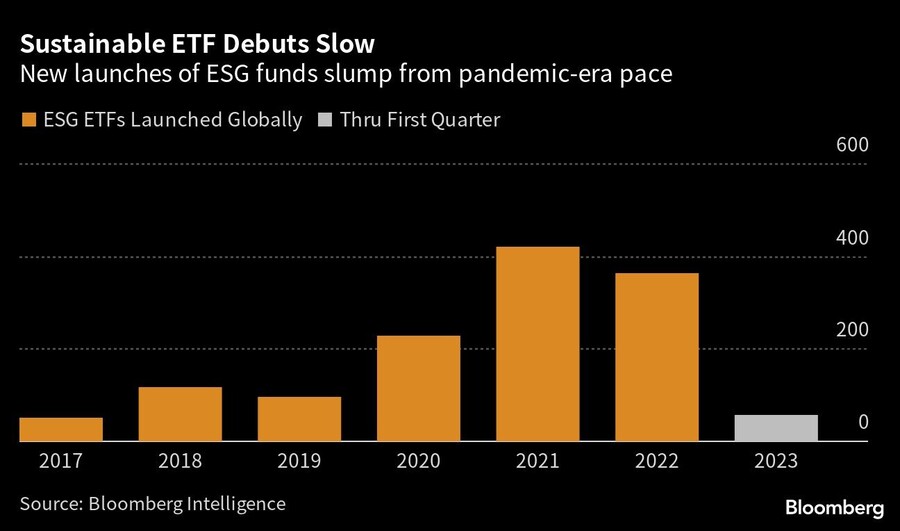
It’s been a sharp reversal for an approach that grew in popularity as investors sought to line their portfolios with companies at the cutting edge of the carbon transition or those that encourage diversity within the C-suite. A brutal 2022 for markets has cast do-good investing to the wayside, with investors fleeing a spectrum of ESG products in search of more profitable and cheaper funds.
“The ESG boom is over and that’s because there’s no defined criteria or structure to what constitutes ESG, as well as the fact that you tend to pay up in fees for an ESG product, yet get largely the same results as a typical U.S. equity index,” said Todd Sohn, an ETF strategist at Strategas Securities.
ESG funds are facing many headwinds. They have high expense ratios, there's a growing political backlash against all things “woke,” and fears that the U.S. could be headed into a recession have made many investors cautious.
At least eight ETFs have already liquidated this year versus 13 in all of 2022. It’s part of a general pullback: ETFs in the U.S. are failing at roughly do,uble last year’s rate.
Yet there are still new ESG funds being launched, with about 40% focused on such themes as clean energy and low carbon, Bloomberg Intelligence found. Climate ETFs are making up a growing share of global fund assets, and investors face liquidation risks, as well as cannibalizing social and governance investment options, by piling into the highly crowded pillar.
Nonetheless, choppy markets have made issuers more aware of funds that aren’t meeting demand.
“I think both investors and ETF sponsors have a more informed and mature concept of ESG today as opposed to a few years ago, when many of these products launched,” said Jane Edmondson, co-founder of EQM Indexes. “While there were many excellent, thoughtful ESG ETF product implementations, many others were bandwagon products hoping to capitalize on investor appetite for ESG.”

Retiring RIA seller David Laidlaw alleges the Carnegie valued his stake on $11.7 million EBITA while pitching potential buyers on $21.3 million.

New tool gives RIAs and family offices AI help vetting private market deals, with some users reportedly halving review time.

Investors got projected returns dressed up as real ones, SEC says

Parents must still act to get the $1,000 federal seed and employer contributions, giving financial advisors a role in the rollout.

FINRA booted Rudy Anguiano from the industry for “conversion - the intentional and unauthorized taking of another person’s property.”
As AI makes financial information more accessible than ever, Lana Hock explains why human judgment, trust, and empathy remain the qualities clients value most in a financial advisor
Northern Trust’s Ken Lassner shows advisors how to convert volatility into after-tax portfolio gains

