
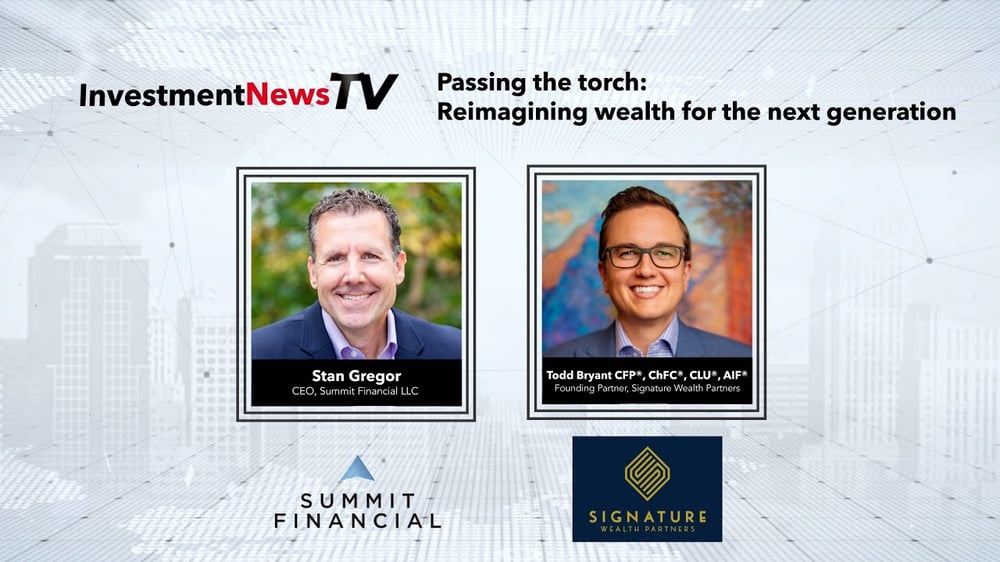
With the largest intergenerational wealth transfer underway, advisors must rethink how they engage families, heirs, and future decision-makers. In this exclusive interview, industry leaders reveal practical approaches to legacy conversations, modern communication, and collaborative planning that help advisors retain assets across generations. Watch the interview with Stan and Todd to future-proof your client relationships.
[00:00:09] Chris Davis: Hello and welcome to Investment News TV. With the largest intergenerational wealth transfer in history underway, we're here to discuss innovative strategies that advisors are using to engage both current clients and their heirs, and how they are addressing complex tax and succession planning issues. Joining me is Todd Bryant, founding partner Signature Wealth Partners, and Stan Gregor, CEO Summit Financial. A warm welcome.
[00:00:40] Stan Gregor: Good morning. Welcome.
[00:00:41] Todd Bryant: Good morning, Chris. Thanks for having us.
[00:00:43] Chris Davis: So my first question to you, Todd, is what approaches are advisors using to initiate and facilitate family conversations about their wealth, values, and legacy?
[00:00:55] Todd Bryant: Yeah, that's a great question, Chris, and such an important topic. What Stan and I do, it's not really about the transactions. It's more about the relationships and the long-term value of those. And our business, there's so many people that call themselves advisors, but it's moved over the years from just being that transactional or maybe just investment management focused to really focusing on the overall financial planning, not just for our clients today, but for the legacy moving forward. For me personally, I've reached a nice sweet spot in my career where I've been doing it for 17 years. So I know what I'm doing, but I'm 40, I've got two young kids. I'm not going anywhere anytime soon. So I'm going to be here for the next few decades continuing to work with my clients. So I've got clients that have been with me for a while now, but I also have the next generation that's going to be taking over. So I think just for the benefit of my clients first and foremost, having these generational conversations is important. Getting the children involved. For me, that just starts in a fact-finding stage when I'm just getting to know them for the first time. I'm learning about who are their children, how are their families structured, asking about their parents and their relationship to money, how they were raised, those types of things. And in doing so, I'm getting a lot of the names of these people, these individuals. And then as we're working together, I'm learning where do they live and what do they do and what are their jobs? And for clients of mine, most of my clients that are in retirement and they have adult working children, I'm finding out more about their grandkids because they love talking about their grandkids. So I'm learning about all of these things and over time I'm incorporating that into the planning conversations as well.
[00:02:47] Chris Davis: Thank you. And Stan, yeah, I wanted to, again, we can address values and legacies.
[00:02:53] Stan Gregor: Yeah, from our standpoint, just like Todd's business, we have a multifamily office service model. So planning, discussions, those engagements, that's all part of how we interact with our client base. It's not a transactional model like Todd explained. It truly is a holistic approach with the clients and in most cases, all of the matriarchs and patriarchs where we start those relationships. But we go significantly deeper than just the investment piece. So the piece around financial planning, the piece around legacy planning, succession planning, if they have a business, those are very deep conversations we have. And more of that is really geared around the family office service model, which is we have in-house resources that work with our advisors and work with those clients. Chris, when you think about what that means, having in-house attorneys that actually understand trust and estate documents, understand wills, understand legacy planning when it comes to a business, right? How does that get transferred to the next generation? And what is the first generation, right? What does the matriarch and patriarch truly want as their legacy? Those are all the steps that we take in and values, desires. Those are critical components in those conversations.
[00:04:21] Chris Davis: Thank you. So, Stan, if we can move over to communication and certainly diverse strategies for younger generations and diverse family members.
[00:04:29] Stan Gregor: If we look at our parents and what values and the way communications was done back when they were younger versus the newer generation today, there's a difference. There is a difference in communications. And what we have seen as a business, we're a 43-year-old company, and we've seen that communication process change dramatically. And I would say, especially over the last five to seven years with all the new technologies that are out there from social media, different platforms. We have to be aware of those new and different ways of communicating. And we've been doing that with our advisors and obviously with their clients. AI is playing a big role, right? The access to information. And I think about year 2000 or before that when the supposed new internet was being rolled out. It's so different now, right? Information is so readily available. And, you know, one of the trends that we're seeing with, I call it the newer generation, is their focus is different than their parents. Their focus is more on authentic, more on value, more on relationship, right? It's not just about performance. So we are absolutely adapting, call it the parents and how they want to have a communication plan put together versus the newer generation and bridging those two generations together is critical, right, to continue the legacy planning with those clients.
[00:06:14] Chris Davis: Thank you. And Todd, yes, if we can address how you're tailoring communication within Signature Wealth Partners.
[00:06:21] Todd Bryant: Yeah, another great question, Chris. And I'll echo Stan's comments on that, that there are differences in the way in which the different generations like to communicate. I'm technically a millennial. I've never admitted that on television like this before, but my communication is then going to be different than maybe the older generations or the younger generations. More specifically, I think that the more the communication is better. So for us, I'm sure Stan as well, we have a newsletter, which is very engaging for our clients. And I've had several different versions of newsletters over the course of my career. And luckily, the one now that particular one we're using has really gotten a lot of good reviews. And it does take a little more work on my end, but the sense of, you know, really speaking well to the clients and it does a good job of also speaking to different generations. So that's, you know, the monthly touch point from that. I'm also more hands-on as far as texting goes. I know we all know the rules around texting. And we have through our broker dealer, a dedicated phone number for texting clients. And we have to text clients through that phone number. And I use it exclusively for clients. But as opposed to kind of painting that in a more of a not so nice light of, yes, we have to use this. It's kind of a pain to have to use this other number. I basically tell them that they have exclusive access to me 24-7, text me anytime, day or night. I do have the alerts turned off at nighttime and I'm not going to generally text them back on the weekends, but I will get back to them the next morning or the next business day. And I basically say for yourselves or for your family members, they can text me on this number. And we know that the younger generations or I don't know, pretty much everybody these days, more than 90% prefer texting over phone calls. So they have that option to have that text message with me where I'm required to do it anyway via my compliance. But I utilize that as a resource to them where just say text that number anytime, questions about anything, I'll be here for you to take care of it. And I found that a lot of clients will really enjoy that and utilize that. And I kind of frame it as a way that makes it unique versus we all know in reality, we all need to do it that way. But I just try to frame it that way to make them feel extra special in that regard.
[00:08:50] Chris Davis: Thank you, Todd. So, yeah, Todd, let's move over to family meetings and the role that they play in building trust and continuity.
[00:09:00] Todd Bryant: Yeah, I think in also continuing the conversation with technology, having meetings via Zoom makes that a lot easier than it was before. Before, we're dealing with families where they live in all different states, and it's not always going to be conducive to get them all together in one place. They might all be together for the holidays. But I'm also together with my family for the holidays. So it's really hard to try to juggle that. So I think the use of video technology and Zoom and Teams and those types of things does make it a lot easier to do that. But I also don't discount the fact of having those in-person meetings is so crucial. And although I very rarely would have a meeting on a Saturday with my kids' activities and things, about a month ago, I did have a meeting. A client of mine, his wife recently passed away and we had a lot of decisions that we needed to make. And he wanted to bring in his three adult children, who happened to be in town during that period of time. And we had a meeting at my conference room here on a Saturday. And a lot of the conversation was going back to your first question on values and what's important and what do we really want to make sure is taken care of for the money now, but also when it eventually passes on to the adult children and then potentially grandchildren as well. So I think that those communications, that aspect of those meetings is very critical.
[00:10:30] Chris Davis: Thank you. And Stan, yeah, we can address family meetings and workshops, certainly across multi-generational planning.
[00:10:37] Stan Gregor: Yeah, and just like Todd, obviously the advent of Zoom and Teams, that communication is critical. But one of the things that I would say we do differently is we usually host an annual meeting with the patriarchs and matriarchs, and we bring in the entire family. And you'd be amazed at the pride that the parents feel and the children feel on how the family, you know, how mom and dad built a business. So there's a whole educational piece that we do. We kind of do a bit of a genealogy update, right? Grandma, grandpa, great grandma, grandpa. That's, you know, this is where the roots started from. We get into the more current generation and how they built a business. And what we've realized is that that builds a connection. It builds an appreciation for either grandma, grandpa, or mom and dad. And hopefully that next generation, when that business is turned over to them, there's an appreciation of how it got there and those traditions can continue. So that is a unique thing that I've seen work very well with, call it your larger families, your multifamily office clients that fit that high net worth, ultra high net worth number. But in addition to that, we build upon those meetings. So you have that, you know, we usually have advisors have an offsite with the family. So the family gets together, they go to a location and Saturday and Sunday is a little bit of a show and tell, right? How mom and dad got there. And then we start getting into the dynamics and the importance of preserving what grandma, grandpa or mom and dad built and the values around that. It could be everything from education. You know, what schools should the grandkids hopefully be applying for or thinking about? How do you preserve family values? How do you deal with tax issues? How do you deal with, God forbid, something happens to one of the children? And what does that look like? And a lot of planning around that. But it is extremely well received by all the members because it's not your normal sit down with an advisor and speak about the portfolio. The portfolio is the family. It's so much broader. So I would encourage anybody listening, if you have families that are in that stratosphere of net worth, that is something that you may want to consider to host as a much broader offsite family approach.
[00:13:14] Chris Davis: Thank you, Stan. So let's move over to the next point, collaborating. And Stan, how are advisors collaborating with tax, legal, and estate planning professionals to address complex issues?
[00:13:28] Stan Gregor: Yep, Chris, great question and something that's definitely top of mind. So the industry, if you go back 10, 15, 20 years ago, the advisor was truly the centerpiece of that relationship. And the clients rarely had access to anybody behind the advisor that helped them look smart, knowledgeable about information or helped them. What you're seeing today is the clients truly value the team approach. So your question around what does that look like? Well, having the attorney in that discussion, having a tax professional in that discussion, having the portfolio strategist or investment strategist part of that, having the team that works on risk management, banking, succession planning. That team concept is critical. And it's, again, I mentioned this earlier, we have a multifamily office service model, which that's exactly what we do. We bring in those five or six or seven different lead specialists to work on their specialty. And then as a group, they present as one holistic offering. So it's critical. It is critical that you have the experts around you. And it's critical that clients know those experts are there for them as well.
[00:14:50] Chris Davis: And Todd, back to you, anything about collaboration you would like to add?
[00:14:55] Todd Bryant: Yeah, I think the continued use of technology also makes the collaboration easier as well. Within our broker dealer, like I'm sure many other firms have, we have access to some attorneys that will review documents and do those types of things. I've been a user of HolistaPlan for many years now. So I'm not a CPA, I'm not filing their taxes for them, but we can use tools like that to very quickly take a look at the taxes and try to plan for that accordingly. So I think a lot of the technology has come a long way to help in the tax planning realm of what Stan and I do. And I also believe that collaboration also with local advisors too, not affiliated with my firm has been good. I always try, especially for larger clients to get that introduction, just like I want to with their adult children. I also want to speak with the CPA and meet with the attorney and build those strong relationships as well. Because, you know, just like with the family meetings, we want to get everybody involved. We also want to try to make sure that the team that's supporting them around us, the advisor, the CPA, the insurance agent, the investments guru, all of that is going to be taking care of that client and make sure that we're all on the same page. So, yeah, I think it's very critical to success of high net worth clients.
[00:16:20] Chris Davis: Yeah, thank you, Todd. And let's talk about tools and resources that you're using to provide and help clients document and communicate their wishes for wealth transfer and philanthropy.
[00:16:36] Todd Bryant: I also think with more advanced technology, there's also more advantages to those types of things as well. And it goes just beyond just having, obviously, they need to have their estate planning documents done and the trust and will power of attorney and all of that. But I've seen it happen a lot. I know people also have personal stories. If somebody passes away and they don't know the passcode to log into Netflix. They don't have the bank account information. They don't even know where all their bank accounts are. So I even think about that myself on a regular basis. I'm reminding my wife, all right, here's a list of where everything's at. Here's what we got. And there are some great tools to be able to utilize that. But that's also part of the conversations when I get into more of the estate planning with clients, is making sure not only do you have all those legal documents in place, but you need to have a plan in place of what happens to my Facebook page when I die type thing. And I think that there's some good resources. Sometimes it's simple as a spreadsheet, or there's also good resources to communicate those as well.
[00:17:44] Chris Davis: Thank you. And Stan, again, if we can address tools and resources.
[00:17:51] Stan Gregor: Yeah, so obviously technology plays a tremendous role here. So a part of the estate planning and the family planning and the legacy planning is what Todd just described, right? And fortunately, today, we're on a virtual platform. We're on a digital platform. So all of that information is what's captured during various sessions meeting with clients. So Todd's comments about just getting into the passwords of bank accounts, trust accounts, all of that is captured in what I would say is the client's digital vault. So the technology out there today exists that the clients can be anywhere in the world. They have an encrypted username, password, they can get into their information. And if something was to happen to them, there's a trusted person that they've acknowledged that that person has the information as well. So it's so different. The years of having to carry a notebook or some notes on passwords and usernames. Today's all digitized. So it's all there. And there are documents from a trust and estate, the wills, all of that is simply available. And in most cases, Chris, the professionals that work with the clients, let's call it the attorneys, they have access to the legal portion of those files. When it comes to the tax information, the CPAs have access to the tax portion of those files. And then maybe the beneficiaries or the people that are in charge of managing the estate or have access and control, they have access to a broader section of those documents or whatnot. So it's all available. It's there. It's critical. And it's so much seamless now than it ever was before.
[00:19:44] Chris Davis: And thank you. A really fascinating session. A huge thank you to Todd and Stan. And thank you for watching Investment News TV.

Daejon Love and Taylor Chan's $1.3 million romance fraud scheme exposes how AI search engines can be manipulated by fabricated online identities

“It was a third party scam,” said the attorney representing the claimants.

Meanwhile, &Partners draws another Commonwealth practice, and Wealthcare welcomes a $550 million planning practice in the Northeast.

Palo Alto AI platform recruits RIA and fintech leaders as industry data show AI adoption reshaping advisor staffing.

Meanwhile, Raymond James, Wedbush, and LPL recruited veteran advisors from across Texas, North Carolina, and California.
Northern Trust’s Ken Lassner shows advisors how to convert volatility into after-tax portfolio gains
Dan Biagini of American Equity says the steady decline of pensions, longer lifespans and a reset in interest rates are rewriting how advisors build retirement income
