
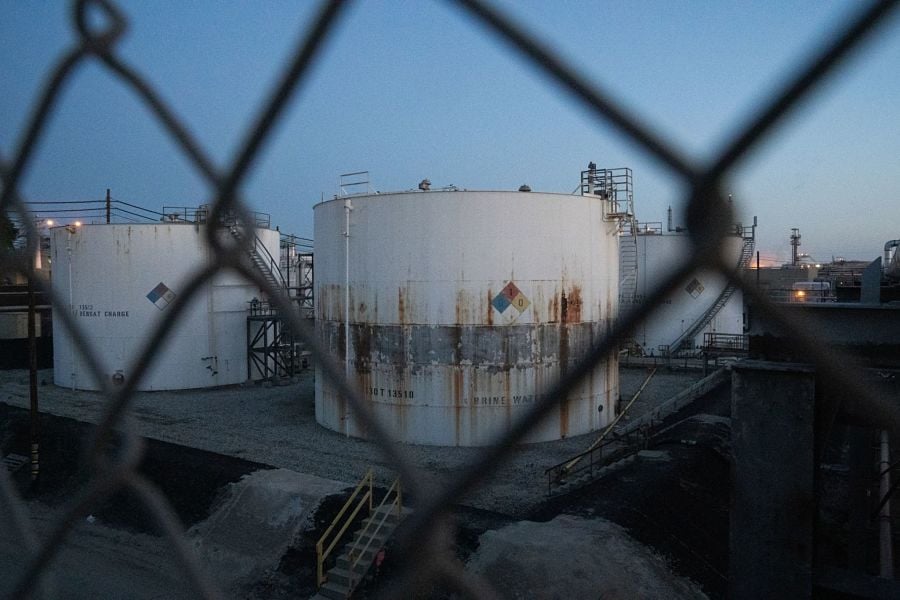
Negative oil prices are like a massive underwater detonation. Inevitably, dead sea animals come floating to the surface. This week we saw the unraveling of a Singapore-based oil trading firm, which now owes 23 global banks almost $3.9 billion. So you’ve got to wonder who’s next, and if another big whale will go belly up.
Your first thought might be a large oil producer, or a bank active in trade financing. But most of the drama has circled around exchange-traded funds. It turns out passive funds — big winners from the global financial crisis — aren’t so different from active funds after all.
Take a look at the world’s largest oil ETF, the $3.7 billion United States Oil Fund (USO), which has been anything but passive lately. For a second straight day Wednesday, it reshuffled the mix of futures it owns to track crude prices. The fund now plans to reduce its holdings in near-term contracts — June futures, in this case — to about 20%, with the rest divided roughly among July (50%), August (20%) and September (10%). In a better world, all of its portfolio would be in June contracts right now.
The USO fund simply wanted to cut its own losses. If June futures also go negative, its investors would suffer a total wipeout. But at least they won’t have to dig into their pockets to close positions: An ETF can't trade below zero. Someone else — the clearing exchanges or even the fund provider — will have to soak up the losses.
There’s good reason to suspect this possibility. Unlike Brent, the West Texas Intermediate contract is settled through physical delivery, and storage units are getting full. So if the coronavirus outbreak rages on, sapping end demand, investors in June futures could end up in tears, too.
This active portfolio management is terrible news for believers in buy-and-hold investing. When fund managers rejigger methodology on the go — which the fine print allows — we just don't know how to calculate returns. More specifically, longer-term investors end up buying oil at much higher prices than necessary.
We live in what the USO fund calls a “super contango” world, in that long-dated futures value oil at a much higher price than front month contracts. So instead of buying oil via June futures at about $14 a barrel, we’re potentially gaining exposure at about $20.70, based on Thursday morning pricing in Asia.
The USO ETF at least has the good sense to rebalance its portfolio into a basket with various maturity dates. The Hong Kong-listed Samsung S&P GSCI Crude Oil ER Futures ETF said in a filing Wednesday that it will roll over all of its June contracts to September futures “shortly after” the announcement, without providing a time frame. The September contract costs 85% more.
Granted, fund managers could say this flurry of activity aims to protect us. That’s not a passive fund’s job. We buy ETFs because we fancy ourselves active managers. If we’re worried about negative June oil, we could just liquidate our holdings. And what if we think this week was a one-time event? A great buy-on-the-dip opportunity was stripped from us.
By tweaking their portfolio compositions, passive funds can no longer meet their investment objective, which is to reflect the daily percentage changes of the crude spot price, as USO eloquently said itself in a filing.
No doubt negative prices toss up nasty surprises. But fund managers panicked, and lost their investment mandate along the way. We, in turn, lost our confidence in these cheap products, too.
Shuli Ren is a Bloomberg Opinion columnist.

Halbert Hargrove senior wealth advisor weighs in on the products' guaranteed income upside, the operational drag and his wish list for carriers.

With 8.6% of advisors set to switch firms in 2026, Cerulli says advisor recruitment hinges on technology, branding and HNW support.

“I’m seeing more disputes like this between advisors and other advisors at the same practice,” said one industry executive.

Longer retirements and steady inflation could drain retiree portfolios before heirs inherit, with 4% net returns running dry by year 34.

A single fintech partner triggered a $68.8M credit hit.
Knighthead Life entered the market with a competitive MYGA. A strong launch earned advisor confidence and paved the way for FIAs.
As AI makes financial information more accessible than ever, Lana Hock explains why human judgment, trust, and empathy remain the qualities clients value most in a financial advisor

