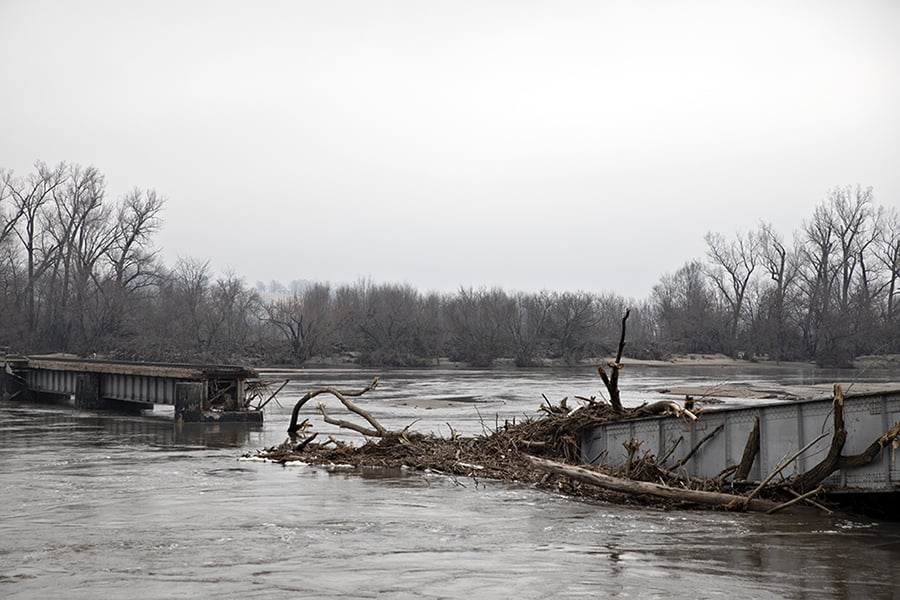
March has been a month of madness, but not because of my bracket. This madness came in the form of a historic natural disaster, perhaps the worst of its kind ever to hit the state of Nebraska. And while Nebraska may be seen as a "flyover state," what happened here will affect the U.S. in a big way because of our role in feeding the rest of the country, from crops and beef to ethanol.
Nebraska alone is estimating over $1 billion in losses of corn and livestock. There is no harder business than farming, and sadly, for many, 2019 will be their last year on the family farm.
While it is absolutely heartbreaking to see what has happened to tens of thousands of families, this catastrophic event has taught me some profound life lessons, both as an adviser serving clients and as a member of my community serving others.
(More: Technology must reinforce trust, or else)
Timing is the key factor
When you think about it, so many factors are responsible for our success or failure. These factors come in a variety of forms: people, events, information, location, knowledge, IQ, AQ, EQ. But one single factor carries more weight than the others: timing. This single factor holds the power to give any individual factor profound meaning or immediate significance.
For Nebraska, those factors were 1) a wet fall in 2018, followed by 2) an abnormally frigid winter with above-average snow accumulation that packed the ground with frozen water, and 3) a rapid, unexpected thaw when temperatures rose quickly over a 10-day period.
With all those factors building upon one another — and the deadly ingredient of timing — the rivers rose, dams broke, snow melted and ice jammed, leading to an unprecedented flood in a state with more miles of rivers than anywhere else in the country.
Think about the independent and seemingly unrelated factors that influence your firm's future. Do you know what to watch for? Do you frequently monitor those factors' effects on your business? Can you anticipate how each could influence the future of your practice?
So often we minimize the things happening around us — industry
consolidation, increasing consumer expectations, the value we provide, fee compression, aging advisers — rarely aware of the cascading effects they could have if timing brought them together to create "the perfect storm," for better or worse.
(More: 4 questions every adviser should be able to answer)
Harness the power of the collective
While we all endure challenging — sometimes insurmountable — obstacles in life, people have a way of pulling together in the midst of tragedy. They support each other and lend a helping hand. These difficult moments seem to bring out the best in us. I saw this firsthand in small towns as hundreds of people came together to pile sandbags along levees, protecting their homes, towns and families.
One of our stakeholders, Mandi Liston, and her husband Adam were living proof of "doing well by doing good" when Adam, a commercial airline pilot, volunteered his time and skills to fly food to those in need in Nebraska and reunite family members separated by the rising waters. The Liston family saw a need, understood how they could apply their talents to a larger cause and most importantly, they acted on it (by setting up a GoFundMe page to pay for gas and the renting of a few planes). CNN's Anderson Cooper even took notice last week and spoke with Adam about his efforts.
No good talent goes unrealized when it's used for a cause bigger than one person. Think about your team, your community, your church or even your family. How are you harnessing everyone's talents and intentions for the advancement of something bigger than yourself? Answer this and you'll have a deep-seated purpose led by a passionate team that knows no limits.
Responding versus reacting
Every day we get caught in the trap of reacting to the bombardment of things competing for our time and attention. We lose track of time. We fall behind on commitments. We lose connection with others. And we deplete the finite energy and attention we should be giving to the most important areas of our life. It kick-starts a vicious cycle of reacting to life instead of responding to it.
The truth is, disasters like the flooding in the Midwest remind us of what is important. Struggle and hardship give us an appreciation for what we do have. It re-centers us and course-corrects our actions. These moments allow us to understand the difference between simply reacting to what the world throws at us — or responding. Unlike reacting, responding comes from preparation, planning, mindfulness and intention. It is the act of preparing for the unexpected and knowing what to do when life throws you a curve ball.
How are you preparing your firm for the unexpected? How are you preparing your clients for the scenarios in life that may cause them distress or discomfort? Do you spend every day frantically reacting to what hits your desk — or responding with a sense of control and confidence?
Yes, the effects of the flood will have immeasurable effects on Nebraskans for months and years to come, but we will move forward and repair. The question is, can we as advisers learn the same lessons from loss or tragedy? Are we able to respond rather than react? And are we reminding ourselves everyday to build something bigger than ourselves?
(More: The financial adviser evolution is underway)
Ron Carson is CEO and founder of the Carson Group, which serves advisers and investors through its businesses: Carson Group Coaching, Carson Group Partners and Carson Wealth. Follow him @RCHusker.