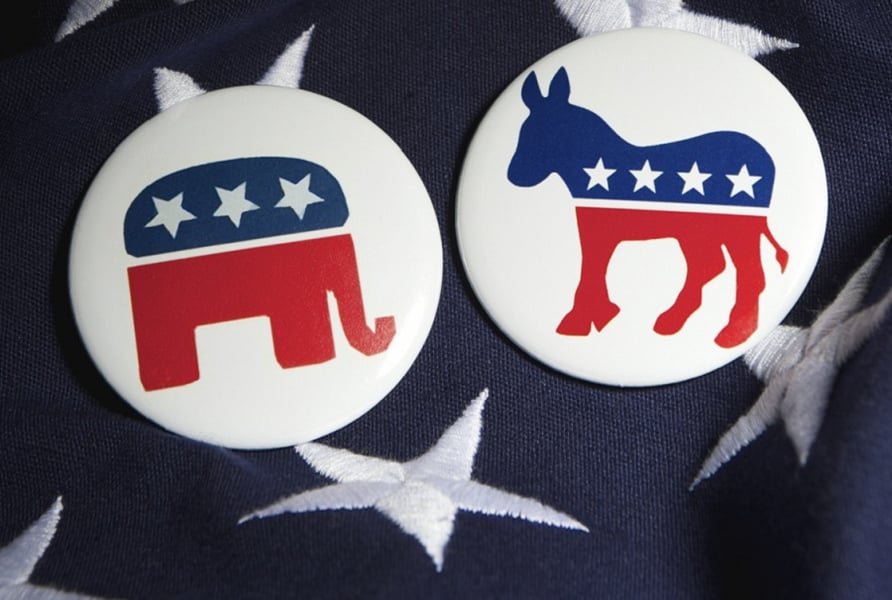
The super-divisive and unavoidable election cycle underway has advisers walking a fine line with clients when the conversation turns to rousing personalities like Republican presidential candidate Donald Trump and Bernie Sanders, a socialist aiming for the Democratic nomination.
Most advisers seek to keep their clients, who sit on both sides of the aisle, focused on the facts, and try to avoid showing their own support for a candidate. They also aim to keep the discussion on policy if it ever does veer into a sensitive area, as opposed to politicians themselves.
“Clients have fears about who is going to win and it's very polarizing,” said Blair duQuesnay, chief investment officer for advisory firm ThirtyNorth Investments in New Orleans. “The fury is still building.”
Emotions are running high from Republicans who have hopes of returning to the White House after eight years out of the presidency, and from Democrats who want to hold onto the executive branch since the U.S. Congress is likely to remain under GOP control, she said.
This election cycle has made it especially challenging for advisers to talk about current events without offending sensibilities, as an anger-fueled electorate appears willing to back unusual characters. With nine months to go until people head to the polls Nov. 8, it's likely to get even worse.
(More: How the 2016 presidential candidates stack up with advisers)
With particularly outspoken clients, it's best to avoid debating them altogether and risk alienating them, advisers said.
When the presidential election comes up during meetings, adviser Ryan Linenger tries to stay apolitical and lets the client lead with their views on politics.
“Then I stick to the numbers and the true policy of what's happening in the markets and in the economy,” he said. “I have a couple clients who are so passionate about it, and I try in those instances to take what they're saying and find some common ground with them.”
(More: Wells Fargo sees U.S. election year hurting equities)
Mr. Linenger, founder of Glen Ellyn, Ill.-based Linenger Wealth Management, said he often tells clients to turn off the television.
“If you watch TV news more than 30 to 60 minutes a day, you're going to make yourself crazy and start playing to emotions rather than logic and fundamentals,” he said.
In addition to keeping personal politics out of the conference room, many advisers are careful about what they post or even “like” on social media.
Victoria Fillet, president of Blueprint Financial Planning in Hoboken, N.J., said she doesn't put anything on Facebook or other social media supporting a particular candidate or party.
In fact, she doesn't back a particular party as a rule, and tells clients she hasn't decided yet which candidate she'll throw her vote behind.
“I try to remain neutral without sounding stupid, or like I don't know what's going on,” she said. “But you don't want to alienate your best client.”
Ken Sutherland, president of LifePlan Group in Raleigh, N.C., tries to stick to talking about how markets have performed under each party. He likes to point out that in the months after a presidential election and before the inauguration, markets always go up, “which everyone wants right now.”
Since Lifeplan Group mostly focuses on retirement planning, Mr. Sutherland gets a lot of questions about how
Social Security would fare under different presidential candidates.
“I have learned not to fuel the fire,” he said. “I tell them it simply doesn't matter who gets elected because whoever it is will have to fix the [
Social Security] system.”
(More: Election 2016's potential ramifications for advisers)
Bill Aquila, an adviser with Rockwood Wealth Management in New Hope, Pa., said the upcoming election has become an emotional trigger for some of his clients, who include “the gun-toting right and the socialist left.” It's making them feel like they have to do something, he said.
“We remind them that they are investing for the next 20, 30, even 40 years,” Mr. Aquila said. “Just like we aren't going to change their portfolios because of markets going down, we aren't going to make changes based on who gets elected.”
Ms. duQuesnay said she tries to temper clients' emotions about politics by pointing out that markets and the economy have performed well under both of the nation's main political parties.
“I like to say that the U.S. economy finds a way to grow and markets continue to perform despite all the changes in policies, tax law and regulation,” she said.